
Drivers Are Not Happy With Their Cars' Screens
Infotainment screens are the one area in cars where initial quality has gotten worse year-over-year, a study found.


- Infotainment screens are causing problems for new car owners.
- A new study shows that out of 100 vehicles, 44.4 report problems with their infotainment systems in some capacity.
- The largest jump year-over-year is from Apple CarPlay and Android Auto connectivity.
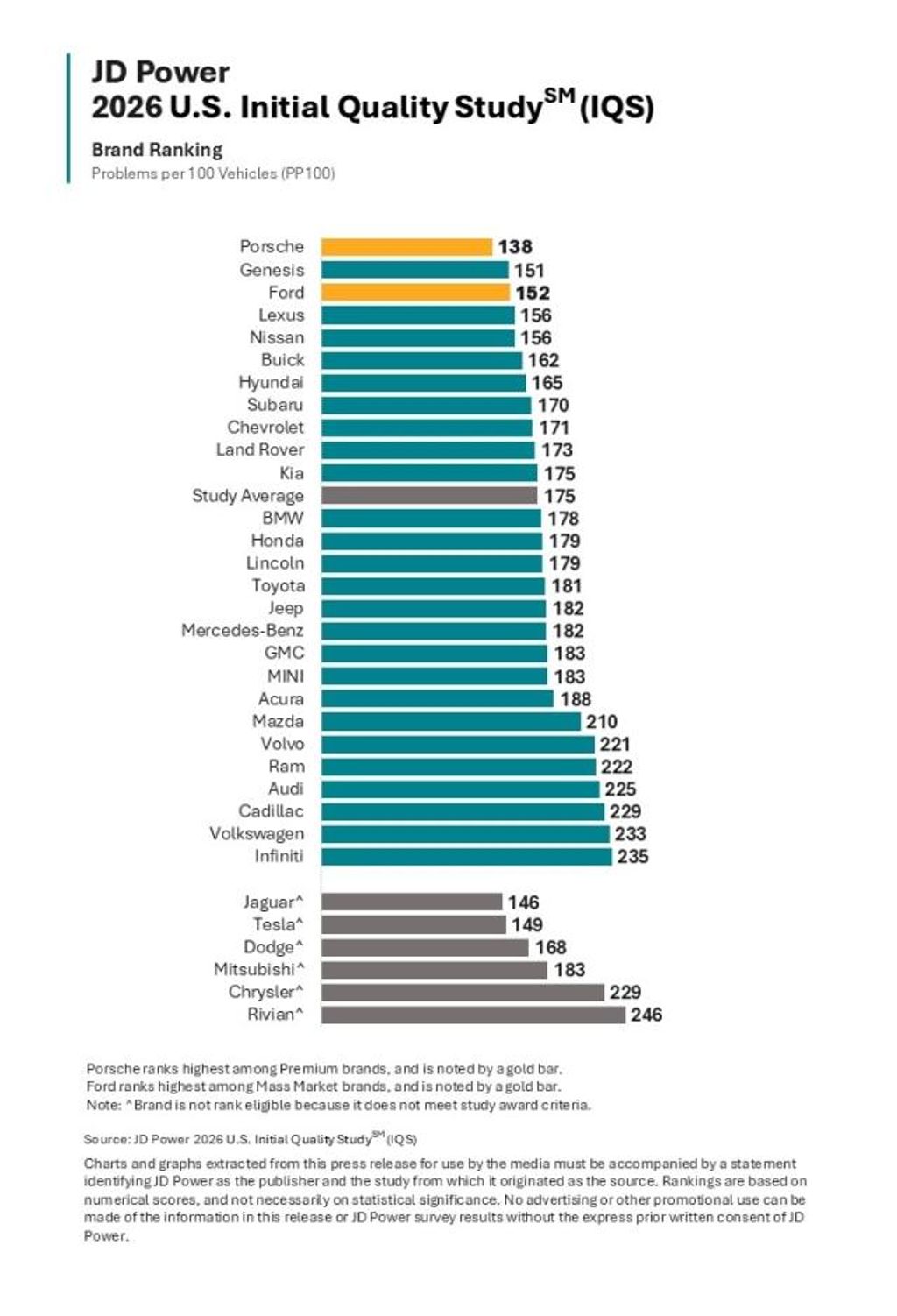
Modern cars have basically become smartphones on wheels. Unfortunately, that means that they seem to have also inherited the bugs, too—or at least that's what J.D. Power's 2026 Initial Quality Study has found.
The annual study measures how many problems new-vehicle buyers experience in their first 90 days of ownership across 10 categories. Here's the good news: Overall, people are seeing fewer problems than they did last year, and results improved in every category. The only area where buyers are seeing more problems than before is infotainment.

In total, 44.4 out of every 100 vehicles in the mass-market segment saw infotainment-related complaints. According to Frank Hanley, senior director of auto benchmarking at J.D. Power, 6.1 of those problems were related to connectivity issues, which covers Apple CarPlay, Android Audio, Bluetooth, and Wifi.
Issues with Apple CarPlay and Android Auto were "the largest single contributor to the year-over-year decline in infotainment quality," accounting for 3.8 problems per 100 vehicles. For comparison, Bluetooth made up just 0.5 problems per 100 vehicles.
One reason for the issues, according to Hanley, is that vehicle software isn't keeping up with the pace of modern consumer electronics. "The phone can update much quicker than the phone can," he explained. Every time that Apple or Google pushes a software update, automakers have to ensure that their own software still plays nicely with it. That means significant amount of validation testing, especially because vehicle software touches dozens of interconnected systems elsewhere in the car.
Connectivity issues extend past screen-mirroring software. Hanley said that smartphone apps that control features like climate control, door locks, and remote start were problematic too. Infotainment issues are more critical than ever, since the screen now serves as the central command center for so many cars, Hanley said.
Consumers are being forced to use giant tablet-sized screens, and there's real pushback to that. Hanley says that J.D. Power is seeing a growing number of complaints from drivers who say they are distracted by the screens. Consumers also say that the lack of physical buttons and burying of features behind menus are forcing them to take their eyes off the road and use the infotainment system to actually perform basic vehicle functions. A total of 46% of drivers who say that the vehicle caused a distraction problem pointed at the touchscreen.

Car companies have heard the feedback and are working to make their tech not only easier to use, but more seamless. In some cases, that means doing away with screen mirroring altogether. And in others, it means simplifying controls back to actual buttons.
Volkswagen's CEO says that more physical controls are a "non-negotiable," Hyundai called touchscreen controls "annoying," and Polestar was on board too (until it was squeezed out of the U.S. market earlier this month). Even regulators in Europe pushed automakers to bring back physical controls if they wanted a good safety rating. And consider the Slate Truck, which is coming later this year with no built-in touchscreen or stereo at all. It's tough to have connectivity issues when there's nothing to connect to anyway.
As for what consumers are reporting fewer problems with, the single biggest contributor to the year-over-year boost in vehicle quality came from a decidedly low-tech feature: cupholders. J.D. Power touted their "more accessible location and capacity to hold a variety of sizes of cups/water bottles." Driver assistance, EV range, road noise, and final fit and finish also saw large improvements year-over-year.
More Infotainment News
RECOMMENDED FOR YOU
What Rivian And Lucid's Latest Earnings Say About The EV Startup Race
After Driving Over 25 Chinese Cars, These Are The 6 I Would Buy
How Much Quicker Is The Newest Version Of Tesla FSD? This Test Put It Against Old Software To Find Out
The Hyundai Ioniq 5 N Has A Range Problem. Smaller Wheels Helped A Lot
Subaru Is Spending Three Times More To Sell EVs Than Gas Cars. It's Not Working
Ford's Bronco EV Is Better Than It Has Any Right To Be. Why Isn’t It Sold In The U.S.?
What To Know About California's $3,500 EV Rebate—And Which Teslas Qualify