
Ford’s New Battery Container Is Here To Take On The Tesla Megapack
Ford Energy’s LFP-powered DC block was designed to last 20 years and packs over 5 megawatt-hours of energy.
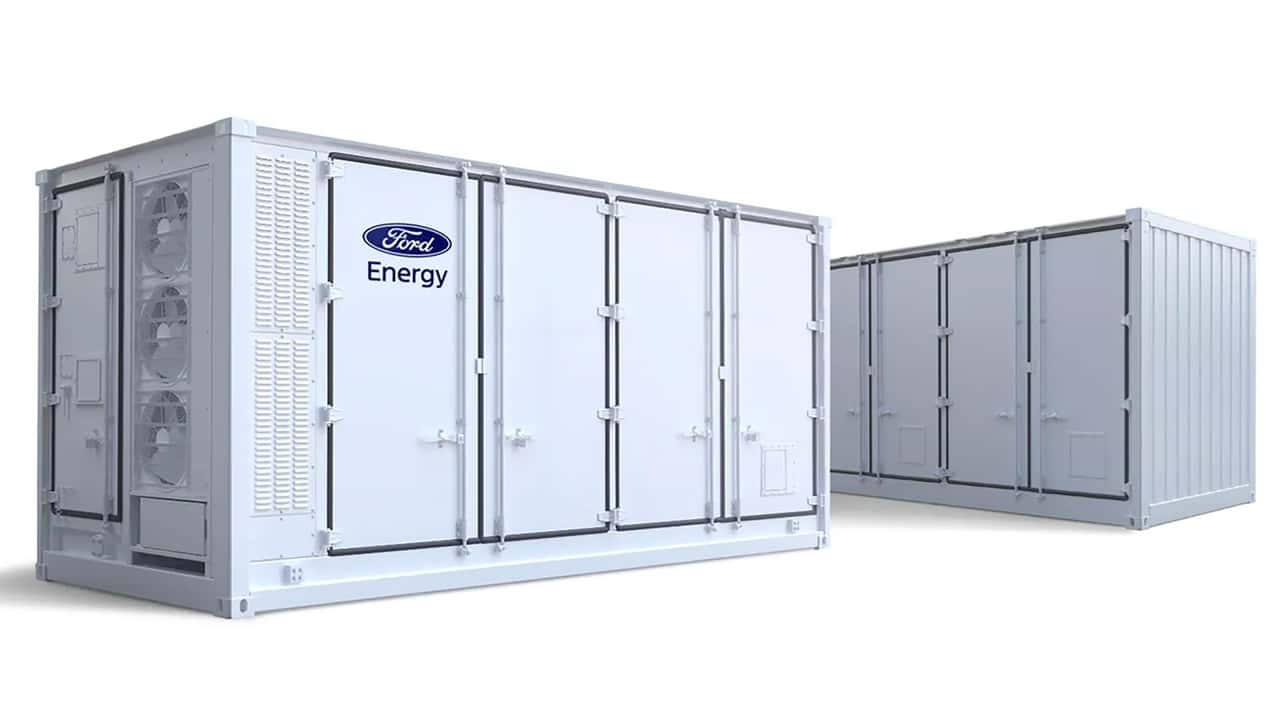

- Ford has officially entered the stationary energy storage industry.
- Ford Energy is a wholly owned subsidiary of Ford Motor Company.
- The new entity will build modular battery containers in Kentucky using prismatic LFP cells.
After trying and failing to overtake Tesla in electric car sales, Ford has now officially entered the battery energy storage market with a new subsidiary called Ford Energy. The company’s first product, the DC block, will compete directly with Tesla’s Megapack.
It’s an industry where sales are booming, whereas the American EV market has cooled significantly after the cancellation of the $7,500 federal tax credit last September, so Ford is taking advantage of its enormous manufacturing footprint to capitalize on the opportunity.

Ford is repurposing its EV battery factory in Glendale, Kentucky, to assemble LFP battery packs for stationary storage systems.
Designed to last at least 20 years, Ford Energy’s flagship product fits hundreds of 512 amp-hours lithium iron phosphate (LFP) prismatic cells in a standardised 20-foot container, along with all the necessary power electronics. The company offers a two-hour system, as well as a four-hour model, and both feature liquid-cooled thermal management and a three-level battery management system that continuously monitors voltage, current, temperature, state of charge, and state of health.
Each container is fitted with a layered fire protection system that combines smoke, heat, and hydrogen detection with ventilation and suppression.
According to Ford Energy, the DC block packs 5.45 megawatt-hours and has a rated DC voltage between 1,040 and 1,500 volts. All containers can operate at temperatures between -31°F (-35°C) and 131°F (55°F), and feature an IP55 ingress protection rating.
To make it all happen, Ford has repurposed its existing battery factory in Glendale, Kentucky, which initially assembled high-nickel battery packs for the F-150 Lightning and E-Transit in collaboration with SK On. Late last year, however, the two companies went their separate ways, and Ford decided to keep the Kentucky plant for itself, while SK On took full ownership of a battery plant in Tennessee.

Seeing how the F-150 Lightning was discontinued last year and the E-Transit’s sales figures are underwhelming to say the least, it makes a lot of sense for Ford to go into the highly lucrative business of stationary energy storage. Last year, Tesla’s fastest-growing business was its Megapack system, bringing in $1.1 billion in gross profit in the fourth quarter alone.
Ford says its planned manufacturing scope covers everything from the electrode coils, which are assembled into individual modules, to the containers themselves. The projected annual manufacturing capacity is 20 gigawatt-hours, with the first customer deliveries scheduled for the beginning of 2027.
By comparison, Tesla, which has a considerable lead over Ford in this sector, has a total annual manufacturing capacity of 80 GWh, or 20,000 Megapacks, and has so far deployed over 47 GWh of energy storage in over 65 countries.
More ESS Stories
RECOMMENDED FOR YOU
The 2027 Ford Mustang Mach-E Has More Range As Standard
Chinese Auto Giant Chery Wants To Crack The U.S. Market. It Thinks Detroit Could Help
Ford Opens Fathom EV Pickup Invite List Ahead of Launch
The Entegra Coach Embark Is An Electric RV Without The Range Anxiety
This YouTuber Got Burned By His Lucid Air And Elon Musk. So He Bought A Mustang Mach-E GT
Slate’s Bare-Bones Electric Truck Surprised This Early Reviewer
The Longest-Range EVs You Can Buy In 2026