
Ford's Hybrids Had Their Best Year Ever. EVs, Not So Much
The F-150 and Maverick hybrids soared last year as EV sales slumped.

- Ford sold a record number of hybrid vehicles in 2025.
- Its EV sales slumped by 14.1%.
- The F-150 Hybrid and Maverick Hybrid alone made up nearly three-quarters of Ford's hybrid sales.
2025 was a tough year for Ford's electric vehicle business. But its hybrids are booming, signaling strong demand for at least partial electrification even as the EV market hits a rough patch.
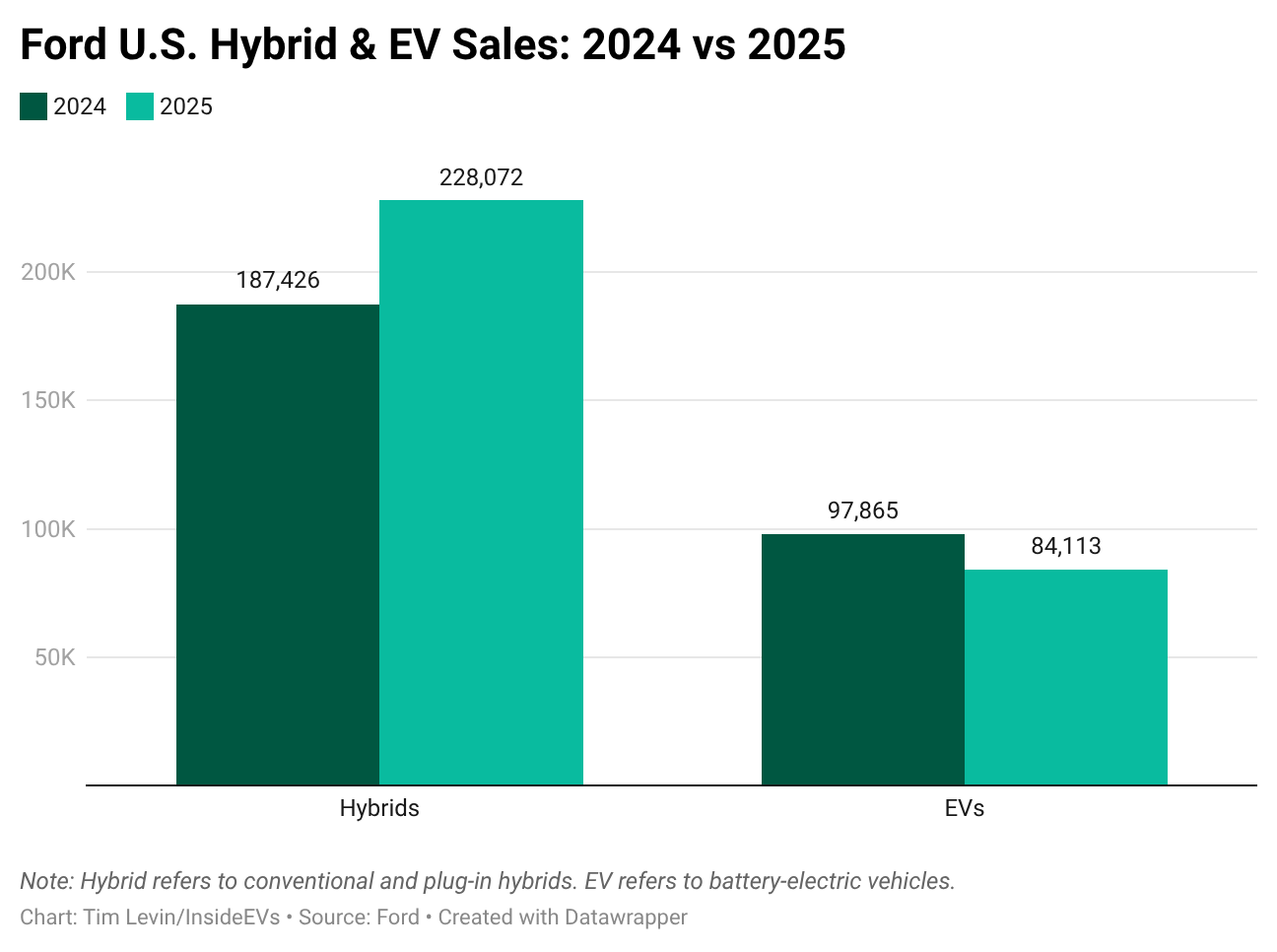
The automaker on Tuesday announced that it sold a record 228,072 hybrids (including both conventional and plug-in hybrids) in the U.S. last year, a 21.7% gain over 2024. Two of Ford's hybrid heroes were its trucks. It sold over 81,000 compact Maverick Hybrids and nearly 85,000 F-150 Hybrids.
Stepping into a hybrid is a lot easier than transitioning to an EV—they bring better fuel economy with zero lifestyle change and minimal upfront cost. Just look at how handily the F-150 Hybrid trounces its electric cousin; in the all-electric F-150 Lightning's best year ever in 2024, Ford sold around 33,000 trucks. But, importantly, hybrids still emit far more CO2 than full EVs. So climate experts say they can't be a long-term solution to blunting the worst effects of climate change.
More Sales News
Meanwhile, the automaker's EV sales took a tumble as the U.S. yanked support for EV buyers and as the automaker stopped selling the F-150 Lightning pickup.
Ford sold 84,113 EVs in 2025, a 14% drop from the nearly 98,000 units it shipped the previous year. E-Transit van sales crumbled, declining by 58.9%. F-150 Lightning sales fell by 18.5%—an expected outcome since Ford officially canceled it late last year. The Mustang Mach-E was a bright spot, holding steady as one of the top-selling EVs in the country with 51,620 units sold last year.
The whole auto industry is facing a reset moment around EVs. The untimely expiration of the $7,500 EV tax credit on September 30 had two seismic impacts on the market: pushing people who would've otherwise bought later to accelerate their purchases, and also instantly making many electric options more expensive. The Trump administration's rollback of other clean-car rules removed the urgency for automakers to rapidly electrify their fleets.

Ford is taking advantage by canceling the Lightning and some other upcoming EVs and betting on its next-generation Universal EV Platform, which debuts in 2027 in a $30,000 pickup. But slowing down is a big gamble too: Ford's rivals already have several EVs on the road and are actively rolling out more.
Ford says its success on the hybrid front proves that it can navigate a choppy environment for EVs better than competitors. It's true that while GM doesn't sell any hybrids, it also has a far deeper EV lineup than Ford does.
"Ford's powertrain diversification enabled it to outsell the combined electrified sales (hybrid, plug-in hybrid, and electric) from GM and Stellantis, demonstrating Ford's ability to achieve record hybrid volumes even when conditions for electric vehicles shift," the company said in a press release.
Contact the author: Tim.Levin@InsideEVs.com
More EV News You'll Love
RECOMMENDED FOR YOU

Ford’s New AI Assistant Can Read Your Car’s Manual And Diagnostics
Tesla Burned Through Its California EV Rebate Funds In Just Five Days
Ford's Bronco EV Is Better Than It Has Any Right To Be. Why Isn’t It Sold In The U.S.?
The Ford Fathom Will Get a $25,000 Hybrid Crossover Sibling: Report
EV Reveals Have Gotten Way, Way Too Drawn Out. The Ford Fathom Proves It
This Kit Turns The Volkswagen ID. Buzz Into A More Capable Off-Road Van
Ford Fathom: Everything We Know About The Sub-$30,000 Affordable EV Truck