
‘I Can Either Wait For the Rain To Stop Or Get Charged Idling Fees’: Woman Charges Tesla at Station. Then the Weather Turns
'Wait y'all have to pay a fee to idle in the charging spot?'
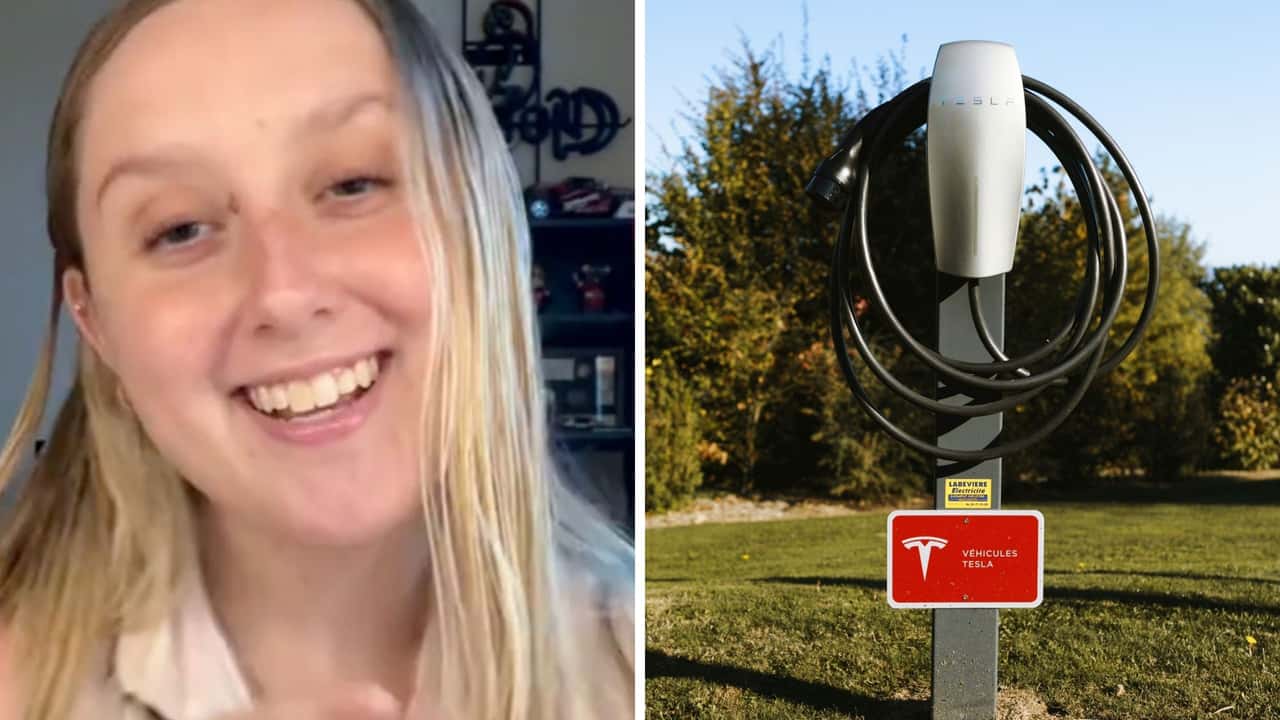

Every EV owner knows the math: Finish charging, unplug, move along. But what happens when Mother Nature throws a thunderstorm into the equation? One TikTok shows the silent standoff between a driver and the rainstorm that could cost her a few bucks or a dry ride home.
The post from Tesla owner Hailey (@haileyfo) makes it clear right away that she’s got a real dilemma on her hands, thanks to the downpour that shows no signs of letting up while her car is near the end of its charging cycle.
“I can either wait for the rain to stop and get charged idling fees, or I can unplug my car and get soaked,” she explains in the video’s caption.
What Are Idling Fees, and Why Do They Exist?
Idling fees are a purposeful component of the business strategy around the charging infrastructure for electric vehicles. Once your EV finishes charging at a public station and remains plugged in beyond the grace period, many operators begin charging you not for electricity, but for the continued use of the charging spot. It’s essentially a “late fee” for charger hogging.
Tesla, for instance, charges $0.50 per minute once Supercharger occupancy hits 50% or higher—and $1.00 per minute when the station is at full capacity. If the driver moves within five minutes of completion, the fee is waived. Other networks vary in their structures. Some offer a short grace period (like 10 minutes) and idle fees up to $1 per minute in busy locations.
The rationale? These fees help maintain the availability of fast chargers, especially during peak use. As one analogy puts it, staying plugged in after charging is like leaving your car at a gas pump long after the tank’s full—it’s just not considerate.
If you’re using a Tesla Supercharger, here’s what to expect:
FROM THE TRENDING NEWS DESK
Viral bits from across the social media landscape
Our team of experts tracks what's trending so you don't have to—from viral videos to online debates that have everyone talking.
- Grace period: You typically have five minutes to unplug after charging ends to avoid charges.
- Pricing tiers: $0.50/min when station occupancy ≥ 50%; $1/min when station is fully occupied—i.e., “peak” demand.
So, staying 10 minutes past the grace period could cost you $5–$10; an hour could run $30–$60, depending on how busy the station is.
Tesla isn’t alone in this—other charging networks worldwide also use idling fees.
- In Australia, networks like Chargefox and Evie implement idle fees after a 10-minute grace period, often charging up to $1 per minute at busy locations.
- Singapore’s SP Mobility charges $0.50/min after a 30-minute idle grace period, capped at $40 per session. Fees apply daily from 9 a.m. to 11 p.m. at participating locations.
- In Gig Harbor, Washington, a city-run ChargePoint station will soon charge $0.40 per minute if you don’t unplug within 15 minutes of a full charge, plus the usual per‑kWh cost. This helps the city offset operating costs and fund expansion.
Stay Dry, Stay Fee-Free
For most EV owners, avoiding idle fees is second nature, but when you’re staring through a rain-streaked windshield at a charger in the open, the calculus changes. That’s where preparation, and a little bit of strategy, can make all the difference.
One of the simplest defenses is to let the car tell you when it’s ready to go. Most charging networks, including Tesla, Electrify America, and SP Mobility, allow drivers to enable push notifications in their apps that ping the moment the battery is topped off, and often again as the grace period winds down. Those few extra minutes of warning can mean the difference between an orderly unplug and a costly overstay. Some drivers go a step further and set a personal timer on their phone or watch as a fail-safe. After all, storms, dead zones, or even app glitches can silence a notification.
Now Trending
Another smart tactic is to avoid reaching 100% altogether. Charging from 80% to 100% is slower because of the way EV batteries manage heat and voltage, so stopping at 80–90% not only saves time but also spares the battery from unnecessary strain. Tesla even recommends this approach for daily driving. In practice, it buys you a wider window to get back to your car before fees start ticking, offering a crucial advantage when the weather turns nasty.
Of course, the environment around the charger matters too. In urban centers, some fast-charging stations are located under parking decks or canopy roofs, giving drivers a built-in escape from bad weather. It’s not glamorous, but a few seconds of cover can make the difference between a dry dash to the cable and a soaked shirt that follows you the rest of the drive.
Timing is another factor many overlook. If you plan your charging stop so that the “topping-off” phase coincides with a meal break or a short errand, you can position yourself close to the car before it finishes, reducing the time spent unplugging.
And then there’s the question of how busy your station really is. In rural or suburban areas with low charger occupancy, idle fees might not apply at all, or the grace period could be more generous. But in crowded metro locations, or at highway stops during peak travel times, those rules are often enforced to the minute. Knowing the habits of your local stations can help you decide whether to ride out a sudden storm in place or make a break for it.
InsideEVS reached out to Hailey via direct message.

RECOMMENDED FOR YOU

Tesla Apparently Won't Let Cybertruck Buyers Transfer FSD Without Spending Another $20k
The Rivian R2 Is Finally Here. The CEO Just Shared When To Expect More Models
This Tesla Model 3 Went Nearly 400 Miles In A Range Test, 30 More Than Its EPA Rating
'I Want To Own It': What Engineering Explained's Jason Fenske Thought Of The Rivian R2
Teslas Are More Likely To Hit 250,000 Miles Than Almost Every Car Brand
The Electric BMW M3 Is Coming. Here's What It Might Look Like
The Best EV Lease And Finance Deals In June 2026