
Man Films Himself Watching ‘Law and Order SVU’ While Eating Chipotle During Tesla Road Trip. How Safe Is This, Really?
We explain why it's not a good idea to multitask on Autopilot.
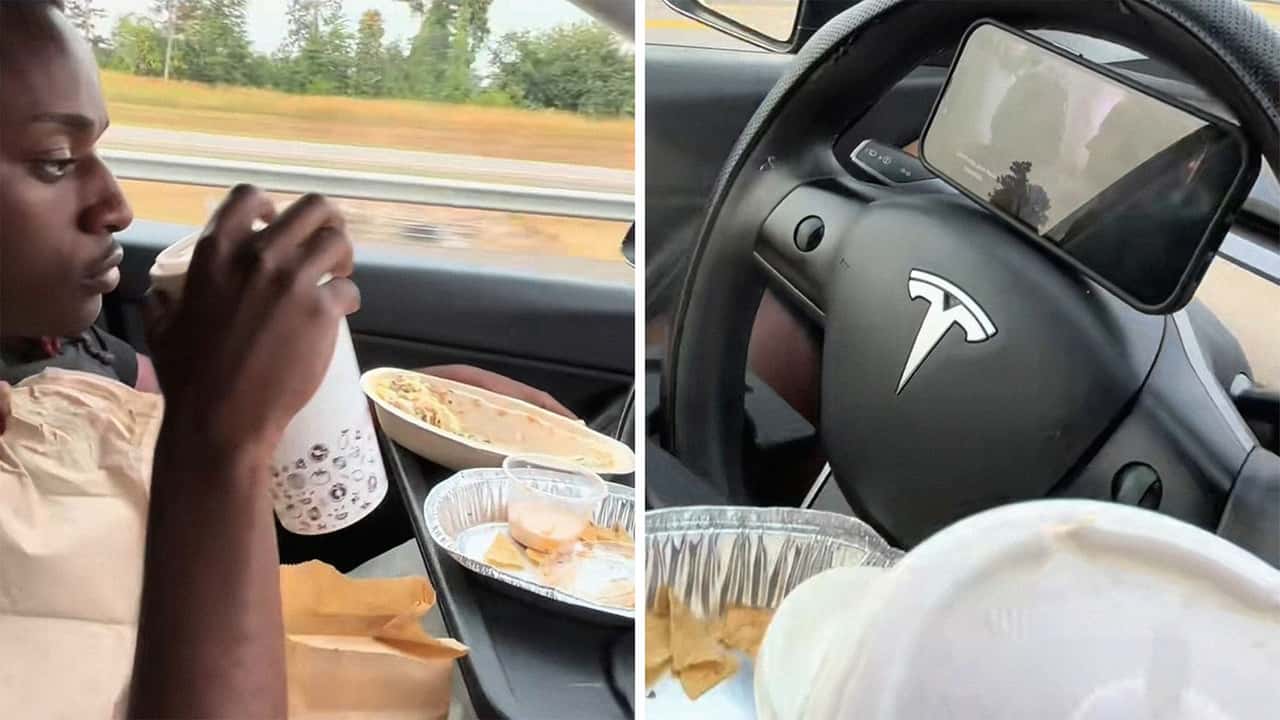

Some people eat Chipotle in the parking lot. Others wait until they get home. But in a popular TikTok clip, a creator set up a full tray table mid-drive and threw on Law & Order SVU for ambiance while his Tesla handled the road.
The clip from Riofrm13 (@riofrm13hillz) shows him chowing on a combo meal and cruising on the expressway, completely at ease with the Tesla’s self-driving technology to keep safe and on time.
FROM THE TRENDING NEWS DESK
Viral bits from across the social media landscape
Our team of experts tracks what's trending so you don't have to—from viral videos to online debates that have everyone talking.
The video’s blend of casual multitasking, food, and crime drama is framed as “just another Tesla day.” Comments ranged from mostly amused to jokingly incredulous and raised some questions about driver focus and safety culture.
Spoiler: Don’t do this, it is dangerous.
What Autopilot (and FSD) Requires
Despite the name, Tesla Autopilot and Full Self‑Driving (Supervised) are classified as SAE Level 2 systems, meaning drivers must remain alert, keep hands on the wheel, and be ready to take control at any moment.
Tesla’s manual emphasizes: “You must pay attention to the road … keep your hands on the steering wheel at all times, and remain ready to resume full control.”
Federal regulators, including the National Highway Traffic Safety Administration, have flagged driver disengagement as a critical issue. Their EA22‑002 investigation found that in over 80% of crashes, drivers regained steering or braking control less than one second before impact—often too late.
FROM THE TRENDING NEWS DESK
Viral bits from across the social media landscape
Our team of experts tracks what's trending so you don't have to—from viral videos to online debates that have everyone talking.
A Consumer Reports assessment labeled Tesla’s torque‑sensor-based driver monitoring system “insufficient,” arguing it fails to detect true attentiveness.
Research published separately shows that drivers using Autopilot gradually become complacent, engaging in safety‑critical behaviors like eating, watching screens, or even sleeping behind the wheel
Crash History and Legal Fallout
Tesla has faced growing scrutiny over this technology. The NHTSA has opened probes into 2.4 million FSD-equipped vehicles, citing at least 13 major crashes, including multiple fatalities linked to reduced visibility and misuse.
In June 2024, Tesla issued a recall for over 2 million vehicles to implement enhanced driver alerts and tighter controls on Autosteer usage.
A Florida jury ruled Tesla partly liable for a 2019 fatal crash involving its Autopilot system, awarding roughly $243 million in damages. It was the first time Tesla has been held accountable by a jury in an autopilot incident.
Analysts warn that a recent verdict may delay Tesla’s robotaxi ambitions and have regulatory repercussions for its FSD rollout.
Depending on the state and the specific behavior observed, a police officer could issue a citation for distracted driving, even if the vehicle is in Autopilot or Full Self-Driving mode. Most U.S. states have laws prohibiting distracted driving, and Tesla’s Level 2 automation does not exempt drivers from those rules. Legally, the person in the driver’s seat is still responsible for operating the vehicle and must remain attentive and in control at all times.
Watching a video while driving, especially on a screen mounted within the driver’s view, can run afoul of these laws. In California, Vehicle Code 27602 explicitly prohibits drivers from watching videos on in-view screens. In Florida, Statute 316.305 primarily targets texting but also gives officers authority to cite drivers for general distraction behind the wheel.
Even if the vehicle appears to be managing the road, an officer observing a driver eating, streaming TV, and ignoring the surroundings could lawfully intervene, particularly if the behavior is deemed a risk to public safety.
Distracted Driving and Dining
Videos circulating on platforms like TikTok and YouTube often show drivers eating, watching videos, or otherwise disengaged while the car is in motion.
A 2022 study by MIT’s Advanced Vehicle Technology Consortium found that drivers tend to become less attentive over time when using Autopilot, despite generally keeping their hands on the wheel as required by the system’s torque sensor. The study suggested a measurable decline in vigilance and situational awareness, particularly when drivers became accustomed to the system's reliability over long periods.
Meanwhile, Tesla-focused forums and Reddit communities frequently condemn extreme or reckless use of the software, yet also acknowledge that the system’s branding, particularly the “Full Self-Driving” label, may lead some users to overestimate its capabilities. This design choice has raised concerns among safety advocates that less tech-savvy drivers may develop a false sense of security behind the wheel.
Most of the comments in the video seem to endorse the behavior.
“Only reason I’d ever get a Tesla,” reads one.
“My dream date,” goes another.
But one got it right: “ER final boss.”
Another adds: “Bro abusing technology.”
InsideEVs reached out to the creator of the post via direct message.

RECOMMENDED FOR YOU

Tesla Apparently Won't Let Cybertruck Buyers Transfer FSD Without Spending Another $20k
The Rivian R2 Is Finally Here. The CEO Just Shared When To Expect More Models
This Tesla Model 3 Went Nearly 400 Miles In A Range Test, 30 More Than Its EPA Rating
'I Want To Own It': What Engineering Explained's Jason Fenske Thought Of The Rivian R2
Teslas Are More Likely To Hit 250,000 Miles Than Almost Every Car Brand
The Electric BMW M3 Is Coming. Here's What It Might Look Like
The Best EV Lease And Finance Deals In June 2026