Home
News
Safety
Why Hurricane Floods Can Cause EV Battery Fires
In the wake of Hurricane Helene, authorities are warning EV owners that batteries and salt water are a bad combination.

Photo by: Pinellas County Government
Mack Hogan 
By: Mack Hogan
Sep 30, 2024 at 4:30pm ET
Add InsideEVs as a preferred source in Google
- (https://twitter.com/intent/tweet?url=https%3A%2F%2Finsideevs.com%2Fnews%2F735638%2Fev-fire-after-flood%2F&text=Why%20Hurricane%20Floods%20Can%20Cause%20EV%20Battery%20Fires&via=InsideEVs)
- copy
Share
Comment
- Floods have pummeled the Southeast, especially North Carolina, destroying countless structures and leaving many vehicles at least partially underwater.
- Authorities say electric car batteries that have been submerged in salt water pose a fire risk, as the flooding can trigger a short circuit.
- If your vehicle has been flooded, be aware of the low but real chance that it can ignite, and never try to drive any vehicle after it has been flooded without first getting it checked out by a technician.
As the Southeastern U.S. is reeling in the wake of Hurricane Helene, authorities are reminding EV owners to be careful if their vehicles have been flooded, as the Associated Press reported. We've even seen video evidence of an allegedly flood-damaged Tesla Model X exploding in a garage.
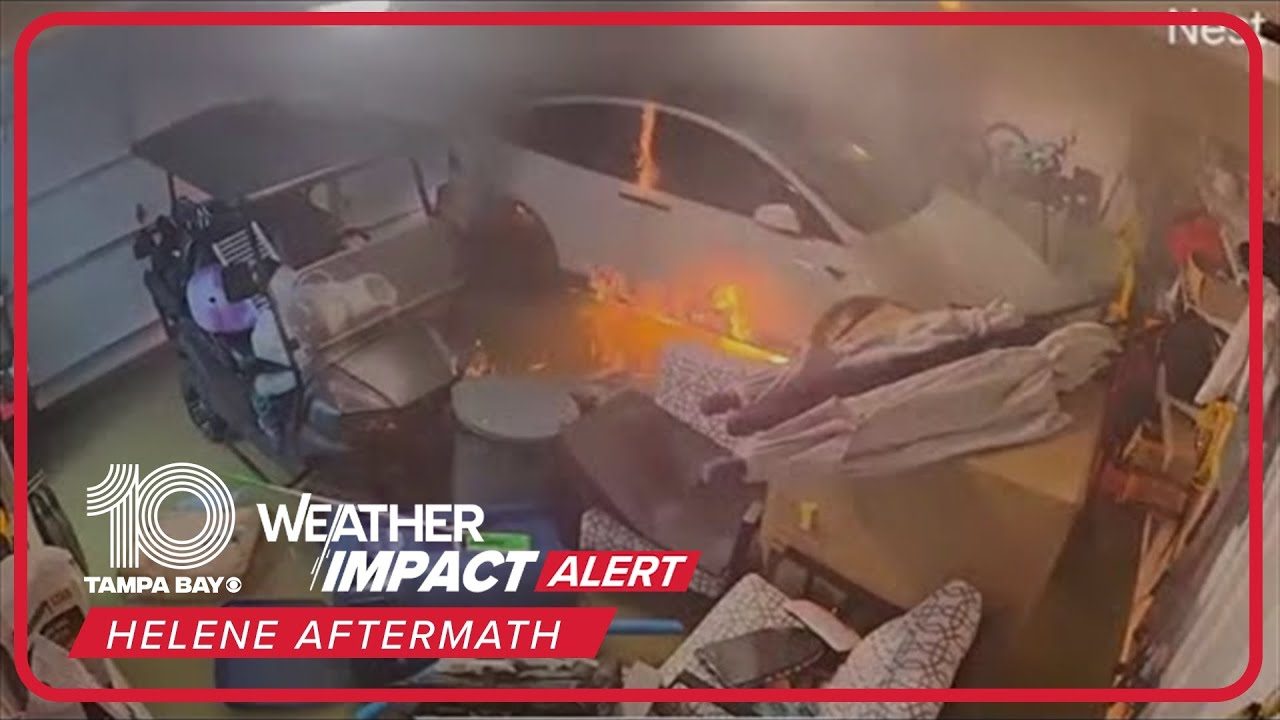
Tesla has long warned of the fire risk that flooded cars pose. The company recommends not driving a car that has been submerged until it is inspected by an authorized repair facility, and says that flooded vehicles should be parked 50 feet from any structure. Florida Governor Ron DeSantis urged EV owners to get their vehicles to higher ground ahead of the storm. Tom Barth, chief of the special investigations branch of the National Transportation Safety Board's office of highway safety, told The Associated Press that saltwater can short-circuit batteries. The conductive salt water can bridge the gap between the battery's positive and negative terminals, shorting the pack and leading to thermal runaway.
Batteries are designed to be safe in a very of conditions, including submersion, so most have seals to prevent any moisture from getting in. But salt water is extraordinarily corrosive—look at the undercarriage of any car driven somewhere where they salt the roads—and those seals can fail.
“Where it begins to be a problem is if you have the batteries submerged in standing water. That’s where it starts to overcome the moisture seals in the battery,” Barth told the AP.
That doesn't mean this is likely to happen. According to National Highway Traffic Safety Administration research, also cited by the AP, after Hurricane Ian flooded 3,000-5,000 electric vehicles. Six hundred were declared total losses and 36 of those caught fire. That means roughly one-tenth of 1% of flooded EVs overall caught fire, but about 6% of those that were totaled did ignite. Research at the Idaho National Laboratory—conducted as part of the NHTSA study—found various ways in which water from Hurricane Ian penetrated the battery packs of flooded cars:

Get the best news, reviews, columns, and more delivered straight to your inbox.
back
Subscribe For more info, read our Privacy Policy & Terms of Use.
Their sample included a Lucid Air, Porsche Taycan, Tesla Model X, Model S, Model Y and Model 3. None of them seemed to pose a fire risk, but researchers were clear that it's possible for EVs to ignite after submersions. Experts also note that a fire can sometimes start after the floodwater has receded, so just because it's dry now doesn't mean it's safe. Like any car, you shouldn't try to use it after a flood before getting it checked out. Even if there's no fire risk, attempting to turn it on may cause further damage. And regardless of your vehicle's powertrain, if the floodwater went past the floorboards you are likely looking at a total loss.
What do you think?
View
Comments
But if you're in North Carolina right now, you can't exactly call a tow truck. If you have an EV that is or was submerged—especially if it is inside of an attached garage—be aware that it is a potential fire risk. Given that emergency services may struggle to reach a house quickly, it may be safest to move to a safer location. If you cannot safely move, stay aware of the risk while also understanding that a fire is extremely unlikely.
As EVs evolve, automakers are also working hard to make sure they fail safely when flooded or in extreme circumstances. Authorities, automakers and regulators continue to learn more about how to handle EV-related fires and specific issues, and EV fires remain far rarer than internal combustion fires. EVs with Vehicle-to-Load (V2L) or Vehicle-to-Home (V2H) functions can also be lifesavers during natural disasters, allowing owners to power fridges, lights and other home electronics when the grid is down. But if you know you're in a flood zone, the safest thing to do is move your vehicle out of the danger zone before the water rises.
Related EV News
 How Electric Vehicles Powered Houston Homes During Hurricane Beryl
How Much Of A Fire Risk Are Electric Cars?
5 Myths About Electric Vehicles & Charging Debunked
How Hyundai And Kia Are Dealing With EV Fire Concerns In Korea
We want your opinion!
What would you like to see on Insideevs.com?
Take our 3 minute survey.
- The InsideEVs team
Share this Story
- (https://twitter.com/intent/tweet?url=https%3A%2F%2Finsideevs.com%2Fnews%2F735638%2Fev-fire-after-flood%2F&text=Why%20Hurricane%20Floods%20Can%20Cause%20EV%20Battery%20Fires&via=InsideEVs)
- copy
GO TO COMMENTS
(
)
Got a tip for us? Email: tips@insideevs.com
View all comments ( )
Trending
I Took A Rivian R2 On A Camping Trip To The Middle Of The Desert
Solid-State Cells Can Make The U.S. Competitive In Batteries Again: CEO
BYD's Futuristic EV Charger Can Run On Sunshine And Batteries
Google’s Gemini AI Assistant Now Works On Apple CarPlay
Latest Stories
- Do EVs Wear Tires Faster? Here's What The Studies Show Nov 13 - Features -
- The VW ID. Buzz Is Getting A New Job As A Robotaxi Nov 13 - News -
- Audi A4 EV Delayed Amid VW Group Financial Troubles: Report Nov 13 - News -
- Tesla Just Killed Its Cheapest All-Wheel-Drive Model Y Nov 13 - News -
- A Record Number Of Uber Miles Are Happening In EVs Nov 13 - News -
- Slate Is Selling A $30 'Screenless GPS' For Its Low-Tech Truck Nov 12 - News -
- America's Top 3 SUVs Are About To Be Hybrid Or Electric Nov 12 - News -
RECOMMENDED FOR YOU
Think Chinese Cars Aren't Safe? These New Crash Tests Say Otherwise
Do EVs Wear Tires Faster? Here's What The Studies Show
The BMW iX3 Just Aced Euro NCAP’s Newer, Stricter Safety Tests
The VW ID. Buzz Is Getting A New Job As A Robotaxi
Teslas Will Now Deploy Their Airbags Before Crashes Happen Thanks To Cameras
Audi A4 EV Delayed Amid VW Group Financial Troubles: Report
China’s Next Safety Target May Be Yoke Steering Wheels