Home
Honda
E
News
Analysis: Honda e Fast Charging Dissapoints
It aspires to be a premium EV, but fast charging performance is not strong.

Mark Kane 
By: Mark Kane
Jun 6, 2021 at 10:50am ET
Add InsideEVs as a preferred source in Google
- (https://twitter.com/intent/tweet?url=https%3A%2F%2Finsideevs.com%2Fnews%2F512213%2Fhonda-e-fast-charging-analysis%2F&text=Analysis%3A%20Honda%20e%20Fast%20Charging%20Dissapoints&via=InsideEVs)
- copy
Share
Comment
Honda e is one of the most interesting electric city cars on the market - described as "Lovable Retro Urban EV" - however, in terms of DC fast charging, it's quite basic.
Let's take a look at Fastned's fast charging results for the Honda e and compare it with other small EVs.
Charging power vs state-of-charge (SOC)
The manufacturer says that Honda e can charge at up to 50 kW and we saw some sessions with 49 kW peak. In the Fastned example, the peak charging power was a little bit lower, at 46 kW.
Fastned explains that it's the session for a car with the battery in optimal conditions (temperature of around 30°C).
The highest power is available between 10-20% SOC and then it decreases in steps. The good thing is that it maintains around 20 kW from about 70% SOC to over 95% SOC.

State-of-charge (SOC) vs time
We estimate that fast charging from 20% to 80% SOC should take about 33-35 minutes. The lower number comes from Bjorn Nyland's test in which he also noted a bit higher power than Fastned (see video below).
Time to add 100 km (62 miles) of range should be around 21-23 minutes when starting at 10% or 20% SOC.

Average charging power vs state-of-charge (SOC)
The average power in the very important range from 20% to 80% SOC is 30 kW, which is 64% of the peak value. Just like the peak value, also the average does not impress.

C-rate vs state-of-charge (SOC)
The peak C-rate* - charging power in relation to the total battery capacity of 35.5 kWh - is about 1.3C.
The average C-rate when charging from 20% to 80% SOC is 0.83C. It's quite low, especially since the car has a liquid-cooled battery.
*C-rate tells us how the charging power relates to the battery pack capacity. For example: 1C is 1-hour charging power (current), when the power value in kW is equal to the battery pack capacity in kWh. 2C would be enough to recharge in half an hour.
The net battery capacity is estimated at 28.6 kWh (Bjorn Nyland's test), which represents about 81% of the total battery capacity.

Range replenishing speed vs state-of-charge (SOC)
The rate of range replenishing depends on the energy consumption and the energy consumption depends on the use case. For the Honda e, we will use WLTP range ratings.
- WLTP
Taking into consideration the WLTP range of 220 km (137 miles) and available battery capacity of 28.6 kWh, we can assume energy consumption of 130 Wh/km (209 Wh/mile).
The effective average speed of range replenishing when charging from 20% to 80% SOC would be 3.8 km/minute (2.4 miles/minute).
As we can see, not too high range, combined with not too high charging power, translates into a low rate of replenishing range. 5 km (3.1 miles) per minute is not particularly fast and Honda e is noticeably below it from 40% SOC.

Comparisons with other EVs

Fiat 500 electric (convertible)
Volkswagen e-up!
We will compare the Honda e fast-charging results with several other small electric models, that were already analyzed:
- Fiat 500 electric (42 kWh) 2021
- Renault ZOE Z.E. 50 2019
- Peugeot e-208 2020
- BMW i3 (42 kWh) 2019
- MINI Cooper SE 2020 (together with i3)
- Volkswagen e-Up!, Škoda CITIGOe iV, SEAT Mii Electric (2020)
Comparison of charging power
If we compare the charging power, Honda e drowns in the sea of other models, basically trying to keep up with Volkswagen's triplets (VW e-Up!, Škoda CITIGOe iV, SEAT Mii Electric) that are the slowest charging EVs that we analyzed.

The average power output in the 20-80% SOC window appears to be between Volkswagen's triplets and Renault ZOE Z.E. 50 and that's slow.
DC Fast Charging Comparison by InsideEVs Model
[data source] Drive /
Battery
(kWh) Max
Power Avg
Power
(20-80%) 2021 Fiat 500 electric (42 kWh)
[Fastned] FWD
42 kWh 85 kW 63 kW 2021 Honda e (35.5 kWh)
[Fastned] RWD
35.5 kWh 46 kW 30 kW 2019 Renault ZOE Z.E. 50
[Fastned] FWD
55 kWh 46 kW 35 kW 2020 Peugeot e-208 (all PSA e-CMP 50 kWh)
[Fastned] FWD
50 kWh 99 kW 53 kW 2019 BMW i3 (42 kWh)
[Fastned] RWD
42.2 kWh 50 kW 47 kW 2020 MINI Cooper SE
[Fastned] FWD
32.6 kWh 49 kW 45 kW 2020 Volkswagen e-Up! (2nd model evolution)
[Fastned] FWD
36.8 kWh 37 kW 29 kW
Comparison of C-rate
The comparison of C-rates reveals the problem. Honda e is around 1C (the peak is 1.3C, while the average in 20-80% SOC window is 0.8C). It's not enough to be competitive.

Volkswagen's triplets have a similar battery capacity and similar average. Only Renault ZOE has a lower average (0.6), but at least it has a high battery capacity of 55 kWh.
DC Fast Charging Comparison by InsideEVs Model
[data source] Drive /
Battery
(kWh) Max
Power Avg
Power
(20-80%) Max
C-Rate Avg
C-Rate
(20-80%) 2021 Fiat 500 electric (42 kWh)
[Fastned] FWD
42 kWh 85 kW 63 kW 2 1.5 2021 Honda e (35.5 kWh)
[Fastned] RWD
35.5 kWh 46 kW 30 kW 1.3 0.8 2019 Renault ZOE Z.E. 50
[Fastned] FWD
55 kWh 46 kW 35 kW 0.8 0.6 2020 Peugeot e-208 (all PSA e-CMP 50 kWh)
[Fastned] FWD
50 kWh 99 kW 53 kW 2 1.1 2019 BMW i3 (42 kWh)
[Fastned] RWD
42.2 kWh 50 kW 47 kW 1.2 1.1 2020 MINI Cooper SE
[Fastned] FWD
32.6 kWh 49 kW 45 kW 1.5 1.4 2020 Volkswagen e-Up! (2nd model evolution)
[Fastned] FWD
36.8 kWh 37 kW 29 kW 1 0.8
Comparison of range replenishing speed
The range replenishing rate is really disappointing in Honda e.

It has the lowest average in 20-80% SOC window among all models:
DC Fast Charging Comparison by InsideEVs Model
[data source] Drive /
Battery
(kWh) Avg
Power
(20-80%) WLTP range
rep. rate
(20-80%) 2021 Fiat 500 electric (42 kWh)
[Fastned] FWD
42 kWh 63 kW 9 km/min
5.6 mi/min 2021 Honda e (35.5 kWh)
[Fastned] RWD
35.5 kWh 30 kW 3.8 km/min
2.4 mi/min 2019 Renault ZOE Z.E. 50
[Fastned] FWD
55 kWh 35 kW 4.4 km/min
2.7 mi/min 2020 Peugeot e-208 (all PSA e-CMP 50 kWh)
[Fastned] FWD
50 kWh 53 kW 6.7 km/min
4.2 mi/min 2019 BMW i3 (42 kWh)
[Fastned] RWD
42.2 kWh 47 kW 6.4 km/min
4 mi/min 2020 MINI Cooper SE
[Fastned] FWD
32.6 kWh 45 kW 6.1 km/min
3.8 mi/min 2020 Volkswagen e-Up! (2nd model evolution)
[Fastned] FWD
36.8 kWh 29 kW 3.9 km/min
2.4 mi/min
Conclusions
The conclusion from the DC fast charging analysis of the Honda e 2021 is that it offers very basic performance - just in case.
The charging power is low in relation to the battery capacity and turns out to be noticeably lower than in the case of most of the other small EVs, not even premium. The range replenishing rate is also bad.
Without any doubt, Honda could do better.
2021 Honda e (35.5 kWh) :: DC Fast Charging Summary by InsideEVs
Drive: RWD; Battery pack (net / total): 28.6 / 35.5 kWh
[Data source: Fastned] Peak Power
Peak C-rate
Average Power (20-80% SOC)
Average-to-Peak Power
Average C-rate (20-80% SOC)
Time (20-80% SOC) 46 kW
1.3
30 kW
65%
0.8
about 33-35 min Range Replenishing Speed (Average 20-80% SOC): WLTP 3.8 km/min (2.4 mi/min)
See also
Tesla Model 3 SR+ Vs Volkswagen ID.3: Fast Charging Comparison
Hyundai Ioniq 5 Amazes: Real Fast Charging Session Data Analyzed
General info:
** Some values on the charts are estimated from the data source.*
* Temperature of the battery cells might highly negatively affect charging capabilities. We don't have data about temperatures of the battery at the beginning and during the charging process. In cold or hot weather, as well as after driving very dynamically, charging power might be significantly lower than shown on the charts (in extreme cases charging might be impossible until the battery temperature will not return to an acceptable level).*
What do you think?
View
Comments
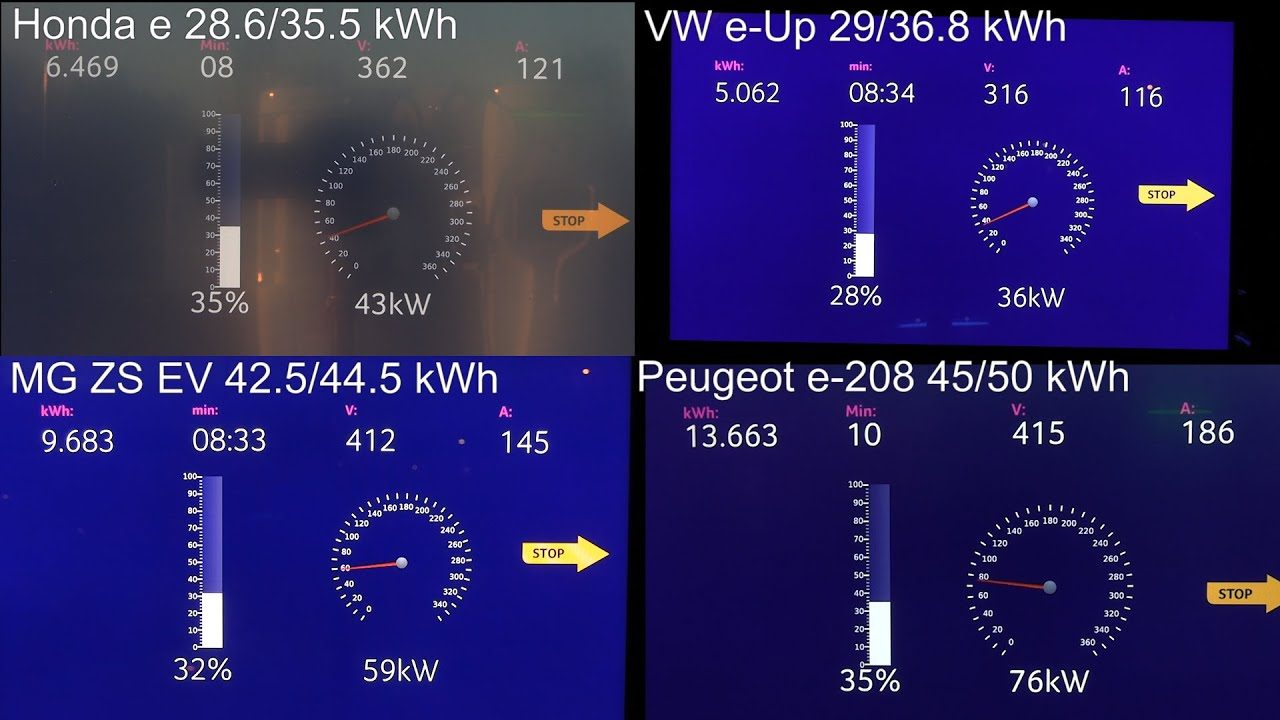
Below we attached Bjorn Nyland's Honda e fast charging test and comparison with a few other EVs.
Honda e specs:
- 220 km (136.7 miles) of WLTP range
- 35.5 kWh battery (about 28.6 kWh usable)
(liquid cooled), cells supplied by Panasonic - 0-100 km/h (62 mph) in about 8-9 seconds
- top speed of 145 km/h (90 mph)
- rear-wheel drive
- electric motor (base version): 100 kW of power and 315 Nm of torque
- electric motor (Advance version): 113 kW of power and 315 Nm of torque
- 6.6 kW on-board charger
- fast charging (CCS Combo 2) up to 50 kW; 80% in about 30 minutes
- four seats
We want your opinion!
What would you like to see on Insideevs.com?
Take our 3 minute survey.
- The InsideEVs team
Share this Story
- (https://twitter.com/intent/tweet?url=https%3A%2F%2Finsideevs.com%2Fnews%2F512213%2Fhonda-e-fast-charging-analysis%2F&text=Analysis%3A%20Honda%20e%20Fast%20Charging%20Dissapoints&via=InsideEVs)
- copy
GO TO COMMENTS
(
)
Got a tip for us? Email: tips@insideevs.com
View all comments ( )
Trending
Diesel Prices Are Surging. This Electric Trucking Company Is Seeing More Interest
I Tried Mercedes MB.Drive Assist Pro. It's Like Tesla FSD, But With One Catch
Tesla Opens Self-Driving Cybercab Orders To 'Select Customers' At $29,990
Tesla Model 3 Maintenance Guide: What Needs Servicing And What Doesn't
Latest Stories
- Tesla Keeps Killing Cars. Now It Wants To Build Cybercabs In Germany Nov 16 - News -
- Tesla Model 3 Maintenance Guide: What Needs Servicing And What Doesn't Nov 16 - Repair / Maintenance -
- Audi A2 e-tron First Drive: Does The Iconic Nameplate Live Up To The Hype? Nov 16 - First Drives -
- I Tried Mercedes' Answer To Tesla FSD. Here's How It Went Nov 16 - Tech Review -
- BMW Just Started Making EV Batteries In America. The New iX5 Will Be First In Line Nov 16 - Manufacturing / Production -
- BMW’s iX5 Beat The Lucid Gravity On Highway Range. Not On Efficiency Nov 16 - Range / Efficiency -
- Tesla Just Bumped The Cheapest Model Y’s Range, But The Price Stays The Same Nov 16 - Range / Efficiency -
RECOMMENDED FOR YOU
America's Top 3 SUVs Are About To Be Hybrid Or Electric
Tesla Model 3 Maintenance Guide: What Needs Servicing And What Doesn't
Honda Is Betting $3 Billion On Hybrids As It Pulls Back From EVs
Audi A2 e-tron First Drive: Does The Iconic Nameplate Live Up To The Hype?
Tesla Drivers Can Now Plug In And Charge Automatically at Ionna Stations
I Tried Mercedes' Answer To Tesla FSD. Here's How It Went
BYD's Futuristic EV Charger Can Run On Sunshine And Batteries