
I Drove China's Best-Selling Car. It's On Top For A Reason
The Geely EX2—or Xingyuan—outsells everything Tesla and BYD make. In five minutes with it, you understand why.
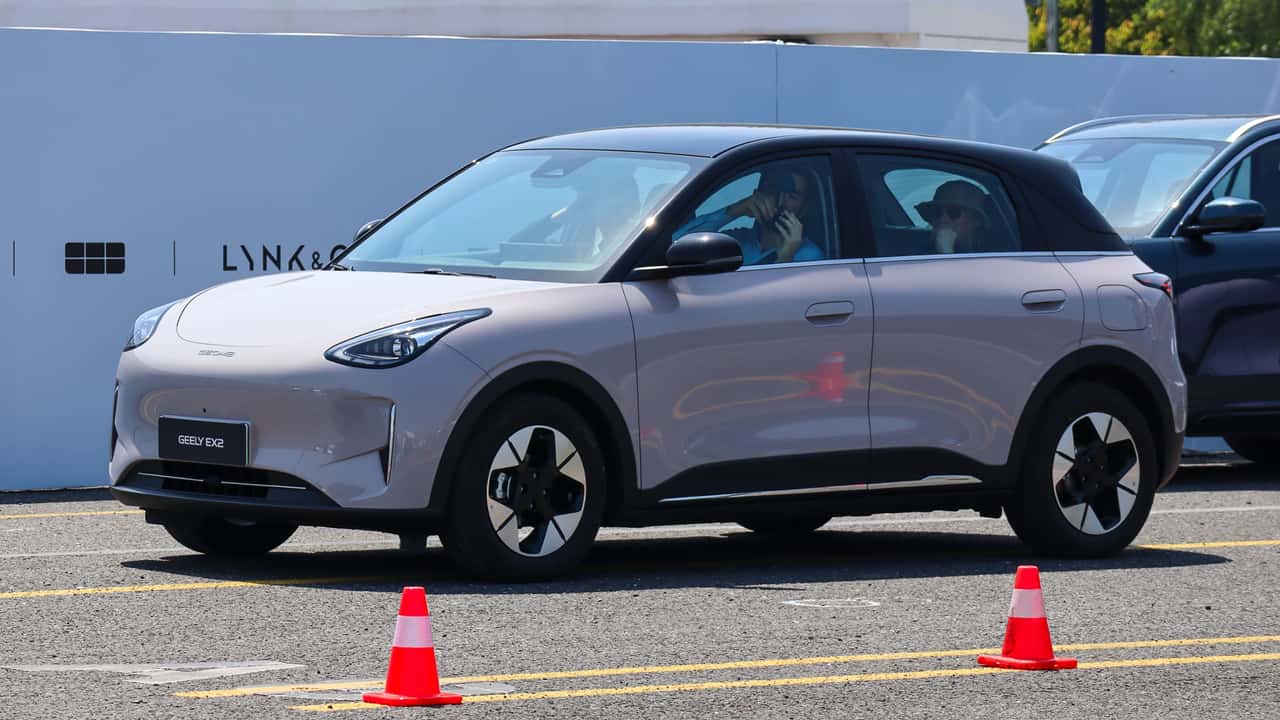

Xingyuan. Or Star Wish. Or EX2, whatever you call it, Geely’s pint-sized runabout has become super popular in China, surpassing some pretty big nameplates in the country’s EV market. Geely moved 465,775 units last year in China alone, beating the Tesla Model Y’s roughly 425k units. It also snatched the crown away from China’s other once-best-selling pint-sized EV that freaked out basically every executive a few years ago: the BYD Seagull. The Seagull only managed to move 310,000 units. This year, Geely’s small EV offering is outselling the Seagull at a nearly 2-to-1 ratio.
While in China, a few days after the Beijing Auto Show, I got a chance to take a spin in one during a showcase of some of Geely’s most important plug-in vehicles, with plans to bring many of them to global markets (except the United States, for now). Although my time was limited compared to the full afternoon I had with the BYD Seagull, I understood why Geely’s pint-sized EV is so popular, and just why it’s beating the Seagull in sales recently.

In short, it hits harder on the value front and feels like it’s designed right for Chinese budget buyers, taking what people like the BYD Seagull, but making it even easier to live with.
And, like many Chinese cars, it’s a damn shame we can’t get it.
(Full Disclosure: Xiaomi and Geely covered my travel to Beijing for the Auto Show and provided lodging and test cars)
What Is It?
There have been plenty of cheap EVs in China. For more than five years, we’ve marveled at cars like the Wuling Hongguang Mini EV, small two-door electric cars that cost as much as a mid-tier laptop.
But those were barely cars. Even in China, concerns about safety and performance surrounded these hypercompact urban commuters. They can’t go very fast; cars like the Wuling Hongguang Mini EV only have a 20-horsepower motor, making them uncomfortable on China’s freeways. Many of them didn’t have airbags or much in the way of crash protection, so accidents, even between two similarly sized vehicles, weren't good for the occupants.
Yet, China’s car market has matured. Sales of these super boxy vehicles have given way to more modern and sophisticated EV designs. These new offerings have more power and more features, undergo crash testing, and still keep prices low. The end result is something that feels safer and more dignified, giving lower-income drivers a chance to access well-resolved EVs for not too much money. I’d argue that the BYD Seagull was one of the first to master this formula. BYD crafted a small EV that felt like a real car. It had 75 horsepower, four airbags, and a modern-looking exterior and chassis, all for prices that weren’t too much more than the glorified neighborhood electric vehicles once popular on the bottom end of China’s market.
The EX2 takes the BYD Seagull head-on, but on its face, the two cars aren’t actually as similar as you’d think.

While the (China-spec) BYD Seagull is the same size as the A-segment Chevrolet Spark EV, the EX2’s extra 14 inches of length and nearly 4 inches of width place it closer to true subcompacts like the Chevrolet Sonic. That extra bit of length and width makes it more spacious than the Seagull; I never found the Seagull to be cramped, especially for its petite dimensions, but the extra length and width give the EX2 an interior advantage over the BYD. The Seagull can only accommodate four passengers, but the EX2 can easily swallow five.
Underneath, the Xinguan feels a little more special, too. While the Seagull’s front motor, front-wheel-drive design with its semi-independent rear torsion beam axle is similar to any given small hatchback from the past 35 years, the EX2 is remarkably sophisticated for a small, cheap car. The EX2 is rear-wheel drive, with a fully independent rear suspension. Geely’s taken advantage of that packaging advantage; the EX2 has a 2.5 cubic foot frunk, while the Seagull’s nose is home to the motor and electronics that make the car go forward and backward. With the seats folded down, the Geely’s 46.6 cubic feet of interior cargo room bests the BYD Seagull’s 32 cubic feet of storage.
What’s It Like To Be With?
My time with the EX2 was limited to a short Gymkhana-style lap or two in a parking lot near Geely’s world headquarters in Hangzhou, China. All of the cars on test were powered by the same 114-horsepower motor, fed by a 40 kWh battery. Price as tested was around $11,000, cheap to most of us here in the West, and pretty competitive in China’s small EV subcompact hatchback and crossover class.
Dynamically, the EX2 is okay. It is clearly tuned for China’s market, which values comfort rather than a sporty drive. The steering is light without much feel, but accurate. The suspension is very soft, and the EX2 has a fairly high amount of body lean for such a small car. Push it too hard, and it will understeer, but that’s likely intentional. China-spec to China-spec, I think I prefer driving the Seagull, but the EX2 isn’t bad.
Geely claims about an 11.5-second 0-62 time for the car, which feels accurate and is adequate for most drivers, especially in China. I didn’t have enough room to go that fast, but it felt sprightly enough, even with a carful of passengers.
As was my observation with the BYD Seagull a year ago, it is striking how refined and high-tech the EX2 is for such a low price. I’ve been inside cheap cars made for so-called developing markets before, and it’s sometimes obvious through ride, handling, or NVH issues that there are a lot of pieces, parts, and tuning and refinement that weren’t performed on some of the cheaper models. Yet, the EX2 feels smooth riding, quiet, and refined, not at all like it’s literally less than half the price of some of the cheapest cars on the U.S market. The EX2’s Flyme Auto infotainment system is speedy and easy to use, and feels just as well-made as other cars made by Geely that are more than five times the price.
Why Is This Important?
I think the real standout quality of the EX2 is how seemingly better suited it is to real, average Joe drivers, compared to the competition. This car really hits all the right notes and shows that Geely is listening closely to what Chinese drivers want, giving them something that its biggest competitor doesn’t have. But it doesn’t quite make the competition irrelevant. The BYD Seagull is also cheap, sometimes slightly cheaper than the EX2. Also, the Seagull has BYD’s “God’s Eye” ADAS software, which includes navigation-on-autopilot city driving, and lane keep assist, not common for cars this cheap, even in China.
Yet, it feels like we can infer from sales numbers that sophisticated ADAS may not be as much of a sales driver as some may think. When it comes to ADAS features, the Geely EX2’s suite is basic, not offering more than traditional cruise control. I’d wager that the bigger interior and extra power are more alluring to practically minded buyers on a budget, rather than pseudo-self-driving tech. I know if I were on a budget, I’d rather have a car that can carry more people, rather than one that can kind of steer itself in very limited circumstances.
This preference for larger affordable models is reflected in China’s market, too. The Geely EX2 may have been the first, but other manufacturers are copying the same playbook with variations. Chery has brought back its infamous QQ name for a similarly sized and priced EV hatchback. Leapmotor’s new A10 (B03X for markets outside of China) also meets the EX2 for similar pricing. There’s a new gaggle of small hatchback or crossover EVs in China, all starting around $9,000, with five seats and a full suite of infotainment features, but not necessarily cutting-edge ADAS suites. (Most of those that do offer sophisticated ADAS features make them optional.) On their face, they seem more practical than the four-seat BYD Seagull.
For us here in North America, these cars look like just what the doctor ordered for cheap, practical EVs. We’re all in search of not-expensive EVs that still can carry people and don’t feel uncomfortable behind the wheel or on the roads. In its current state, the Geely EX2 didn’t feel like it needed many alterations for it to be palatable to markets outside of China.
When the Geely EX2 and cars like it make it out of China, the world will definitely be ready to gobble them up.
Contact the author: kevin.williams@insideevs.com
Related Articles
RECOMMENDED FOR YOU
This Tiny New EV Motor Cuts Weight And Size For Impressive Efficiency
EV Drivers Are Happier With Their Cars Than Gas Car Owners: Study
Everyone Is Afraid Of EV Battery Degradation. It's All The Nissan Leaf's Fault
A BMW iX3 Charged For Just 15 Minutes. Here's How Far It Drove On The Highway
Is The $25K Slate Truck Just Too Basic? I Rode In One To Find Out.
The Tesla Model Y Has Changed A Surprising Amount In 6 Years
China's Best-Selling Car Just Got Better And Cheaper