Home
Features
Opinion
Potential Impact Of California's Ban On Per-Minute Billing For Charging
California's new law will ban charging operators from billing by the minute.
EVANNEX 
By: EVANNEX
Jan 10, 2020 at 7:48am ET
Add InsideEVs as a preferred source in Google
- (https://twitter.com/intent/tweet?url=https%3A%2F%2Finsideevs.com%2Ffeatures%2F392167%2Fpotential-impact-california-time-based-billing-charging%2F&text=Potential%20Impact%20Of%20California%27s%20Ban%20On%20Per-Minute%20Billing%20For%20Charging&via=InsideEVs)
- copy
Share
Comment
EDITOR'S NOTE: This article comes to us courtesy of EVANNEX, which makes and sells aftermarket Tesla accessories. The opinions expressed therein are not necessarily our own at InsideEVs, nor have we been paid by EVANNEX to publish these articles. We find the company's perspective as an aftermarket supplier of Tesla accessories interesting and are happy to share its content free of charge. Enjoy!
More EV News From California:
 California Bans Government Purchase of Gas-Powered Cars (*Mostly)
California Reshapes EV Rebate Program; Excludes EVs Over $60,000
Public charging operators will be required to phase out time-based billing for charging in California. The state’s Office of Administrative Law recently approved amendments to its Electric Vehicle Fueling Systems Specifications that will eventually ban public charging operators from billing by the minute.

Above: Model S charging at a Tesla Supercharger (Flickr: Jakob Harter)
The ban will apply to new Level 2 chargers beginning in 2021, and to new DC fast chargers beginning in 2023. Chargers installed before 2021 can continue to use time-based billing until 2031 (for Level 2 chargers) or 2033 (for DC fast chargers).
This will require some restructuring in the charging market, as several major charging networks, including Electrify America and EVgo, currently bill by the minute, as do some ChargePoint site hosts (and the charger-sharing network EVmatch).
Charging network operators objected to the change, arguing that they are selling a service, but California’s Division of Measurement Standards (DMS) rejected their argument: “The Department acknowledges this group of comments and disagrees with the interpretation of the primary commodity being traded. As defined in BPC § 13400(a)(4) and (p), electricity is considered a type of motor vehicle fuel. NIST Handbook 44 makes clear what the unit of measure of electricity as motor vehicle fuel dispensed from EVSE shall be measured by - either the kWh or the megajoule (MJ).
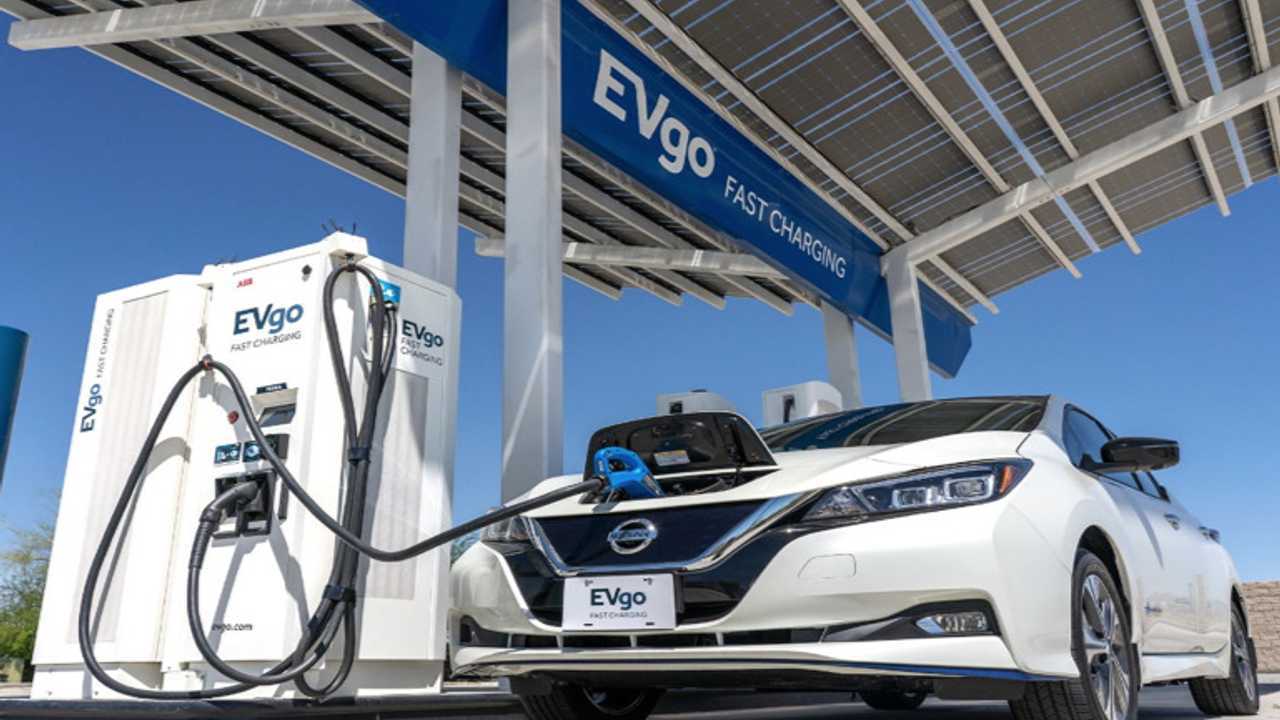
Many EV drivers and industry observers consider time-based pricing to be inherently unfair, because many factors can affect charging speed. When you’re billed by the kWh, you know exactly what you’re paying for, as is the case with gasoline. When you pay by the minute, the final price for a charge can vary depending on your state of charge, your vehicle’s maximum charging speed, or even the ambient temperature. Many drivers have experienced sticker shock - in some cases, charging at a highway fast charger costs more per mile than fueling a legacy ICE vehicle. Electrek calculates that EVgo’s base per-minute rate translates to over three times the average cost of the electricity under ideal conditions.

Above: EVgo station charging a Bolt, Leaf, and Model 3 (Image: EVgo)
The only practical argument we’ve heard in favor of charging by the minute is that, because charging rates tend to drop dramatically as state of charge nears 100%, it discourages charger hogs from overstaying their welcome at a charger when others are waiting. However, the new rule does not prohibit operators from charging an overtime fee (Tesla already does so at some busy stations).
Kevin Schnepp, Environmental Program Manager at the DMS, provided some clarification in a message to Electrek, “Electric vehicle service providers are allowed to charge ancillary fees such as: a connection fee; waiting fee for staying connected after reaching full state of charge; parking fee where such charges are normally applied; and a non-network access fee where applicable, provided that these fees are disclosed to the consumer prior to initiating a charging session (there may be other allowed fees not identified in this example).”
There is another reason that some networks charge by the minute: in some US states (20 at last count), only regulated utilities are allowed to sell electricity by the kWh. It remains to be seen whether more states will follow California’s lead - for the near future, network operators may have little choice but to use different pricing models in different markets.
Tesla has always billed by the kilowatt-hour in states where it’s allowed. However, there’s another amendment to the regulations that does affect Tesla. Charging stations will now be required to have a “primary indicating element on the face” of each station, which will display the price per kWh and a running total of the energy delivered - just like a gas pump. The new rule will apply to new DC fast chargers beginning in 2023, and all DC fast chargers will have to comply by 2033. Current Superchargers don’t have such a display, so Tesla will have some retrofitting to do. However, the meter does not have to be “directly integrated into the device,” so the company should be able to design some sort of add-on module, and avoid replacing the entire unit.
===
What do you think?
View
Comments
This article originally appeared in Charged. Author: Charles Morris. Source: Electrek
EDITOR'S NOTE: This article comes to us courtesy of EVANNEX, which makes and sells aftermarket Tesla accessories. The opinions expressed therein are not necessarily our own at InsideEVs, nor have we been paid by EVANNEX to publish these articles. We find the company's perspective as an aftermarket supplier of Tesla accessories interesting and are happy to share its content free of charge. Enjoy!
Source: Evannex
We want your opinion!
What would you like to see on Insideevs.com?
Take our 3 minute survey.
- The InsideEVs team
Share this Story
- (https://twitter.com/intent/tweet?url=https%3A%2F%2Finsideevs.com%2Ffeatures%2F392167%2Fpotential-impact-california-time-based-billing-charging%2F&text=Potential%20Impact%20Of%20California%27s%20Ban%20On%20Per-Minute%20Billing%20For%20Charging&via=InsideEVs)
- copy
GO TO COMMENTS
(
)
Got a tip for us? Email: tips@insideevs.com
View all comments ( )
Trending
Kia EV3 Lease Deals Are Here, And It’s Cheaper Than The Chevy Bolt And Nissan Leaf
I Let Android Auto Plan My EV Roadtrip. Here’s How It Worked
This Chevy Bolt Has 470,000 Miles. Here’s How Much A New Battery Was
Here's What It's Like To Take Delivery Of A Rivian R2
latest articles
- Can The BMW iX3 Take Down The Tesla Model Y L And Rivian R2? Oct 20 - News -
- Waymo Plans To Have 20,000 Cars By The End Of 2027 Oct 20 - News -
- The Boring Company Uses Tesla Model 3 Sleds To Shuttle Shipping Containers Through Its Tunnels Oct 20 - News -
- How Much Range Do EVs Lose When Parked? (And How to Stop It) Oct 20 - EV 101 -
- This Chinese EV Is Now Made In Europe. More Are Coming Oct 20 - News -
- GM Is Closing Its Detroit EV Battery Plant Oct 20 - Industry -
- The 2027 Lexus NX Plug-In Hybrid Gets A Bigger Battery And Fast Charging Oct 20 - Official -
RECOMMENDED FOR YOU
People Are Mad About The Jeep Recon's 222-Mile Range. Here's What They're Missing
Can The BMW iX3 Take Down The Tesla Model Y L And Rivian R2?
Genesis' First Few EVs Didn't Blow Me Away. The GV90 Flagship Did
Waymo Plans To Have 20,000 Cars By The End Of 2027
EV Reveals Have Gotten Way, Way Too Drawn Out. The Ford Fathom Proves It
The Boring Company Uses Tesla Model 3 Sleds To Shuttle Shipping Containers Through Its Tunnels
EVs Don’t Need This Gas Car Feature. So Why Do So Many Still Have It?