
The Volkswagen ID. Buzz Robotaxi Is Hitting LA Streets
On-road testing of VW’s fully autonomous ID. Buzz minivans is now underway in Los Angeles.
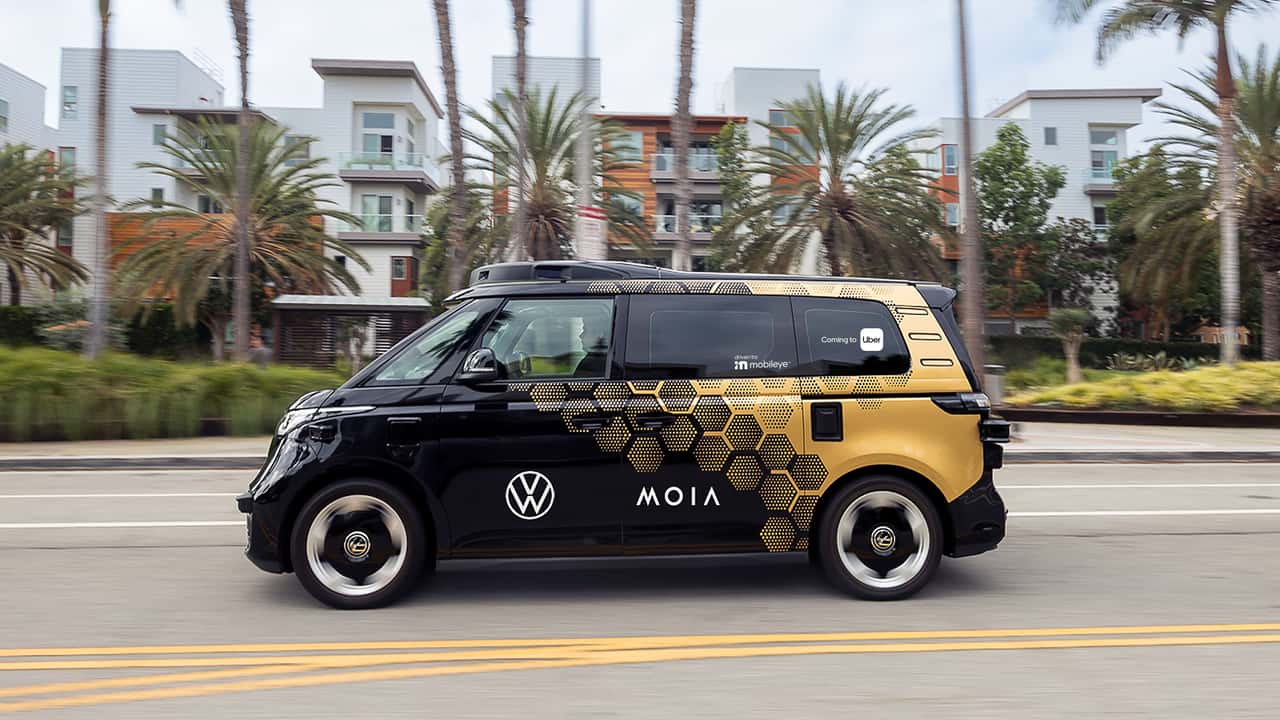

- Volkswagen has started testing its fully autonomous ID. Buzz electric minivans in the United States.
- Over 100 robotaxis will hit the streets with safety operators as testing ramps up.
- The EVs, which were outfitted with autonomous tech from Volkswagen Group’s MOIA subsidiary, will start offering rides on the Uber platform in late 2026.
The first Volkswagen ID. Buzz robotaxis have hit the streets of Los Angeles for on-road testing, with hundreds slated to start roaming the City of Angels before hitting the Uber app in late 2026.
The move is part of Volkswagen Group’s partnership with ride-hailing giant Uber, which was announced last April. The cars are outfitted with all the necessary automated driving hardware by the VW Group’s MOIA subsidiary, which develops autonomous mobility technology.
Gallery: Volkswagen ID. Buzz AD autonomous vehicle


As part of the partnership, thousands of self-driving Volkswagen ID. Buzz EVs will eventually offer Uber rides in multiple U.S. cities, but before that happens, MOIA America will deploy over 100 robotaxis with safety operators behind the steering wheel for real-world validation. Earlier this year, Volkswagen ADMT was renamed MOIA America.
“With the introduction of MOIA America, we’re establishing a unified brand presence as we expand our autonomous testing activities in the U.S.,” said Paul DeLong, President of Commercialization, MOIA America. “Los Angeles is a natural market to introduce MOIA’s autonomous vehicles for ride experiences, given its long history of shaping car culture and embracing new mobility technologies. Together with Uber, we’re bringing MOIA’s autonomous vehicles and expertise onto a platform millions of riders already use and trust.”
The MOIA-built ID. Buzz minivans feature a 27-sensor suite that integrates 13 cameras, 9 Lidar units, and 5 radars. All the data from these sensors is fed into a Mobileye-sourced computer that then decides what the car should do in all types of scenarios, including those where emergency vehicles are involved.
Last year, when the ID. Buzz AD robotaxi was unveiled, MOIA claimed that the EV meets all the requirements for SAE Level 4 automated driving, with remote supervision and safe handling of edge cases baked in.
Inside, the van has four passenger seats and a luggage rack where the front passenger seat used to be. There’s also a seat for the driver, but that will presumably stay empty once fully self-driving rides go online toward the end of this year, as the Volkswagen Group claims.
More Stuff Like This

RECOMMENDED FOR YOU
VW Wants Higher Tariffs After Chinese PHEVs Overtake Its Best-Seller in Europe
After Driving Over 25 Chinese Cars, These Are The 6 I Would Buy
Volkswagen's Cheapest EVs Are Already A Hit: 70,000 Orders And Counting
The Hyundai Ioniq 5 N Has A Range Problem. Smaller Wheels Helped A Lot
All The EVs That Got Canceled Or Delayed In 2025 And 2026 (Updated)
What Rivian And Lucid's Latest Earnings Say About The EV Startup Race
Volkswagen’s Cheapest New EV SUV Has 265 Miles Of Range