
‘A User Skill Issue For Sure’: Woman Gets New Ford EcoSport. Why Does The Trunk Open Like That?
"Ford, please NEVER design a door to open like this again"
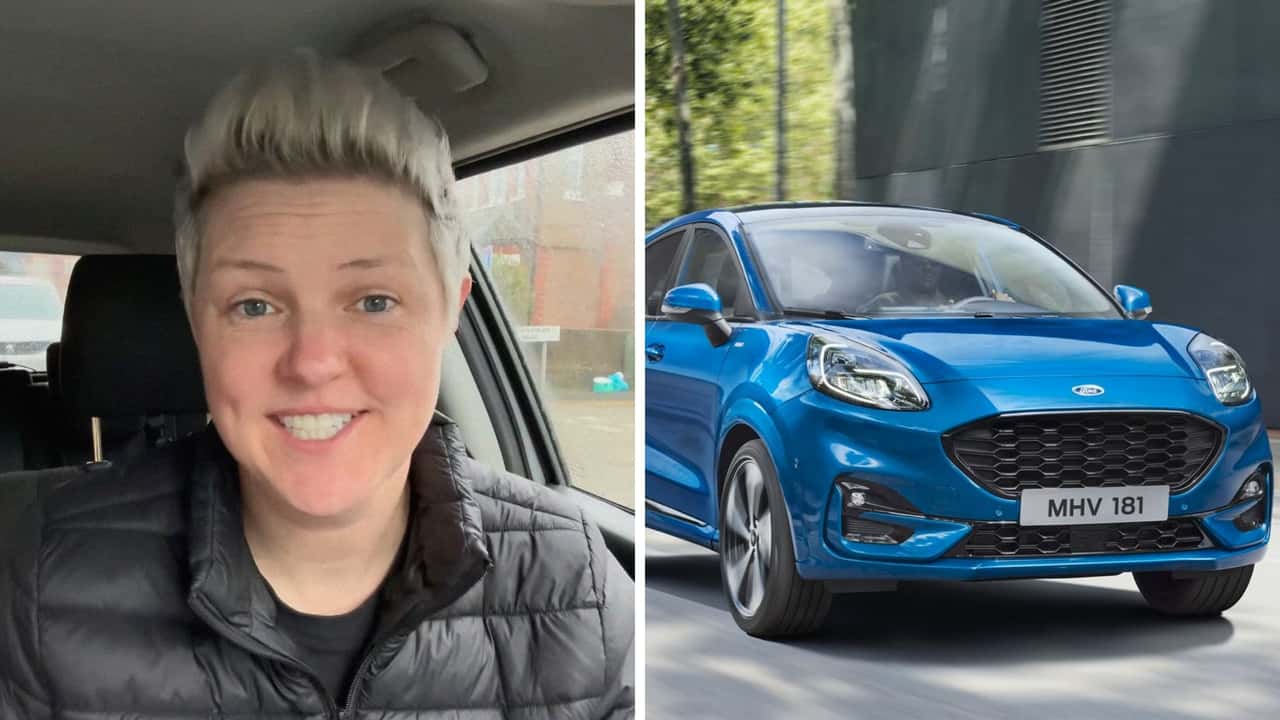

It’s not a software bug or a manufacturing defect. It’s a parked car, a neighboring bumper, and a rear door that opens sideways instead of up. Yet a short TikTok showing a Ford EcoSport’s blocked trunk has sparked a comment-section debate over bad drivers, bad design and whether buyers should be expected to plan every grocery run around a hinge.
The viral clip from driving instructor Sophie (@onlinedrivinginstructor) is a picture of frustration, showing the EV parked so close to a nearby vehicle that the sideways-opening gate cannot open all the way. In the clip, which has been viewed more than 2.9 million times, Sophie used the occasion to indict Ford's design choices.
Design Choice Isn’t New, Just Unexpected
Ford didn’t invent the side-hinged rear door, and the EcoSport isn’t even unusual globally. The compact crossover has used a sideways-opening tailgate since its original launch in international markets more than a decade ago, a decision tied largely to packaging, cost, and global platform consistency rather than novelty. Similar rear-door designs have long appeared on vehicles like the Jeep Wrangler and various small SUVs sold outside the U.S., where parking layouts and usage patterns often differ from American norms. Ford’s own product documentation and early press materials for the EcoSport describe the rear door as a deliberate carryover from its global design, not a market-specific experiment.
What’s changed isn’t the door. It’s the expectation. In a U.S. market now dominated by upward-lifting hatchbacks and powered liftgates, many buyers simply assume that’s how a trunk opens unless told otherwise. That assumption rarely gets challenged until a grocery run or parking lot reveals the limitation in real time.
The frustration captured in Sophie’s video is amplified by modern parking conditions. While vehicles have steadily grown wider and taller over the past two decades, parking space dimensions in many commercial lots have remained largely unchanged. The Institute of Transportation Engineers has noted that standard parking stall widths in older developments often range from 8.5 to 9 feet, a size that leaves little margin once adjacent drivers park close to the line. In those conditions, any outward-swinging door—rear or side—can quickly become unusable.
That reality undermines one of the most common critiques in the comments, which insists that the situation could have been avoided by better parking. Even perfectly centered parking doesn’t guarantee clearance once another driver pulls in close behind or overhangs slightly, a frequent occurrence in busy retail lots.
“User Error” or Design Tradeoff?
Commenters were quick to label the clip a “user skill issue,” arguing that Sophie should have pulled forward, parked differently or simply chosen another vehicle. Some went further, suggesting the problem proved incompetence rather than inconvenience. But that framing ignores how vehicle design choices inevitably impose constraints on real-world use.
FROM THE TRENDING NEWS DESK
Viral bits from across the social media landscape
Our team of experts tracks what's trending so you don't have to—from viral videos to online debates that have everyone talking.
Side-hinged rear doors work well in some contexts. They can allow access in low-ceiling garages and avoid the overhead clearance issues faced by tall liftgates. They can also reduce mechanical complexity and cost compared to powered hatches. The tradeoff is lateral clearance, a factor that becomes increasingly important in dense parking environments where drivers have little control over neighboring vehicles.
In other words, the problem isn’t that the EcoSport’s design is flawed. It’s that the design demands more situational awareness than most modern drivers are accustomed to needing.
While the original EcoSport wasn’t electric, Ford is relaunching the model as an EV. As automakers rethink vehicle architecture around batteries, aerodynamics, and interior packaging, traditional assumptions about cargo access are increasingly up for revision. Some EVs prioritize sloping rear profiles for efficiency, reducing hatch openings. Others add front trunks that shift the distribution of cargo. Still others use split tailgates or unconventional hinges to balance weight and space constraints.
Consumer research from organizations such as Consumer Reports and J.D. Power has consistently shown that buyers focus heavily on range, charging speed, and technology features while often overlooking practical considerations such as door swing, cargo loading angles, and clearance requirements. Those details rarely appear on spec sheets, yet they can shape the daily ownership experience far more than a few extra miles of range.
Sophie’s video inadvertently highlights a broader lesson about vehicle ownership in an era of increasingly specialized design. No car is built to accommodate every scenario without compromise. The burden often falls on buyers to understand how those compromises intersect with their habits, whether that’s frequent grocery runs, urban street parking, or tight residential garages.
The comment section may have framed the moment as driver error versus manufacturer mistake, but the truth sits somewhere in between. The EcoSport’s rear door behaves exactly as designed. The parking lot behaves exactly as parking lots usually do. The clash between the two is less about blame than about mismatched expectations.
InsideEVs reached out to Sophie via direct message and comment on the clip. We’ll update this if they respond.
RECOMMENDED FOR YOU

The Best EV Lease And Finance Deals In June 2026
This Simple Trick Boosted My Plug-In Hybrid's Fuel Economy To 50 MPG
Ford’s Chinese EREV Bronco Would Do Great In America. But Don’t Hold Your Breath
Sodium Batteries And EVs That Power The Grid: Inside GM's Big Energy Push
Electric Trucks Have Failed Spectacularly In America. Here's Why Ford Is Trying Again
EVs Are Cleaner Than Gas Cars. Your ZIP Code Decides By How Much
Ford’s New Battery Container Is Here To Take On The Tesla Megapack