
‘My Truck Doesn’t Lose Kilometres When It Gets Cold Out Lol’: Cybertruck Driver Says It’s The Best Winter Car He’s Had
“Nearly every store in town closed down early, but that didn't stop me from going wherever I needed to go."
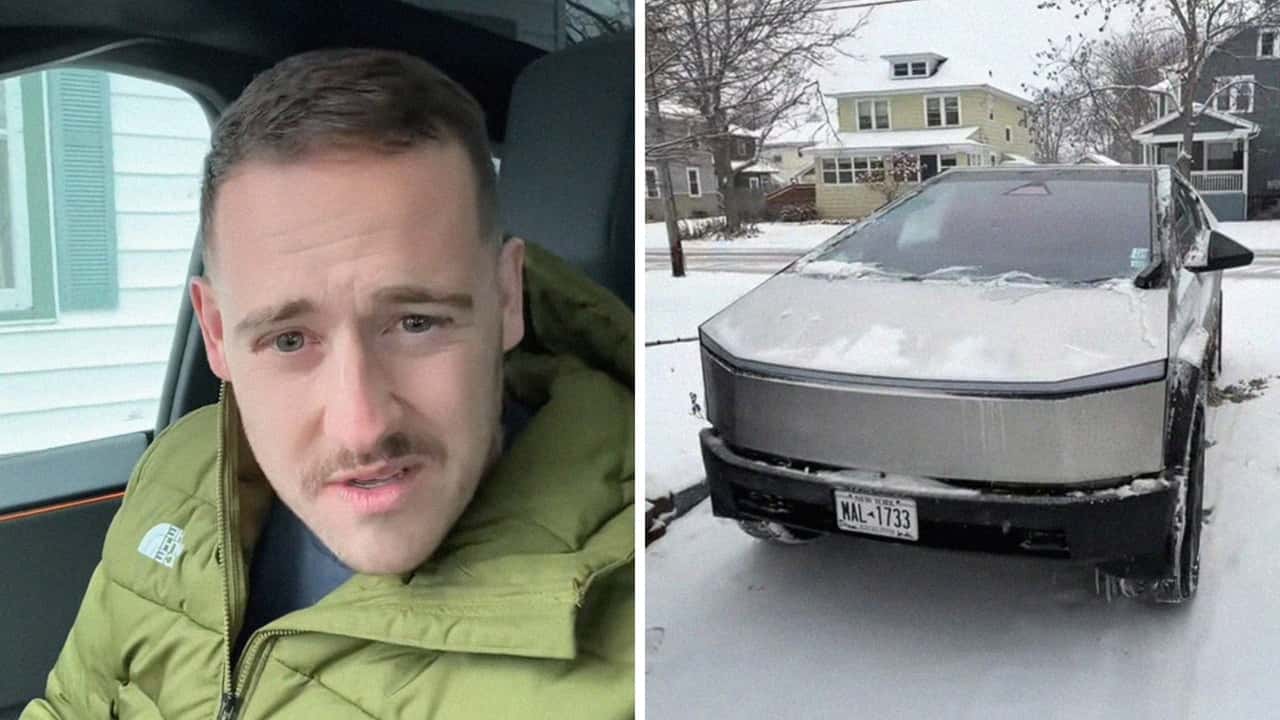

The cameras were iced over, the roads were blanketed, and visibility was nearly gone, but a Cybertruck owner insists his EV handled the winter storm flawlessly. His TikTok demonstration has ignited a familiar winter debate.
The clip from rabid EV fan Joe Fay (@jf.okay) sees him barreling through some of the worst winter weather New York state can throw at him. His verdict on the duel with Mother Nature? The Cybertruck prevails and keeps him safely on the road while the rest of his town shuts down after a heavy snowfall.
“Nearly every store in town closed down early, but that didn't stop me from going wherever I needed to go because of my electric vehicle,” he said in the clip that’s been viewed more than 13,000 times. “It doesn't slip, it doesn't slide. The traction control is absolutely amazing.”
Fay’s praise-heavy video leans on the Cybertruck’s traction control, bright headlights, and unusually large single windshield wiper, which he says performed without issue despite heavy icing. While his clip is anecdotal, many of the attributes he highlights do align with what engineers say about how EVs behave on snow- and ice-covered roads.
Modern electric powertrains can adjust torque to each wheel far more quickly than gasoline-powered vehicles, which rely on mechanical interventions such as engine power reduction or traction-control pulsing through the brake system. Because electric motors respond in milliseconds, they can correct slipping wheels almost instantly.
EVs also benefit from a low center of gravity thanks to large battery packs mounted beneath the cabin. Federal agencies, including the U.S. Department of Energy, note that this design trait improves stability in slippery conditions, often making EVs more planted than similarly sized internal-combustion vehicles. That doesn’t mean EVs are immune to harsh winter realities, but it does explain why videos like Fay’s resonate with owners who say the vehicles offer confident control even in deep snow.
Range Concerns Loom Large
Not everyone commenting on Fay’s video was impressed. One of the most persistent counterarguments raised on TikTok centered on reduced range in freezing temperatures, a concern often cited by EV skeptics. That effect is real: AAA’s laboratory testing has repeatedly found that cold weather can reduce EV range by 20% to 40%, especially when cabin heating systems are working hard.
FROM THE TRENDING NEWS DESK
Viral bits from across the social media landscape
Our team of experts tracks what's trending so you don't have to—from viral videos to online debates that have everyone talking.
But reduced range isn’t the same as degraded drivability, and that’s where much of the comment-section argument veered into misconceptions. Gasoline vehicles also lose efficiency in winter due to seasonal fuel blends and reduced engine temperatures, a point several commenters highlighted. The U.S. Department of Energy estimates that conventional vehicles can lose up to 15% of their fuel economy with winter gasoline formulations. Fay, for his part, focused exclusively on traction and control rather than battery longevity or loss of usable miles.
The TikTok comment thread quickly morphed into a miniature case study of the broader cultural debate around EV adoption. Supportive viewers chimed in, saying their own Teslas “eat snow for breakfast,” while skeptics pushed back with familiar talking points around battery replacement costs, charging availability, concerns about being stranded in remote areas, and disinterest in EV aesthetics. Arguments broke out over whether EV batteries cost $20,000 to replace despite industry data showing most large-pack replacements fall between $5,000 and $15,000 depending on model and supplier.
Other commenters echoed the fear that getting stranded in the cold with a depleted EV battery leaves drivers with fewer options than gasoline motorists. Roadside charging providers have been expanding in recent years, however, with companies like SparkCharge and nationwide networks such as AAA offering mobile charging services in some markets. Whether such services are equally available in more remote northern regions remains an open question, but their existence counters the narrative that EV drivers have no emergency solutions.
Where The Cybertruck Fits In
Although the Cybertruck is still new enough that comprehensive third-party winter testing remains limited, early user reports mirror what’s visible in Fay’s clip. The truck’s substantial curb weight of over 6,600 pounds in some trims, combined with dual- or tri-motor AWD configurations, gives it significant snow traction, depending on tire choice. Independent engineers who have reviewed Tesla’s traction management systems in earlier models have documented their responsiveness in low-grip environments, and those systems are foundational to the Cybertruck’s platform. Munro & Associates’ ongoing teardown series has suggested that the truck’s motor control architecture is consistent with Tesla’s broader emphasis on stability through rapid torque modulation.
The Cybertruck’s single, oversized wiper has been criticized by reviewers for its unusual design. But in Fay’s snowy clip, that wiper appears to sweep enough of the windshield to maintain usable visibility. Until more structured testing emerges, it remains unclear how the design performs under more extreme icing, but the real-world demonstration offers early evidence that it may be more functional than its reputation.
Fay’s video is just one snowy commute in one corner of New York, but his experience taps into a much larger conversation about how EVs handle winter. Engineering studies, owner data, and performance evaluations from cold-weather countries all point to the same conclusion: While cold temperatures inevitably reduce range, EV traction and stability often equal or exceed those of gas vehicles. Norway, where more than 80% of new vehicles sold are electric, has published extensive documentation showing EVs perform reliably in harsh winter conditions when equipped with appropriate tires.
Still, cultural resistance to EVs remains strong in many parts of North America, especially in regions where extreme cold is seen not as an anomaly but a way of life. Fay’s TikTok doesn’t settle the argument, but it does offer a data point that winter traction and EV winter performance more broadly is more nuanced than social media debates tend to acknowledge.
InsideEVs reached out to Fay via email and direct message. We’ll be sure to update this if they respond.
RECOMMENDED FOR YOU

Tesla Apparently Won't Let Cybertruck Buyers Transfer FSD Without Spending Another $20k
Tesla Starts Testing Steering-Wheel-Free Cybercab On Austin Streets. Can It Match Waymo?
Tesla Is Selling Discounted Used Cybertrucks Now
California's New EV Incentive Is Almost Here—With Special Benefits For Rivian And Lucid
Someone Keeps Stealing Entire Truckloads Of Tesla Batteries
BMW iX5 Blows Away The Competition With 460-kW Charging, 435-Mile Range
An App Flagged This Tesla Battery As Degraded. The Car Said It Was Worse