
The EU Is Spending Big To Install Thousands More DC Fast Chargers
Over 500 stalls capable of delivering 1 megawatt of power are on the list of projects funded by the European Commission.
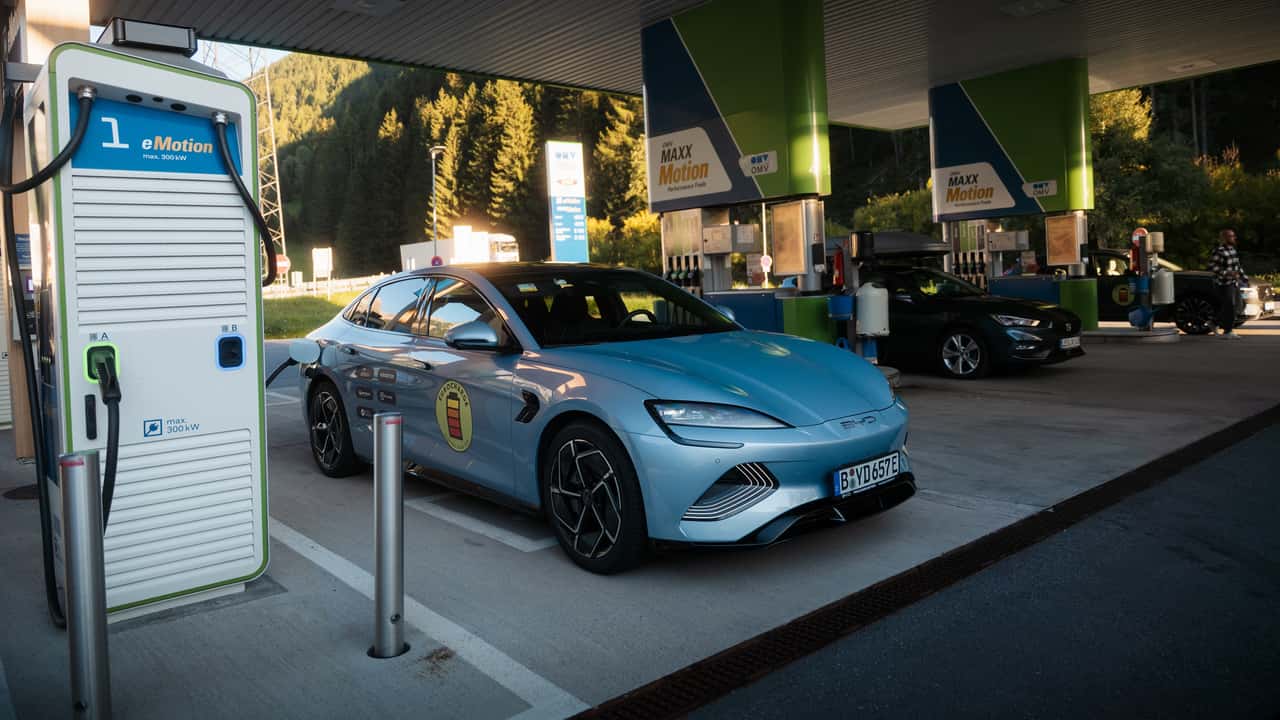

- The European Commission is spending nearly $700 million to boost the EU’s charging infrastructure.
- No fewer than 70 projects will be funded with money from the European Union, including over 500 charging points capable of delivering 1 megawatt of power.
- Over 3,500 DC fast chargers will be installed thanks to EU grants. Hydrogen fueling stations are also on the list.
As we learned earlier this year, going on a multi-country road trip in an electric car in Europe is a breeze. There are plenty of DC fast chargers on major transport routes, and charging along the way doesn’t cost an arm and a leg.
But there’s still work to do. Despite having over 80,000 DC fast chargers spread across its member countries, the European Union is spending hundreds of millions of dollars to help expand the EV charging infrastructure even further.

A Hyundai Inster charging at an OMV DC fast charger
The European Commission’s latest grant session just ended, awarding nearly $700 million (€600 million) to 70 projects that aim to electrify and decarbonize the bloc’s road, maritime, inland waterway and air transport infrastructure along the so-called trans-European transport network (TEN-T).
The bulk of the incentives will go toward installing thousands more DC fast chargers. More precisely, over 1,000 stalls capable of delivering 150 kilowatts of power to light-duty vehicles, over 2,000 dispensers that can deliver 350 kW, and an additional 586 chargers rated at 1 megawatt (1,000 kW) for heavy-duty vehicles.

The chargers will be installed on major transport corridors across 24 EU countries, with the largest single grant going to a French company called Voltix, which plans to install a total of 288 MW of charging capacity for heavy commercial vehicles at 45 locations across several countries.
In addition to expanding EV charging infrastructure, the European Commission’s latest incentive round will provide grants for 16 airports that want to electrify their ground handling services. Hydrogen fueling infrastructure will also get a boost, with 38 hydrogen refueling stations for cars, trucks and buses set to be built with money from the EU. Lastly, 24 seaports will receive funds to electrify port services, install Onshore Power Supply (OPS) stations, and build ammonia bunkering facilities to fuel maritime vessels.
The projects selected for funding were selected under the second cut-off of the 2024-2025 Alternative Fuels Infrastructure Facility (AFIF) call, which closed on June 11, 2025. Since 2021, AFIF has allocated over $2.5 billion in EU grants for alternative fuels projects.
More Stories Like This
RECOMMENDED FOR YOU
This Supercharger Extension Cable Promises To Fix A Big Pain Point, But Falls Short: Expert
BMW Is Working On A Cheaper Neue Klasse EV
Absurdly Fast EV Chargers Are Coming To America, But Cars Aren't Ready
Tesla’s Model Y Price Bump Makes The Ioniq 5 And Mustang Mach-E Look Better Than Ever
BMW And Mini EV Drivers Get A Sweet Discount At Ionna
GM’s Secret Trick To Make The Chevy Bolt EV Cheaper: Build Them 30 At A Time
Lexus Just Solved One Of Its Biggest EV Headaches