
Woman Takes a Road Trip In Her Tesla. Then She Has To Stop 5 Times Between Minneapolis and Chicago For a Charge
Here's what this road-tripper could've done better.
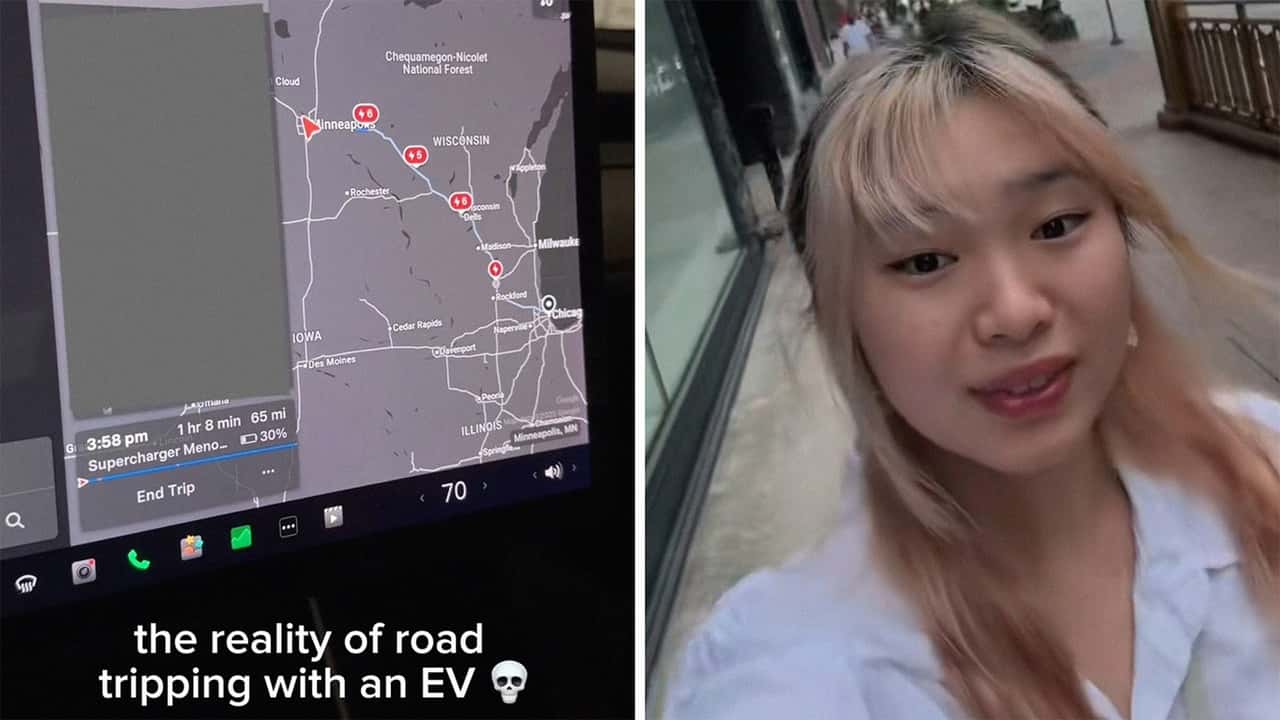

A Tesla driver shared what road tripping in an EV entails: A lot of charging stops. At least, if you did it the way she did, and there are ways to avoid the same pitfalls.
Social media user Meryl (@maybe.meryl) recorded snippets of her journey in a clip that she posted on the widely used social media app. Although she clearly shows she needed to charge up five separate times on her journey, several people replied that she should’ve been able to complete her travel itinerary sooner.
Meryl begins her video seated inside of a Tesla. Her camera’s lens is directed at the large infotainment screen that’s become synonymous with the electric-vehicle maker. A large map indicates that she’s beginning her journey in Minneapolis, and she has one hour and eight minutes to go before she hits her first Tesla Supercharger.
The route indicates that after this first charge, she needs to make at least three more stops before she reaches her Chicago destination.
Tesla Road Trip Charging
From the get-go, she intimates that this long drive isn’t going to be a pleasant one. “The reality of road tripping in an EV,” she pens, capping off her commentary with a skull emoji. After this initial shot, she records herself driving on a highway in her Tesla. Afterward, she records herself plugging a Tesla Supercharger plug into her charging port.
Then, her video transitions to her on the highway again, traveling at 74 mph. The next Supercharger spot she arrives at is her third. An on-screen caption reveals that she “forgot to record no. 2” as she pulls up to the charging stations. Several of them are open with a white Model 3 seen charging at one of the stalls. Additionally, there seems to be a Volvo C40 utilizing a Tesla charging stall as well.
Volvo joins a long list of EV manufacturers that can benefit from Tesla’s massive Supercharger network, which means that folks who need to top off in a jiffy have more options than ever available to them. That is, as long as folks have the necessary adapter on hand to use Tesla’s charger network.
Even More Supercharger Stops
Meryl records herself juicing up yet again before she’s back on the road, this time at a speedier 80 miles per hour. The sun has gotten visibly lower at this point in her journey. And as she arrives at her fourth supercharger, the amber glow of dusk hangs in the clouds. At the Supercharger station closest to her destination, there’s only a single vehicle juicing up, which looks like a Rivian. Again, Meryl plugs in her car and when she’s driving again, night still hasn’t set.
FROM THE TRENDING NEWS DESK
Viral bits from across the social media landscape
Our team of experts tracks what's trending so you don't have to—from viral videos to online debates that have everyone talking.
But it seems that she’s still not done charging her car, either. Because she has to juice up her Tesla yet again, plugging it in for the fifth time on her journey. At the end of her video, she records herself finally making it to Chicago. A text overlay in her clip reveals the total amount of time it took her to get there in an EV. “Made it from MN to Chicago in 7 hours,” she writes. Meryl punctuates her feelings about the total travel time with a crying emoji as her clip comes to an end.
Furthermore, a caption for her clip speaks to a problem many EV owners have opined about with regards to range estimate inaccuracies. She wrote: “I had to stop every 70 miles, I swear.”
For comparison, Google Maps projects that folks driving in a traditional, internal combustion engine vehicle from Minneapolis to Chicago, while maintaining the legal speed limit should make the 408-mile trip in 5 hours and 52 minutes.
So is she correct here? There are habits to employ in your next EV road-trip to avoid this conundrum.
Commenters Sound Off
One user who replied to Meryl’s video criticized her approach to charging her vehicle.
They said that since she began her journey with a 30% charge on her EV, she was already beginning her trip with a mostly depleted battery. Furthermore, they also critiqued her for driving faster than the speed limit, which will decrease a battery’s charge more quickly than it would at slower speeds.
Despite seeing her clip, which features multiple charging stops, they speculated that she would’ve had to have only stopped once during her journey.
“Started at 30% battery. Didn't charge to 80% at any one stop. ~400 miles, you should have only had to stop once for a charge. Also, isn't the top speed between Minneapolis and Chicago [is] 70, not 85,” they said.
However, Meryl, having made the drive herself, countered their points. First, she explained that she was “speeding up to pass” another car in the snippet that she shared. Additionally, she stated that despite charging her battery to 80%, her Tesla’s navigation application indicated that she’d have a significantly lowered charge after 130 miles of driving. In fact, it’d be in the negative. “I tried mapping directly when there were only 130 [miles] left and it said I would arrive with -23% from 80%.”
EV Road Trips
While there are plenty of EVs that have managed to travel impressive distances on a single charge, many consumer vehicles fall short of their EPA range estimates. Teslas aren’t excluded from this criticism, either.
The discrepancy between real-world and actual range has left some Tesla buyers questioning the travel capacity of their cars, like a Tesla Motors Club driver who saw their maximum Model Y range, even at full capacity, was less than its quoted 303 mile mark. One user attributed the shortcoming to battery degradation. However, there are other Tesla owners who had such mitigated range that they thought their cars were defective. As Ars Technica writes: “Tesla exaggerated EV range so much that drivers thought cars were broken.”
This isn’t the case for all electric vehicles, however. InsideEVs compiled a list of fully-electric cars assessed by Consumer Reports that actually performed better than their quoted EPA estimates. The BMW iX managed to eke out 61 more miles of driving past its 309 quoted range. The Mercedes-Benz EQS 580 sedan managed to travel 380 miles on just a single charge. Other offerings from BMW, the i4 and i5 also went further than their quoted EPA ranges. And the Hyundai Ioniq N was able to travel 15 miles longer than its advertised range.
Ultimately, an EV road trip depends on good driving habits—including slowing down when appropriate—planning ahead using apps like PlugShare or the car's onboard route-planner system, and a bit more patience. But more and more, this kind of experience is an outlier rather than the norm.
InsideEVs has reached out to Meryl via email for further comment.

RECOMMENDED FOR YOU

Tesla’s Model Y Price Bump Makes The Ioniq 5 And Mustang Mach-E Look Better Than Ever
Mercedes-Benz's Most Advanced EV Yet Has A New Kind Of Motor And 600 kW Charging
This Supercharger Extension Cable Promises To Fix A Big Pain Point, But Falls Short: Expert
The Skoda Epiq Is Europe’s Big Small Electric SUV
Absurdly Fast EV Chargers Are Coming To America, But Cars Aren't Ready
ChargePoint Wants To Fix The Condo EV Charging Problem With 2,500 New Ports
Tesla Is Now Testing A Virtual Waitlist For Superchargers