Home
Volkswagen
ID. Buzz
News
Volkswagen ID. Buzz Matched ID.3/ID.4 In Bjørn's 1,000 km Challenge
The van happens to be quite efficient and offers really strong fast charging performance.
30:29
Mark Kane 
By: Mark Kane
Oct 25, 2022 at 8:22am ET
Add InsideEVs as a preferred source in Google
- (https://twitter.com/intent/tweet?url=https%3A%2F%2Finsideevs.com%2Fnews%2F617920%2Fvolkswagen-id-buzz-1000km-challenge%2F&text=Volkswagen%20ID.%20Buzz%20Matched%20ID.3%2FID.4%20In%20Bj%C3%B8rn%27s%201%2C000%20km%20Challenge&via=InsideEVs)
- copy
Share
Comment
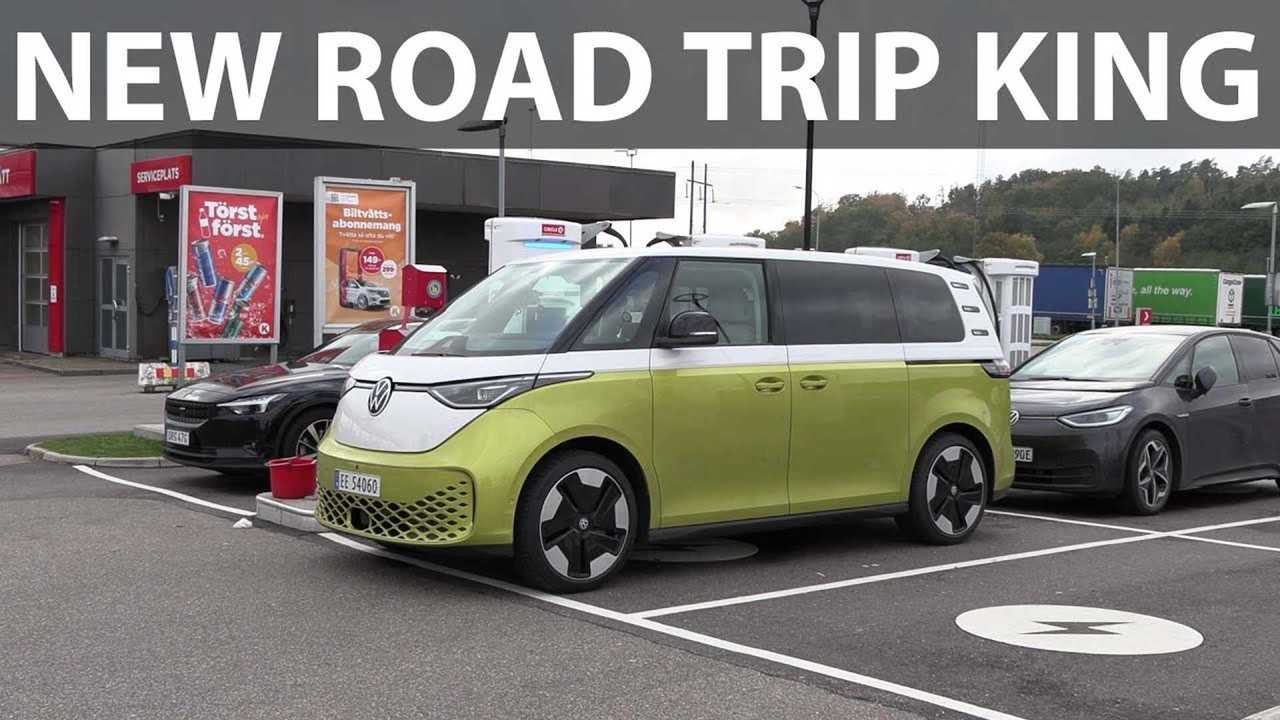
The rear-wheel-drive Volkswagen ID. Buzz, equipped with an 82 kWh battery, achieved a pretty good result in Bjørn Nyland's 1,000 km challenge.
It's not a surprise actually, as the earlier range test already indicated relatively high efficiency (for a van), good range, and very good fast charging capabilities (over 180 kW peak).
The Volkswagen ID. Buzz (RWD, 82 kWh) was able to complete the distance of 1,000 km (over 621 miles), at an average temperature of 12°C, in 10 hours and 30 minutes (after some time deductions).
The first thought is that it's a very similar result to the Volkswagen ID.3, Volkswagen ID.4 and (Skoda Enyaq iV) models, equipped with an 82 kWh battery. The difference is ±10 minutes. Let's note that the ID. Buzz has lithium-ion cells from a different supplier than other MEB-based EVs (which initially caused some issues).
During the test, the car was charged a total of six times along the way (5-6 is a typical number of stops for the challenge). After the initial 208 km (129 miles), the average distance between charging stops was 132 km (82 miles).
The 1,000 km challenge is a unique test (optimized for time rather than convenience), which expands our empirical knowledge about EVs and gives us glimpses of what is physically possible by an experienced driver in a country with dense DC fast charging infrastructure.
The average energy consumption of the Volkswagen ID. Buzz amounted to 299 Wh/km (481 Wh/mile), which is almost identical to the Audi e-tron 55 SUV. Not very efficient, but efficient enough for a van.
The key characteristic of the ID. Buzz during the test was its fast charging capabilities - above 180 kW at peak, and pretty high power even at high state-of-charge (SOC). Let's recall that according to the specs, the van can recharge from 5 to 80% SOC in 30 minutes (as long as an ultra-fast charging stations is available).

What do you think?
View
Comments
Test conditions (according to Bjørn Nyland):
- Start: 100% State of Charge (SOC)
- Temperatures: 9-14°C (12°C on average)
- Total time: 10 hours and 30 minutes
- Average speed (total): 95.2 km/h (59 mph)
- Average energy consumption: 299 Wh/km (481 Wh/mile)
- Number of stops for charging: 6
- Average distance between charging stops:
Total: 143 km (89 miles)
Excluding the initial segment: 132 km (82 miles) - Date / Notes: 15.10.2022
Charging stops:
- after 208 km (129 miles)
- after 360 km (224 miles)
- after 508 km (316 miles)
- after 658 km (409 miles)
- after 765 km (475 miles)
- after 882 km (548 miles)
See also
 US: Volkswagen ID.4 Hit New Sales Record In Q3 2022
Volkswagen Group Global BEV Sales In Q3 2022: 149,300 (Up 22%)
We want your opinion!
What would you like to see on Insideevs.com?
Take our 3 minute survey.
- The InsideEVs team
Share this Story
- (https://twitter.com/intent/tweet?url=https%3A%2F%2Finsideevs.com%2Fnews%2F617920%2Fvolkswagen-id-buzz-1000km-challenge%2F&text=Volkswagen%20ID.%20Buzz%20Matched%20ID.3%2FID.4%20In%20Bj%C3%B8rn%27s%201%2C000%20km%20Challenge&via=InsideEVs)
- copy
GO TO COMMENTS
(
)
Got a tip for us? Email: tips@insideevs.com
View all comments ( )
Trending
‘We’re Moving Really Fast’: Ionna CEO On 500 kW EV Chargers And Flagship New Location
Every EV Motor Type Explained: They Aren't All The Same
I Tried Mercedes' Answer To Tesla FSD. Here's How It Went
Tesla Model 3 Maintenance Guide: What Needs Servicing And What Doesn't
Latest Stories
- Ford Just Started Fathom LFP Battery Production In Michigan. It's A Big Deal Nov 18 - Battery Tech -
- This GM EV1 Lives After A Painstaking Restoration Nov 18 - News -
- ‘We’re Moving Really Fast’: Ionna CEO On 500 kW EV Chargers And Flagship New Location Nov 18 - Charging -
- BMW's First U.S.-Made EV Is Now Rolling Off The Assembly Line Nov 18 - Manufacturing / Production -
- EV Owners Aren’t Worried About Their Batteries. They’re Worried About Myths Nov 18 - News -
- The Polestar 4 Is Getting Vehicle-To-Load, But The U.S. And Canada Are Left Out Nov 18 - Software -
- Waymo Pulls Its Robotaxis Off All U.S. Highways After California Ban Nov 18 - Autonomous Vehicles -
RECOMMENDED FOR YOU
The VW ID. Buzz Is Getting A New Job As A Robotaxi
Rivian Is Inviting Owners To Beta Test Its New Point-To-Point Assisted Driving Tech
The Best EV Lease And Finance Deals In November 2026
REO Runabout vs. Slate Truck: Which Sub-$30,000 Truck Is Better?
Gas Prices Got You Down? This 261-MPG Volkswagen Solves That—For $140,000
Chevy, GMC, and Cadillac EV Owners Can Now Plug And Charge At Electrify America
VW And Skoda EV Owners Have Waited Years For Battery Preconditioning. It's Finally Coming