Home
Audi
News
Audi To Install 4,500 Charging Points At Its Own Sites By Mid-2022
Audi will invest €100 million ($111 million) in more than 4,500 work charging points.

Mark Kane 
By: Mark Kane
Jan 17, 2020 at 2:28pm ET
Add InsideEVs as a preferred source in Google
- (https://twitter.com/intent/tweet?url=https%3A%2F%2Finsideevs.com%2Fnews%2F393503%2Faudi-charging-points-own-sites%2F&text=Audi%20To%20Install%204%2C500%20Charging%20Points%20At%20Its%20Own%20Sites%20By%20Mid-2022&via=InsideEVs)
- copy
Share
Comment
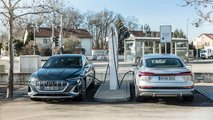
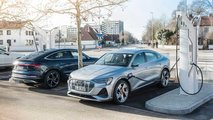
Audi just announced that through an investment of €100 million ($111 million) will install more than 4,500 charging points at its German plants by mid-2022.
It basically means one in ten parking spaces on average, and most of them will be available to the public as well.
"This independent concept is the largest charging infrastructure project carried out by a German employer. The investment provides Audi with a head start in terms of setup and operation expertise for the hardware and software of such charging concepts while also allowing the company to pilot a new business area of mobility."
"A charging concept on this scale is unique in Germany so far – and requires meticulous preparation and largely independent energy management. A separate project team has therefore been preparing and structuring the concept for the implementation since the middle of 2017. The fundamental decision to electrify ten percent of all parking spaces was already made a year earlier."
That's a pretty big work charging project, which will surely support Audi's electrification plan.
See also
 IONITY Announces A kWh-Based Charger Pricing Plan
Audi e-Tron Cannonball Run Attempt: Range & Fast-Charging Tested
Watch How Volkswagen’s Mobile Charging Robot Recharges EVs: Video
Some 3,500 charging points will be installed at the main plant in Ingolstadt, another 1,000 in Neckarsulm and under 100 in Brussels (Belgium) and Győr (Hungary). Charging points are coming also to San José Chiapa in Mexico.
Most of the charging points (4,500) will be up to 22 kW (three-phase), while 110 will be DC chargers (50-350 kW). Already 600 AC and 60 DC points are online.
What do you think?
View
Comments
"At the sites in Brussels, Ingolstadt, and Neckarsulm, charging infrastructure with a total power input of 21 megawatts is already available. This corresponds to the power consumption of a small town with 14,000 inhabitants. This includes 600 charging points with an output of up to 22 kilowatts (kW) and 60 direct current charging points with an output between 50 and 350 kW. By the middle of 2022, there will be 4,500 charging points, each with an output of up to 22 kW, and approx. 50 more with an output of up to 350 kW each at the plant sites alone. A dynamic and intelligent load-management system will be controlling all power input across sites this year already, so the power connection does not need be expanded."
The average cost (including 110 DC fast chargers) will be below €22,000 per charging point.
Gallery: Audi charging infrastructure
4

We want your opinion!
What would you like to see on Insideevs.com?
Take our 3 minute survey.
- The InsideEVs team
Share this Story
- (https://twitter.com/intent/tweet?url=https%3A%2F%2Finsideevs.com%2Fnews%2F393503%2Faudi-charging-points-own-sites%2F&text=Audi%20To%20Install%204%2C500%20Charging%20Points%20At%20Its%20Own%20Sites%20By%20Mid-2022&via=InsideEVs)
- copy
GO TO COMMENTS
(
)
Got a tip for us? Email: tips@insideevs.com
Hide press release Show press release
Audi invests around EUR 100 million in charging infrastructure at own sites
- Audi will electrify one in ten parking spaces at German plants by mid-2022
- Charging initiative will also be available to the public in large part
- Charging infrastructure and management are piloting a new business area
On its journey to becoming a provider of entirely CO2-neutral premium mobility, Audi is making excellent progress at its own sites. By the middle of 2022, the premium brand will equip one in ten parking spaces with a possibility to charge electric cars, most of which will be accessible to the public. This independent concept is the largest charging infrastructure project carried out by a German employer. The investment provides Audi with a head start in terms of setup and operation expertise for the hardware and software of such charging concepts while also allowing the company to pilot a new business area of mobility.
Audi is setting up more than 4,500 charging points for battery-operated vehicles, thereby contributing to the energy transition in private transport. “Establishing such extensive charging infrastructure is a completely new challenge,” Maximilian Huber describes his task. The project manager for site charging is not only in charge of building the charging points but also the energy manager and software provider for the comprehensive charging solution at the automotive manufacturer’s sites. At the main plant in Ingolstadt alone, there will be 3,500 charging points available in the final development. There will be 1,000 charging points in Neckarsulm, just under 100 in Brussels and Győr. Likewise, charging infrastructure will be built at the factory in San José Chiapa. The company already offers expansive charging capacities at the training centers at Munich Airport. The entire project has a total budget of up to EUR 100 million.
A charging concept on this scale is unique in Germany so far – and requires meticulous preparation and largely independent energy management. A separate project team has therefore been preparing and structuring the concept for the implementation since the middle of 2017. The fundamental decision to electrify ten percent of all parking spaces was already made a year earlier. “Such lead times are necessary because the planning and expansion of the energy supply on this scale alone takes multiple years,” explains Huber. Carrying out the setup during ongoing production at the locations is a particular challenge.
The project team is responsible for planning the entire strategy, investment, and concept, and manages the setup and operation of the charging infrastructure as well as the billing of charging procedures at the Audi sites. In this context, the charging points are expanded to suit the needs of the employees and other people using the parking lot, the charging infrastructure is designed accordingly, operating rules are set, and a hotline and support are provided. Recording that complies with calibration law and invoicing of the charging procedures are further important aspects.
At the sites in Brussels, Ingolstadt, and Neckarsulm, charging infrastructure with a total power input of 21 megawatts is already available. This corresponds to the power consumption of a small town with 14,000 inhabitants. This includes 600 charging points with an output of up to 22 kilowatts (kW) and 60 direct current charging points with an output between 50 and 350 kW. By the middle of 2022, there will be 4,500 charging points, each with an output of up to 22 kW, and approx. 50 more with an output of up to 350 kW each at the plant sites alone. A dynamic and intelligent load-management system will be controlling all power input across sites this year already, so the power connection does not need be expanded.
In addition, there is the equipment of the three Audi Training Center locations at Munich airport. Audi’s largest individual charging park with a power input of 2.1 megawatts is connected to the grid here. In connection with the construction of the new ATC IV building, the solar power generated is used for the charging procedure in combination with a battery buffer storage device. “It’s not just about energy supply, though,” says Huber. The project team has also created its own navigation map on the basis of Google Maps that allows employees to see in real time where charging terminals are available. Invoicing via online systems and the integration in an internal settlement system are further important services.
In the medium term, it is being checked how to make the acquired expertise available to other companies that need to expand their charging infrastructure. This is the next step on the company’s journey from a pure automotive manufacturer to a mobility service provider. Audi has set itself the goal to become the leading CO2-neutral premium provider. By 2050 at the latest, the company’s operations are to be entirely CO2-neutral.
View all comments ( )
Trending
I Drove Volvo’s Long-Range Plug-In Hybrid XC60. It’s A Great Stepping Stone To An EV.
I've Driven Dozens Of Chinese Cars. Americans Are Missing Out On These 4 Features
I’m Thankful For My Electric Car
$30,000 Ford Fathom: Inside The Structural LFP Battery That Makes It All Possible
Latest Stories
- Tesla Already Ate Up 90% Of Canada's Chinese EV Import Quota Nov 29 - News -
- $30,000 Ford Fathom: Inside The Structural LFP Battery That Makes It All Possible Nov 28 - Battery Tech -
- I've Driven Dozens Of Chinese Cars. Americans Are Missing Out On These 4 Features Nov 28 - China -
- EVs Outsold Gas And Diesel Cars Combined In The EU In October Nov 27 - News -
- This Audi E-Tron EV Has 125,000 Miles. Replacing Its Battery Was A Huge Pain Nov 27 - Repair / Maintenance -
- Rivian's Winter Sale Is Live: Save on Chargers, Accessories, And More Nov 27 - Pricing -
- I Drove Volvo’s Long-Range Plug-In Hybrid XC60. It’s A Great Stepping Stone To An EV. Nov 27 - First Drives -
RECOMMENDED FOR YOU
This Audi E-Tron EV Has 125,000 Miles. Replacing Its Battery Was A Huge Pain
Tesla Already Ate Up 90% Of Canada's Chinese EV Import Quota
Audi Wants To Make Buttons That Deploy From Behind The Touch Screen
$30,000 Ford Fathom: Inside The Structural LFP Battery That Makes It All Possible
Winter Weather Hits EV Range Hard. One Automaker Handles It Better Than Tesla
I've Driven Dozens Of Chinese Cars. Americans Are Missing Out On These 4 Features
The Best EV Lease And Finance Deals In November 2026