Home
Tesla
News
The Reason Tesla Spent $218 Million On Maxwell Technologies

EVANNEX 
By: EVANNEX
Feb 16, 2019 at 9:45am ET
Add InsideEVs as a preferred source in Google
- (https://twitter.com/intent/tweet?url=https%3A%2F%2Finsideevs.com%2Fnews%2F342863%2Fthe-reason-tesla-spent-218-million-on-maxwell-technologies%2F&text=The%20Reason%20Tesla%20Spent%20%24218%20Million%20On%20Maxwell%20Technologies&via=InsideEVs)
- copy
Share
Comment
WHY DID TESLA ACQUIRE MAXWELL TECHNOLOGIES?
Tesla’s acquisition of battery supplier Maxwell Technologies went mostly unnoticed by the mainstream press, but it could have a tremendous influence on the future of the California carmaker, and of the entire auto industry.
Check Out These Stories:
 Tesla Buying Maxwell, Could Signal Move To Solid State Battery
OXIS Energy Lithium-Sulfur Batteries To Be Produced In Brazil
*This article comes to us courtesy of EVANNEX (which also makes aftermarket Tesla accessories). Authored by Charles Morris. The opinions expressed in these articles are not necessarily our own at InsideEVs.

Above: A sampling of batteries from Maxwell Technologies (Image: Maxwell Technologies)
Maxwell, which was founded in 1965 as a government contractor, is based in San Diego and has about 380 employees. The company has gotten a lot of coverage in the EV press, mainly because of its innovations in the realm of ultracapacitors. The astute will recall that Elon Musk was planning to study ultracapacitors when he arrived at Stanford in the 1990s.
However, Electrek’s Fred Lambert surmises that Tesla’s acquisition of Maxwell may have little to do with ultracapacitors, and much to do with “dry electrodes,” which the company calls “a breakthrough technology that can be applied to the manufacturing of batteries.”
Maxwell claims to have demonstrated that its proprietary electrode can enable an energy density of over 300 Wh/kg, and predicts that it can achieve over 500 Wh/kg. Of course, the energy density of Tesla's batteries is top secret, but it’s widely believed to be the best in the industry. Tesla owner Sean Mitchell, who discusses some of the possible reasons that Tesla bought Maxwell in a recent video, estimates that the energy density Maxwell is talking about would represent an improvement of between 15 and 50 percent compared to Tesla’s current batteries.
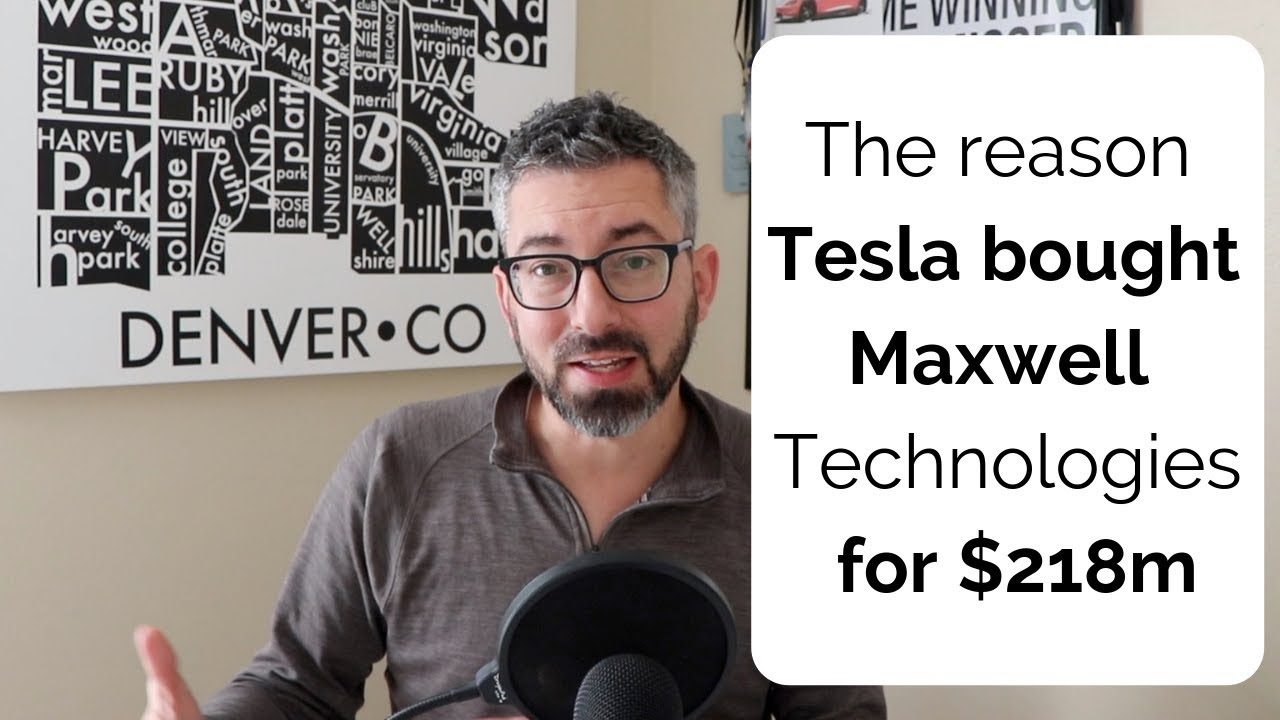
Above: Sean Mitchell discusses the possible rationale for Tesla's most recent acquisition (Youtube: Sean Mitchell)
This would be a huge step forward, enabling longer range and/or smaller battery packs, but other benefits could be even more important. Maxwell says its technology can simplify the manufacturing process and result in a “10 to 20% cost reduction versus state-of-the-art wet electrodes,” while also “extending battery life up to a factor of two.”
A cost reduction of anything like this magnitude would be a huge step forward, possibly enabling Tesla to make the Semi economically viable, and to start delivering the long-awaited $35,000-dollar Model 3.
Of course, companies regularly announce advances in battery tech, but Elon Musk and JB Straubel have repeatedly said that, while they keep a close eye on new developments, they haven’t yet seen a cell that’s proven to be better than those produced by Tesla and partner Panasonic. In mid-2018, Straubel said (as reported by Electrek), “We try to talk with every single battery startup, every lab, every large manufacturer. We get quotes from them. We test cells from them. If there’s anything better, we are all ears, we want to find it, but we haven’t found it yet.”

Above: Tesla's lithium-ion cells (Image: Charged)
The fact that Tesla is willing to pony up around $218 million for Maxwell indicates that it has finally found a firm that can deliver the goods.
===
What do you think?
View
Comments
Written by: Charles Morris; A version of this article originally appeared in Charged; Sources: Maxwell Technologies, Electrek, Sean Mitchell
*Editor’s Note: EVANNEX, which also sells aftermarket gear for Teslas, has kindly allowed us to share some of its content with our readers, free of charge. Our thanks go out to EVANNEX. Check out the site here.
Source: Evannex
We want your opinion!
What would you like to see on Insideevs.com?
Take our 3 minute survey.
- The InsideEVs team
Share this Story
- (https://twitter.com/intent/tweet?url=https%3A%2F%2Finsideevs.com%2Fnews%2F342863%2Fthe-reason-tesla-spent-218-million-on-maxwell-technologies%2F&text=The%20Reason%20Tesla%20Spent%20%24218%20Million%20On%20Maxwell%20Technologies&via=InsideEVs)
- copy
GO TO COMMENTS
(
)
Got a tip for us? Email: tips@insideevs.com
View all comments ( )
Trending
GM's Next-Generation EV Platform Has 30% Less Wiring And 20% Less Battery
Can The BMW iX3 Take Down The Tesla Model Y L And Rivian R2?
GM's OnStar AI Assistant Debuts In The Cadillac Lyriq
Electrify America’s Largest EV Charging Station Is Missing One Big Thing
latest articles
- GM Is Adding Its Own Version Of Tesla's Sentry Mode To Cars Oct 21 - News -
- Rivian Was The Second Best-Selling EV Brand In Q3 2026, But Still Far Behind Tesla Oct 21 - News -
- GM's Next-Generation EV Platform Has 30% Less Wiring And 20% Less Battery Oct 21 - News -
- General Motors Isn't 'Walking Away' From EVs: Exec Oct 21 - News -
- GM's OnStar AI Assistant Debuts In The 2027 Cadillac Lyriq Oct 21 - Software -
- Google Maps Is Getting Gemini AI In CarPlay Oct 21 - Software -
- The Best Affordable Electric Cars In 2026: Cheap, Reliable Options For Everyone Oct 21 - Buying Advice -
RECOMMENDED FOR YOU
The Best Affordable Electric Cars In 2026: Cheap, Reliable Options For Everyone
Google Maps Is Getting Gemini AI In CarPlay
The Boring Company Uses Tesla Model 3 Sleds To Shuttle Shipping Containers Through Its Tunnels
Electrify America’s Largest EV Charging Station Is Missing One Big Thing
Used EVs Hit A Record Share Of Overall Used Car Sales In September
Can The BMW iX3 Take Down The Tesla Model Y L And Rivian R2?
The Roadster Will Have Tesla’s Most Advanced Battery Pack Yet