
Faraday Future Faces Foggy Future: Executives Fleeing, Bills Unpaid, Only 60 Paid Reservations
The supposed "Tesla Killer", Faraday Future, has tallied a whopping 60 paid reservations, to the Tesla Model 3's record-breaking 400,000. Even with the "reported" 64,000 unpaid reservations, killing Tesla seems a bit far-fetched, especially when considering the plethora of struggles that the startup is facing.
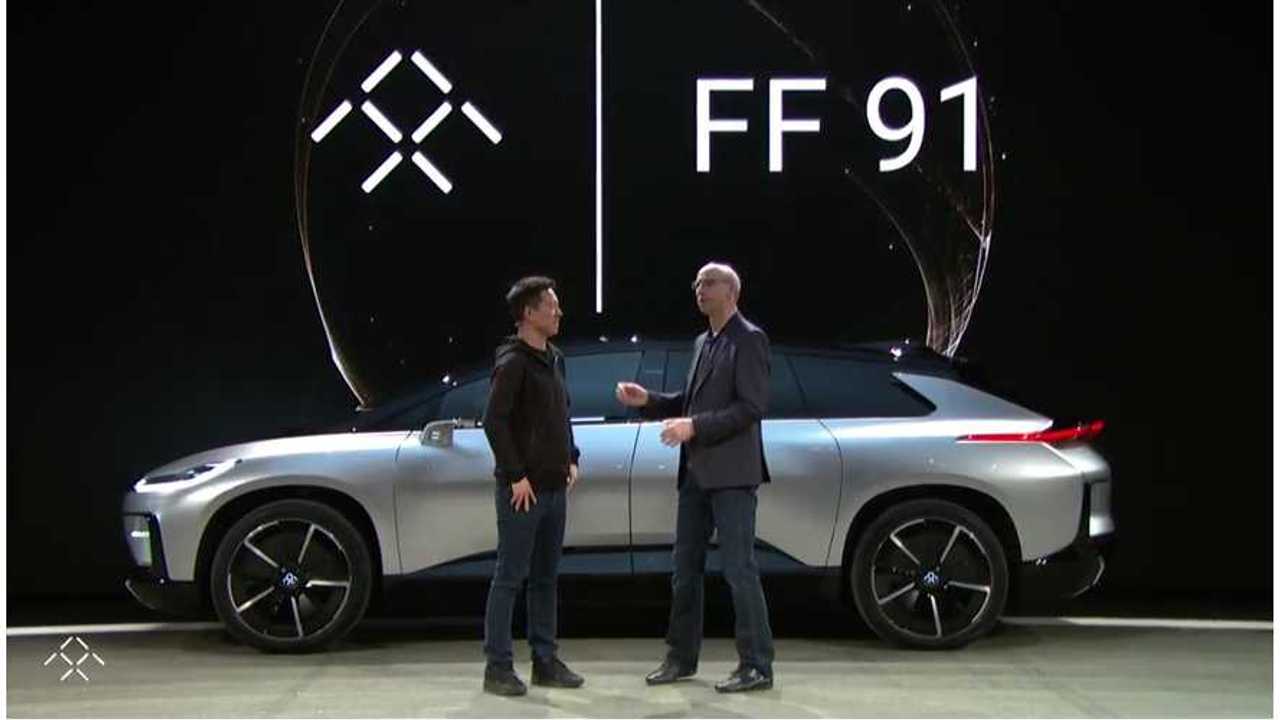


The supposed "Tesla Killer", Faraday Future, has tallied a whopping 60 paid reservations, for its FF91, to the Tesla Model 3's record-breaking 400,000. Even with the "claims" of 64,000 (unpaid) reservations, killing Tesla seems a bit far-fetched, especially when considering the plethora of struggles the startup is facing. Actually, amounting to anything at this point, seems far-fetched.
Global CEO Ding Lei left the company awhile back, and since then, more than a half-dozen other top brass have bailed out. Lei quit Faraday prior to the unveiling of the FFZERO1 last January in Las Vegas. Apparently, he didn't want his name attached as the company went public.
The company doesn't have a CEO now, and hasn't ever really had one. Reportedly, there have been two unofficial CEOs: Chaoying Deng who left the position in October of 2015, and David Wisnieski, who left sometime in 2016. Lei, along with Jia Yeuting, have been the two named "faces" for the company. Lei is a top executive at LeEco, Faraday's sister company. Jia comes and goes, and only has power over the company due to being its only named investor. Recent reports say that he is very unpopular in Beijing at the moment.
Sources familiar with the matter told Business Insider (BI) that the company's corporate structure is a disaster. Especially in terms of relations between the U.S. team and Beijing:
"The US management team really had no say and had to do what wanted because he was paying for everything."
"There were times that the Beijing team would come out and learn what we were doing but were working on their own designs and then they would go back."
As we recently reported, Faraday has run out of money. There was talk of some contributions to alleviate some of the issues, but there has been no word as to whether or not those have come through. Even if so, the small amount of income was barely enough to make a dent. Work has been put on hold on the company's Nevada factory. A source that spoke with BI admitted:
"If CES doesn’t bring in fresh investors, it’s over between February and May."
Another source at Faraday said that Jia was told to keep spending money and pushing, even though the factory construction essentially stopped before it started, and Faraday was being sued by at least two companies, for unpaid bills. The company was being told that the money would come eventually. At that point, about $10 to $15 million per month was coming in. This was only a fraction of what Faraday needed:
"There was no visibility about when the money would arrive — we were told to continue making commitments to suppliers."
"If they can’t figure out a way to get the money out of China in the next 60 days, the suppliers would essentially force them into bankruptcy."
Though the company unveiled the FF91 a few weeks back, there were many unanswered questions. The car failed to park itself. Sources inside the company told BI that the car isn't even close to being production ready. However, Faraday is touting a production date of 2018. The inside source said of the unveiling:
"All that stuff at CES was just a bunch of bulls---, (the car) isn't even close to being complete."
And the story goes on and on and on ...
Source: Business Insider
RECOMMENDED FOR YOU
Faraday Future Cleared By SEC After Years-Long Investigation
Can Tesla FSD Take You Up The Steepest Dirt Road In America All By Itself?
Faraday Future's Latest Plan: Sell This China-Style ‘AI EV' Van To Celebrities
I Went To Toyota’s Employee Electrification Training. Here’s What Surprised Me
Faraday Future Wants You To Buy This $20,000 EV Over A Toyota RAV4
Waymo Is Headed To Germany
Faraday Future Sold Fewer Than 20 Cars In Two Years