
EVs Lose Range In Cold And Hot Weather. But How Much?
Despite losing range in cold weather, EVs are still cheaper to run than hybrids, according to a new AAA study.


- A new AAA study shows how much extreme temperatures affect the efficiency of EVs and hybrids.
- Six cars were tested on a dynamometer at different temperatures.
- EVs take a bigger range hit at low temperatures, but they’re still cheaper to run than hybrids.
Everybody knows that electric cars take a range hit when temperatures drop. That’s just the way batteries work, and it might convince some people that EVs are not for them, so they start looking for alternatives, like conventional hybrids.
Now, though, there’s a new study from AAA that shows even hybrids take an efficiency hit in extreme temperatures, and proves that EVs are still cheaper to run, no matter how hot or cold it is outside. This being said, there is one key differentiator that can flip the script in hybrids’ favor.

The pre-facelift Tesla Model Y was among the EVs tested by AAA.
Six models were hooked up to a dynamometer to keep things fair, and a set of baseline values was recorded at an ambient temperature of 72°F (22°C). The cars ran through a series of procedures with the cabin air conditioning system set at 72°F.
On the EV front, the AAA tested a front-wheel-drive 2025 Chevrolet Equinox EV, a rear-wheel-drive 2025 Tesla Model Y, and an all-wheel-drive 2025 Ford Mustang Mach-E. The hybrids were represented by a front-wheel-drive 2025 Toyota Prius, an all-wheel-drive 2026 Honda CR-V, and an all-wheel-drive 2025 Hyundai Tucson.
None of the cars was brand-new—the lowest-mileage car had 3,721 miles on the odometer, while the highest-mileage model had 13,296 miles.
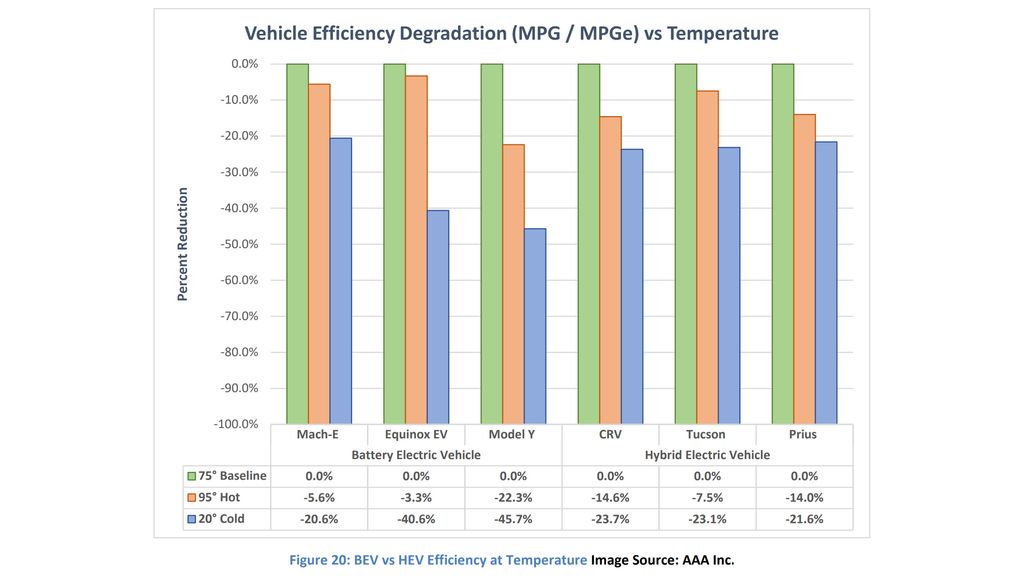
In cold weather, at a constant 20°F (-6.6°C), the average MPGe efficiency drop of the three EVs included in the test was 35.6%, which resulted in an average calculated range loss of 39%. In contrast, the hybrids lost 22.8% in fuel economy. As a side note, the Tesla Model Y RWD Long Range exhibited the biggest difference between the baseline figures and those recorded at 20°F.
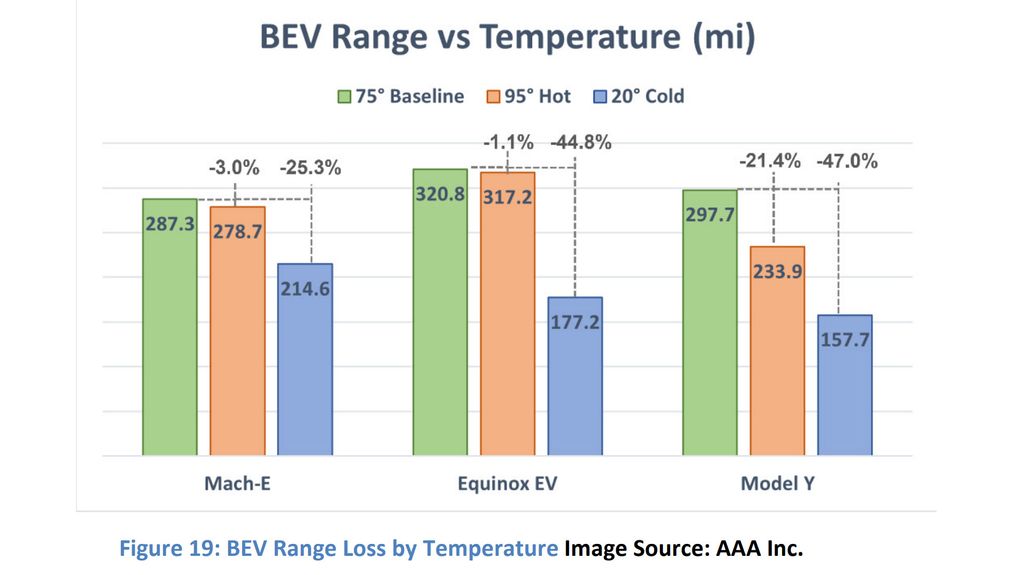
In hot weather, at a toasty 95°F (35°F), the study found that efficiency drops yet again, but at a lower pace. EVs showed a 10.4% decrease in MPGe and an 8.5% loss of driving range compared to the baseline 75°F temperature. Meanwhile, the average efficiency of the three hybrids went down by 12%.
It goes without saying that when efficiency drops, the number of miles that can be driven on a full tank of gas or a full battery also decreases, which means you need to fill up more often to drive the same distance. Still, EVs have the upper hand when it comes to the cost of ownership, even when their range drops by more than a third in freezing temperatures.
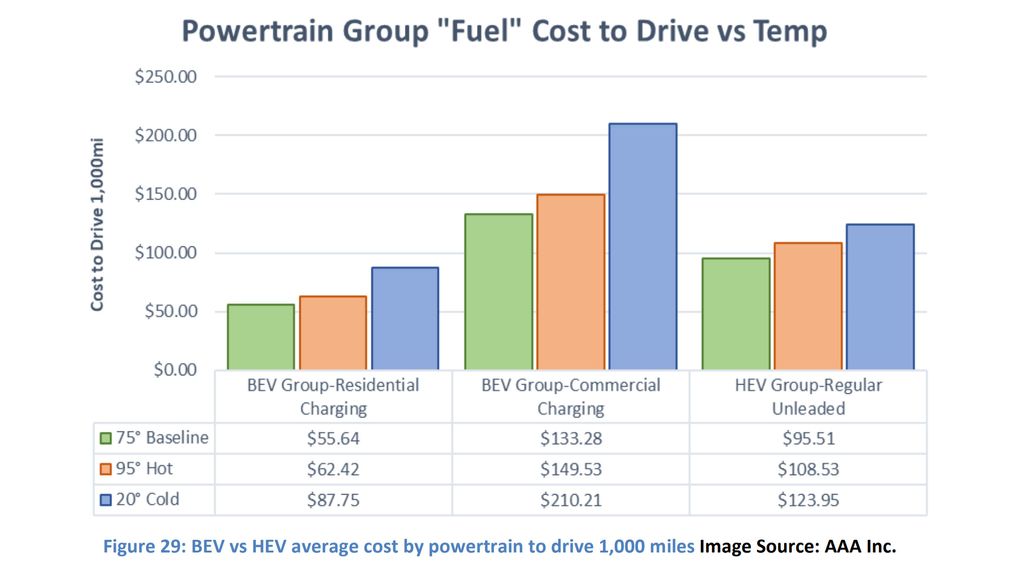
The study revealed that the average cost of driving an EV for 1,000 miles is $87.75 when the ambient temperature is 20°F. That’s $36.2 or 29% less than the average hybrid. However, this only happens when charging at home, where electricity rates are lower than those at DC fast chargers. When using public charging infrastructure exclusively, EVs cost more to drive 1,000 miles than hybrids, no matter the ambient temperature.
What’s more, the EVs tested by AAA exhibited the largest gap between the cost of driving 1,000 miles at 75°F and at 20°F. According to the study, it costs $55.64/1,000 miles at moderate temperatures, but that number increases by 55% when temperatures drop to 20°F. Meanwhile, the average hybrid costs $95.51/1,000 miles at the baseline temperature, and $123.95 at 20°F, which is a 30% increase.
“EVs are efficient in moderate temperatures but lose significant range in the cold,” said Greg Brannon, director of automotive engineering and research at AAA. “We expected this from our previous research, but were surprised by the 23% reduction in fuel economy for the hybrids in cold temperatures. Drivers should consider climate, energy costs, and driving patterns when choosing a vehicle that best fits their lifestyle.”
As always, it’s worth taking the time to research what car would best suit your needs. Modern EVs can successfully replace a gas car or a hybrid, and they’re cheaper to run during the car’s entire lifetime—not to mention they have lower lifetime emissions—but there are cases where an EV might not work. Having access to low-cost charging is essential to keeping your bank account happy—that’s why the majority of EV owners charge at home overnight.
More Stuff Like This

RECOMMENDED FOR YOU
Tesla’s New Three-Row EV Is The Longest-Range Model Y Tested By Edmunds
Chinese Regulators Recall Millions Of EVs Because Their Mechanical Door Handles Are Too Hard To Find
This Tesla Model Y Lost 9% Of Its Range In One Year. Its Owner Isn’t Worried
Inside The $2 Billion Battery Factory Making Cells For Tesla And Toyota
They Bought A 78,000-Mile Tesla With An Unknown Past. Then They Tested The Battery
Nevada Opens The Door To Thousands Of Paid Robotaxis, And Tesla Has The Edge
The Lucid Cosmos Will Have More Range Than Any Tesla