
'Teslas Are For the Girls': Woman Buys 'New' Model Y on CarMax. Then Viewers Sound the Alarm
"Does it have the warranty?"
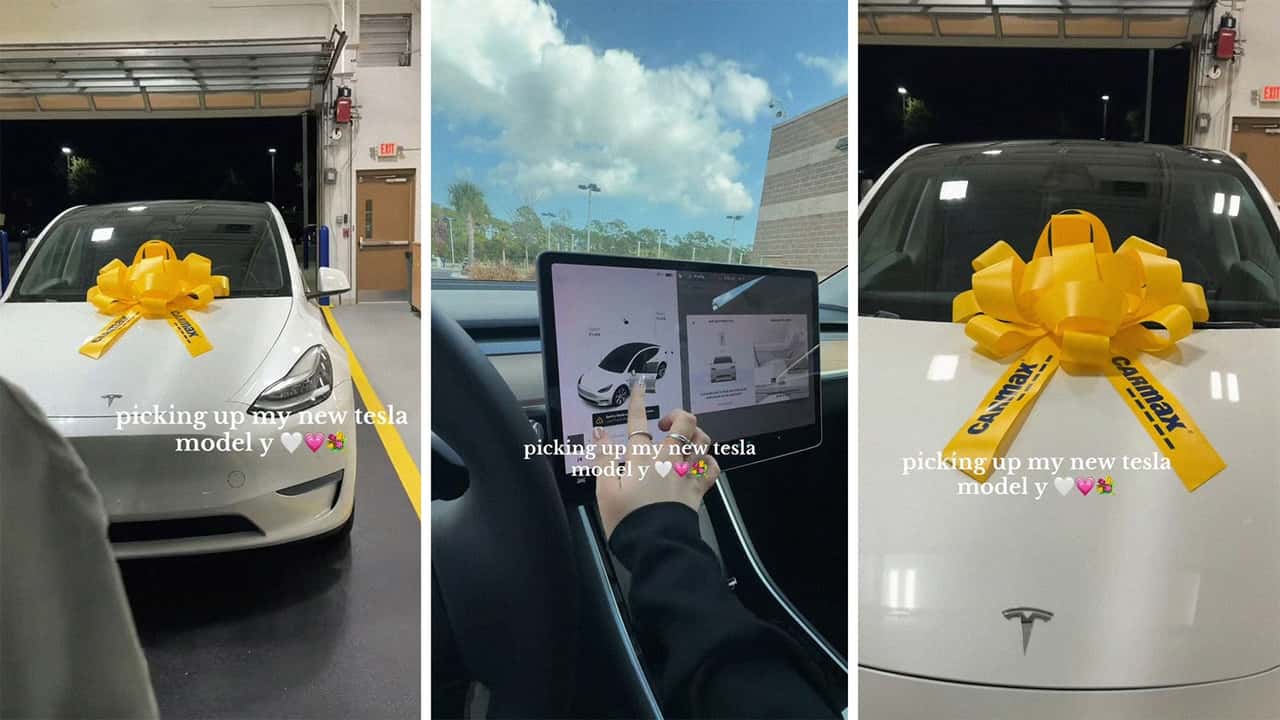

Buying your first Tesla should be exciting. But a viral TikTok raised an unexpected question after one new owner proudly showed off her Model Y: Did she buy it the wrong way?
Supporters cheered her on. Critics told her she’d just walked into a potential battery-health nightmare. And somewhere in the middle sat thousands of EV shoppers wondering what’s actually true.
The clip from creator Tiffany Batista (@tiffany.batistaa) shows her strolling into a CarMax showroom toward her pre-owned Model Y adorned with the bright yellow bow that’s become synonymous with the streamlined, no-haggling auto seller chain. It’s a moment of joy for Batista.
Still, commenters on the clip, which has been viewed more than 8,700 times, were quick to raise questions about the potential downsides of getting a Tesla from a reseller not closely aligned with the EV maker’s technology, software ecosystem, and service infrastructure.

Tesla Model Y charging
Much of the skepticism centers on Tesla batteries and questions about their health, how they've been treated and how transparent sellers are about their condition. While Tesla has long said that its battery packs are engineered for long life and minimal degradation, testing by independent groups has shown that battery health can vary significantly depending on usage, charging habits, mileage and climate.
Major studies, including one by Recurrent, found that while most Tesla batteries retain strong capacity over time, degradation can accelerate if the pack is repeatedly charged to 100% or fast-charged frequently over long periods.
FROM THE TRENDING NEWS DESK
Viral bits from across the social media landscape
Our team of experts tracks what's trending so you don't have to—from viral videos to online debates that have everyone talking.
That uncertainty is exactly what some commenters warned Batista about. One viewer referenced another viral video in which a woman claimed a non-Tesla dealership misrepresented the battery's health, only to learn the pack was below 80% capacity, a threshold many EV experts consider an indicator of meaningful degradation. Tesla’s battery warranty covers eight years or 120,000 to 150,000 miles, depending on the model, but it does not guarantee a specific state of health percentage at any given time.
Another common misconception surfaced in the comments: that a Tesla purchased from CarMax or another reseller somehow loses its battery and powertrain warranty. In reality, Tesla’s warranties transfer automatically to subsequent owners as long as the coverage window hasn’t expired, regardless of where the car was purchased. This aligns with Tesla’s published warranty terms and has been reaffirmed repeatedly by owners who purchased used Teslas from CarMax, Carvana, and independent dealers.
What CarMax Actually Offers Tesla Buyers
CarMax has leaned hard into EV sales over the last three years, reporting steady growth in used EV inventory as early adopters trade up or move to different brands. The company offers a 10-day money-back guarantee and a 90-day limited warranty on all vehicles, including Teslas. Buyers can add the MaxCare extended warranty, though coverage for high-voltage battery components and drive units is limited or excluded depending on the model.
Where some EV shoppers worry is the inspection process. CarMax technicians do not use Tesla’s proprietary diagnostic software, meaning the company cannot run deep-level battery health scans or verify the status of certain locked-down software functions. Tesla has historically refused to share service histories with third-party sellers, making it difficult for resellers to confirm whether a vehicle has undergone specific repairs.
Another wrinkle is app access. Teslas purchased through third parties require approval from Tesla for ownership transfer, which can take anywhere from hours to several days, depending on the documentation and backlog. During that window, buyers may be unable to access the Tesla mobile app, which they need for features like remote unlocking, charging data and climate preconditioning.
Tesla Offers Transparency, But Not Always Better Pricing
Tesla's own used-vehicle program remains the safest route for buyers who want warranty clarity, software transparency and a reconditioning process focused on EV-specific systems. Every car undergoes a multi-point inspection, and Tesla typically includes a one-year or 10,000-mile used-car warranty on top of any remaining original warranties. Tesla outlines this program in detail on its used inventory site.
Still, Tesla often prices its used vehicles higher than CarMax and other resellers. Analysts have repeatedly found that used EV prices fluctuate significantly across retailers, with Tesla’s used inventory sometimes sitting thousands above comparable listings at independent dealers.
That reality is likely why shoppers like Batista end up at CarMax in the first place. If the price is right and the cosmetic condition looks good, the appeal of a straightforward buying process, plus that 10-day return window, can be hard to beat.
Experts say the most important step is understanding the battery as thoroughly as possible. Third-party EV inspectors can conduct external battery health assessments using OBD-II tools that estimate capacity loss, though Tesla's software locks sometimes limit these readings. Buyers should also verify that any advertised driver-assistance features, including Enhanced Autopilot or Full Self-Driving, are active, since Tesla has removed or restricted FSD transfers on vehicles sold by third-party dealers in some cases, consistent with its stated policy.
Finally, shoppers should confirm whether the vehicle still has access to Supercharging at standard rates. Free unlimited Supercharging, once a perk on certain older Teslas, rarely transfers to subsequent owners, especially when the car is sold outside Tesla’s ecosystem.
Batista’s TikTok started as a celebration, but the reaction it sparked highlights a real tension in the used-EV marketplace. Buying from CarMax can offer better pricing and a user-friendly retail experience, especially for newer EV shoppers. Buying directly from Tesla provides more transparency and clearer service pathways but can come with higher prices and limited selection.
For anyone watching her video and wondering what to do, the answer is less about where you buy and more about how well you understand the car you’re getting. A Tesla is fundamentally a battery-powered computer on wheels, and knowing the condition of that battery, the status of its software and the details of its warranty matters far more than the bow on the hood.
InsideEVs reached out to Batista via email and direct message. We’ll be sure to update this if they respond.
Correction: An earlier version of this story misstated CarMax's return policy. It is good for 10 days. We regret the error.
RECOMMENDED FOR YOU
Tesla’s Model Y Price Bump Makes The Ioniq 5 And Mustang Mach-E Look Better Than Ever
The Skoda Epiq Is Europe’s Big Small Electric SUV
The Longest-Range EVs You Can Buy In 2026
ChargePoint Wants To Fix The Condo EV Charging Problem With 2,500 New Ports
Think Fast-Charging Ruins EV Batteries? Look At This 111,000-Mile Tesla Model Y
Costco’s New Discount Makes America’s Cheapest EV Even Cheaper
7 Great Used Electric SUVs: Get New EV Tech Without New Car Prices