
Mercedes Crashed An Electric Truck On Purpose. Here’s What Happened To The Battery
The company simulated a car hitting the side of an eActros 600 truck cab, which has a huge, 621 kWh battery.
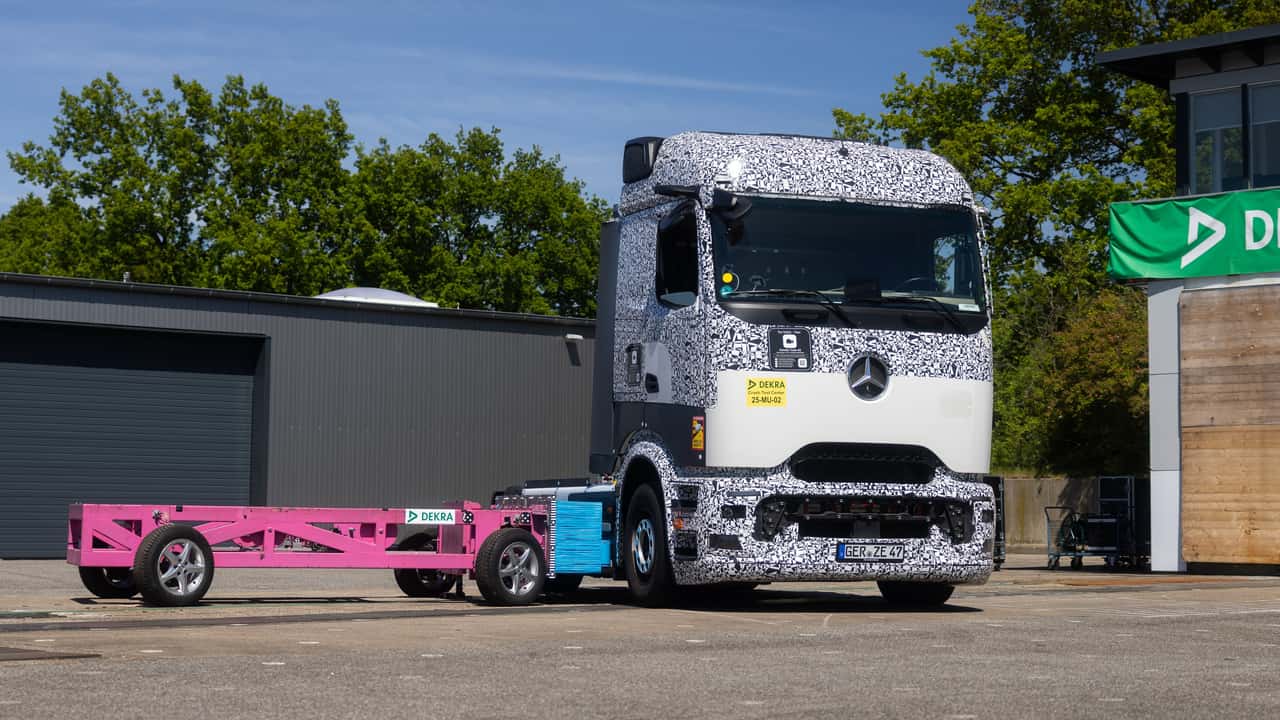

- Mercedes-Benz crash-tested an eActros 600 electric truck.
- The German company simulated a car ramming into the side of the truck, where some of the batteries are located.
- The eActros 600’s high-voltage battery has over 600 kWh of energy.
Electric vehicle battery fires are once again in the spotlight, after Jeep recalled over 300,000 plug-in hybrids because their high-voltage packs could go up in flames. That’s attention-grabbing, sure, but the reality is that modern EV batteries are extremely safe.
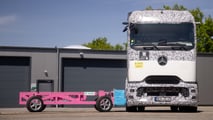
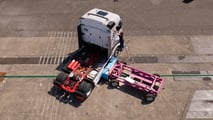
To prove that, Mercedes-Benz crashed an eActros 600 truck on purpose, simulating a car ramming into one side of the electric chassis, where some of the batteries are housed. As a reminder, the eActros 600 is powered by a huge 621-kilowatt-hour lithium iron phosphate battery pack that’s split into three separate compartments.

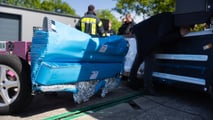
During the crash test, a car-like vehicle weighing over 2,200 pounds (1,000 kilograms) smashed into the right side of Mercedes-Benz’s electric truck at a speed of over 31 miles per hour (50 kilometers per hour). According to the truck maker, this is a typical impact in the heavy-duty trucking world.
So, what happened to the batteries? Well, nothing. “Despite the considerable force exerted, the entire high-voltage battery system and all electrical components remained intact,” Mercedes-Benz Trucks said. That’s reassuring, especially for a vehicle that has seven times the battery capacity of the Chevrolet Equinox EV.
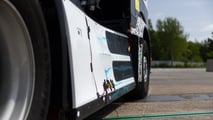
Mercedes-Benz said that the high-voltage battery modules remained intact and that their housing showed no critical deformations, thanks to a frame architecture specifically designed to take a beating in heavy-duty collisions.
Before the real-world crash test was conducted, the truck maker performed several virtual simulations, and the results were similar to the real thing. “The results clearly confirm our expectations; there would have been no danger here in practical use,” said Frank Müller, Head of Accident Research & Passive Safety at Mercedes-Benz Trucks.
Gallery: Mercedes-Benz eActros 600 side crash test


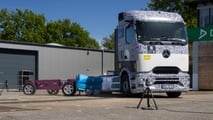

The Mercedes-Benz eActros went into production last year, but the German company is still doing physical testing on a regular basis, so that new findings can be integrated into future iterations of the truck. With a 621 kWh battery pack, the eActros 600 is capable of delivering 310 miles (500 km) of range on a full charge with a gross combination weight of 80,000 lbs (40 tons).
With Europe’s mandatory driver breaks taken into account, the battery-powered big rig can comfortably cover over 600 miles per day if there’s a powerful enough DC fast charger mid-journey. Currently, Mercedes-Benz’s big EV can be charged at up to 400 kW from a CCS2 charger, but the power electronics will be able to handle Megawatt charging when the MCS standard is up and running.
Related Stories
RECOMMENDED FOR YOU
The Best EV Lease And Finance Deals In July 2026
'Completely False': Lucid Denies Report That It's Weighing Bankruptcy After Shares Crash
Mercedes EV Sales Jumped 50% In Q2. That's Mostly Thanks To Europe
'We Will Not Survive': Toyota Boss Wants Japanese Automakers To Team Up To Beat Chinese EVs
The New Mercedes-AMG CLA EV’s Huge Power Comes From Three Tiny Motors
Nearly 10,000 EVs Were Tested For Battery Degradation. These 2 Models Won Out.
Mercedes' New Production Plan Could Make The 'Baby' G-Class EV Far Cheaper