
'Can't Wait For You To Give Me a Ride In Your Tessie': Houston Woman Turns On Full Self-Driving. Then She Films a GRWM
'The Tesla will be our DD.'
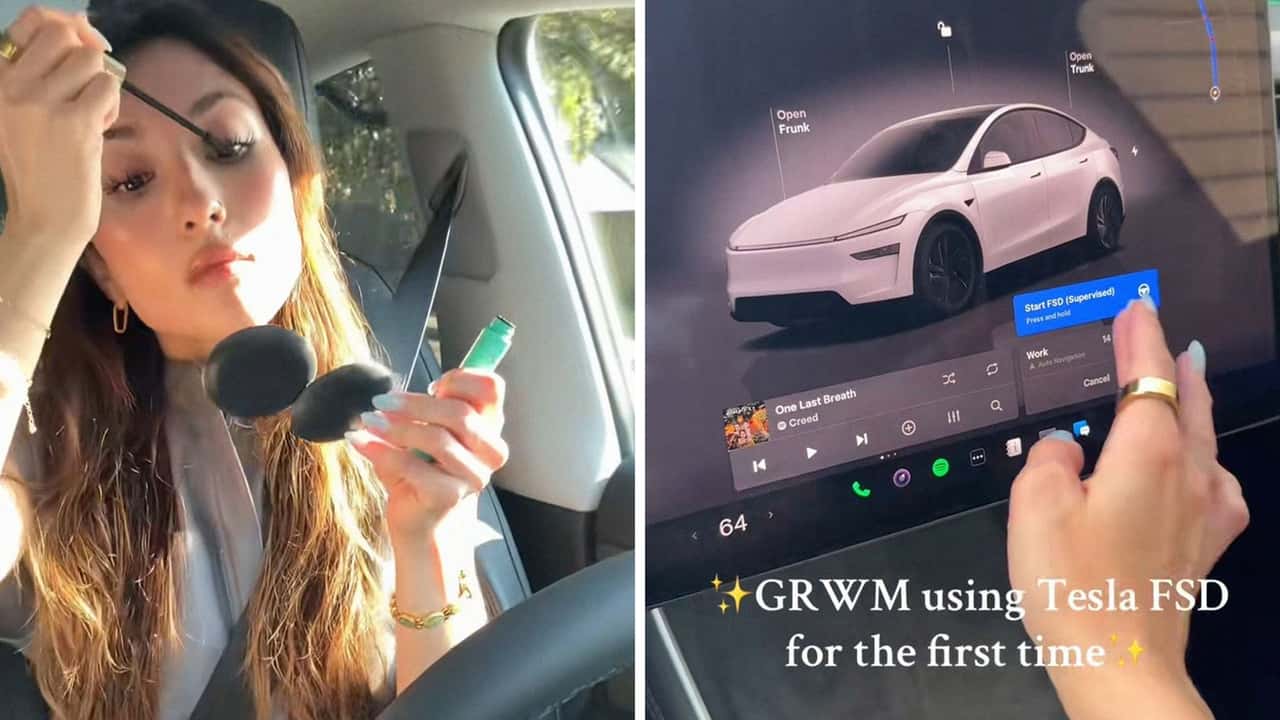

In 2025, even makeup tutorials are going autonomous. One Tesla driver’s TikTok is equal parts “get ready with me” (GRWM) and Full Self-Driving (FSD) demo and is racking up views for its surreal mashup of influencer aesthetics and semi-autonomous driving. But it’s also sparking a familiar debate: Just how hands-free should a “self-driving” car really be?
The clip from Houston-area creator Niki Kury (@nikikury) shows her barely engaging with the steering wheel of the Tesla she’s “driving.” Instead, she’s basking in the “Is this really happening?” delight that lets Tesla’s tech turn her drive time into a primping session.
What Tesla’s FSD (Supervised) Really Is
Tesla’s system falls under SAE Level 2 automation, meaning the car can handle steering, acceleration, and braking—but only under constant driver supervision. Drivers must remain alert and ready to take control at any moment.
As of 2024, Tesla rebranded “FSD Beta” to FSD (Supervised). By January, Tesla reported users had driven 3 billion miles using supervised FSD, with significant investments in AI compute infrastructure to improve the system.
Tesla continues rolling out enhancements. A major software update is expected by September, aiming for improved performance in rare or complex situations, while still requiring driver attentiveness.
Despite improvements, the system hasn’t gotten uniformly safer. Tesla’s own Q2 2025 Autopilot safety report indicates that crash rates have worsened in 2025.
Regulators and safety advocates have long warned about Tesla’s approach to beta testing, including criticisms that FSD is promoted as autonomous, fuelling misuse on public roads.
FROM THE TRENDING NEWS DESK
Viral bits from across the social media landscape
Our team of experts tracks what's trending so you don't have to—from viral videos to online debates that have everyone talking.
Importantly, a recent $329 million jury verdict found Tesla 33% liable in a 2019 fatal crash involving its Autopilot system, highlighting legal risks tied to overreliance on semi-autonomous tech.
Influencers Fuse Lifestyle and Tech
TikTok’s “GRWM” makeup and fashion videos are a mainstay trend, but when set inside a Tesla in FSD mode, the content becomes both attention-grabbing and controversial. That’s exactly what creator Kury delivered in her viral TikTok clip: a polished beauty tutorial taking place while the Tesla drove itself.
The clip embodies a collision of influencer culture with EV tech: High-glam aesthetics meet cutting-edge automation, blurring boundaries between lifestyle content and legitimate tech demos. The standout viewer comment “Can’t wait for you to give me a ride in your new Tessie!” captures that playful, aspirational tone.
There’s another force driving these videos: TikTok’s recommendation engine. The platform is designed to surface content that’s novel, surprising, and engaging, which is exactly the kind of material you get when a trending “Get Ready With Me” video is set inside a Tesla on FSD. The result? A mashup of a beauty tutorial and a high-tech stunt that the algorithm can’t resist.
Experts say this “attention economy” encourages creators to push boundaries, especially when they see others rack up views and followers from similar risky content. And this isn’t the first time Tesla drivers have gone viral for eyebrow-raising behavior. Past examples include eating fast food while on Autopilot, lounging in the passenger seat, or even climbing into the back seat while the car drives itself.
The reward loop is simple: More risk, more views, more followers.
Now Trending
This kind of viral footage doesn’t exist in a vacuum. It contributes to how the public, regulators, and media perceive autonomous driving tech. FSD remains under regulatory scrutiny, particularly in light of Tesla’s Robotaxi pilot in Austin, Texas, which began June 22, still operating with human safety monitors in the vehicle.
By contrast, competitors like Waymo offer fully driverless (Level 4) operations and have consistently published safer operations data.
As Tesla expands its robotaxi service to new markets and seeks broader adoption, content like the GRWM video risks undermining trust by reinforcing that FSD isn’t foolproof and that drivers can dangerously disengage from safety responsibilities.
Tesla does equip its cars with cabin-facing cameras meant to detect if the driver’s eyes are off the road. In theory, the system should chime and flash warnings if you’re distracted. In practice, independent testers have found the monitoring can be slow to react—particularly if your head is pointed forward but your attention is elsewhere.
There’s also the matter of how FSD disengages. If the driver applies too much torque to the steering wheel, which can happen accidentally while, say, reaching for makeup or adjusting a mirror, the system can suddenly hand control back to the human. If you’re not ready, that’s a recipe for trouble.
This is the heart of the issue. Despite the name, FSD isn’t built for true hands-off, eyes-off driving. It’s still a driver-assist tool, not a replacement for a human driver, and every time a video like this goes viral, it blurs that line just a little more.
“The Tesla will be our DD (designated driver),” reads another comment.
InsideEVs reached out to Kury via direct message. We’ll be sure to update the story if we hear back.

RECOMMENDED FOR YOU

Tesla Apparently Won't Let Cybertruck Buyers Transfer FSD Without Spending Another $20k
This Simple Trick Boosted My Plug-In Hybrid's Fuel Economy To 50 MPG
This Tesla Model 3 Went Nearly 400 Miles In A Range Test, 30 More Than Its EPA Rating
Sodium Batteries And EVs That Power The Grid: Inside GM's Big Energy Push
Teslas Are More Likely To Hit 250,000 Miles Than Almost Every Car Brand
EVs Are Cleaner Than Gas Cars. Your ZIP Code Decides By How Much
The Best EV Lease And Finance Deals In June 2026