
Should You Buy or Lease a Tesla Model Y Juniper? Expert Reveals the Easy Way To Quickly Calculate Which Is Better
'$394 a month.'
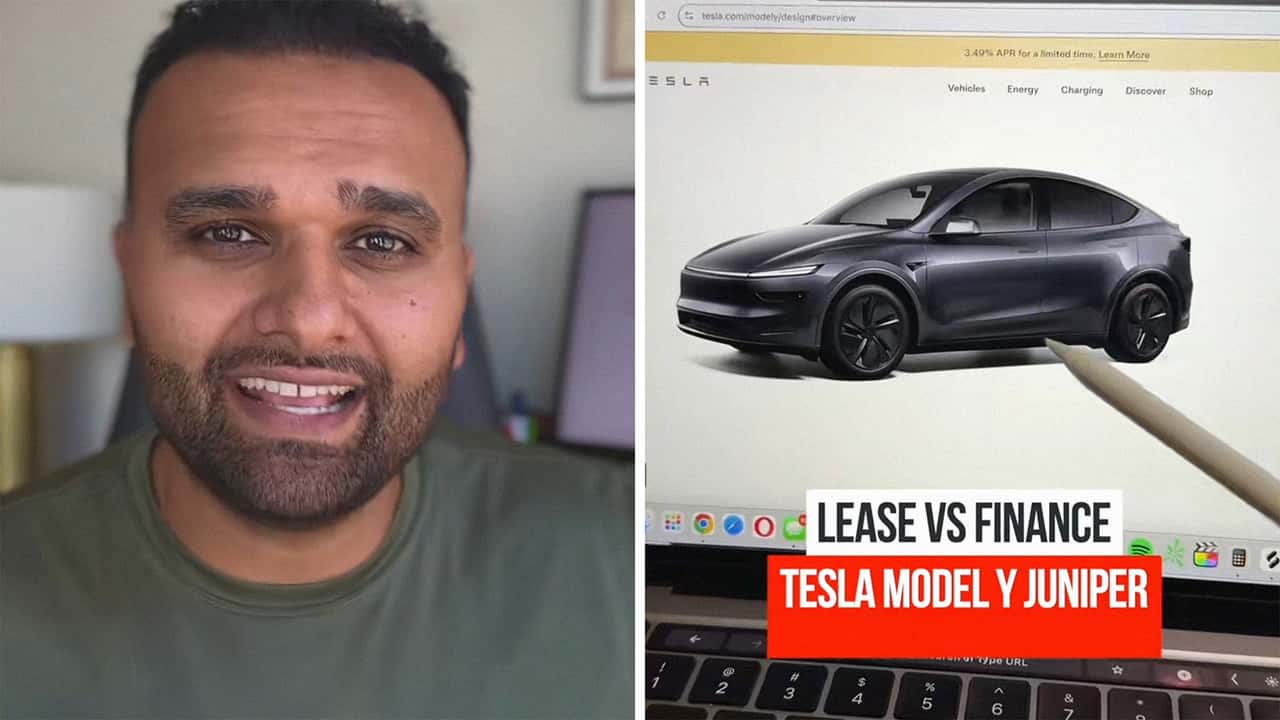

A personal finance aficionado shared a simple calculation folks can use to determine whether or not they should lease or buy a car. Ravi Wadan (@raviwadan) demonstrated how to ascertain this figure in a recent, viral TikTok that’s accrued more than 74,000 views on the popular social media platform.
Wadan begins his video recording the Model Y Juniper’s information page on Tesla’s website. He points to it with a white tablet pen as he delineates if leasing or buying would be a better option for one of the best-selling cars in the world. He says, “Ladies and gentlemen let’s talk about whether you should lease or finance a new Tesla Model Y Juniper.”
On the EV brand’s website, he shows that consumers can lease the long-range, rear-wheel drive version for $349 a month. This option comes with some restrictions, however. Folks will need to drop $3,000 down on the car and are restricted to 10,000 miles a year if they lease.
However, when he jumps to the next page, he shows that this lease payment immediately jumps up by an additional 50 bucks per month. Furthermore, if buyers think all they need is $3,000 and the first month of payments, Wadan shows that they’re going to need much more than that.
“So right now you can lease this Tesla Model Y for $394 dollars a month. It’s a 36-month lease that allows for 10,000 miles a year. And the total due at signing amount including all taxes and fees is $6,021,” he says. Note that taxes and fees will vary by location.
Calculating the Percentage
Following this, his video transitions to him performing some calculations on his laptop. This is to break down what consumers are going to ultimately pay for the car on a month-to-month basis. “Now if we take the $6,021 that’s due at signing. And we subtract the monthly payment of $394 dollars from that amount, you get $5,627. And if you divide this by 36 since it’s a 36-month lease, you get $156. And if we add the monthly payment of $394 to this amount, you get a zero-down effective monthly payment of $550 a month,” Wadan tells his viewers.
The TikToker performs further calculations. “And if we divide this by this Tesla’s MSRP of $44,990, you get 1.22 percent,” the TikToker states.
Now Trending
Next, he explains the significance of this 1.22% figure.
FROM THE TRENDING NEWS DESK
Viral bits from across the social media landscape
Our team of experts tracks what's trending so you don't have to—from viral videos to online debates that have everyone talking.
According to him, since it falls below the 1.5% threshold, he recommends leasing over financing to maximize a customer’s value from a vehicle. Wadan explains why this is the case. “Now anytime you run this calculation and you get a number over 1.5%, that typically is a vehicle I would rather finance instead of lease. Under 1.5% is a good lease deal in terms of value. Under 1.25% is a great lease deal. Under 1% is extremely rare and what I consider an amazing lease deal in terms of value,” he relays to his audience.
Wadan then reiterates that anyone who is debating whether or not they should lease or finance this specific Tesla model package should go with a lease. “And this Model Y Juniper rear-wheel drive sitting at 1.22 percent means I would definitely lease this Tesla. Financial knowledge is power,” he says at the end of his clip.
Other Auto Experts Talk the 1% Lease Rule
Wadan isn’t the only person who’s discussed this leasing versus financing logic. The website LeaseGuide also penned an article that details “a simple way to determine if a lease deal is good or bad.”
Indeed, the piece references “the one percent rule” and echoes a similar leasing principle that the TikToker discusses in his video. “The…’one-percent’ method of sizing up a lease offer is based on the concept of dividing the monthly payment…by the MSRP sticker price of the car. If the result is very close to 1%, or less, the better the deal,” LeaseGuide states. Furthermore, the outlet writes that sales tax shouldn’t be factored into this calculation.
The piece goes on to break down an example with a vehicle that carries a $30,000 sticker price. If the monthly lease amount with no money down is $290, we divide $290 by $30,000. That gives us .96% which the site is “an outstanding deal,” just like Wadan said in his TikTok. LeaseGuide gave another instance with a $30,000 car that has a $375/month lease note, bringing its divide value to 1.25%. The piece calls this “an excellent deal, although not outstanding.”
Although, unlike Wadan, the website seemed to disagree with the notion that anything below 1.5% is indicative of a high value lease. That’s because they referenced a $390/month lease payment on a $30,000 car. This would result in a 1.3% lease value figure, which LeaseGuide says “would not be a great deal, possibly just average or poor.”
Other Lease Vs. Financing Factors To Consider
When calculating this percentage, you should understand additional charges that could factor into a leasing agreement. Down payments should be divided across the lease period (by month) and added to the monthly cost. Furthermore, ensure that the amount of miles you select for your lease match your driving needs. That’s because dealerships will charge you for every mile that you’re over, culminating in potentially hefty fees depending on how much you’ve put on the odometer. Additionally, some dealers are more pedantic than others when it comes to what is classified as wear and tear on a leased vehicle. You may find yourself on the hook for minor dings and scratches that can occur during everyday driving, subsequently inflating the initial percentage figure you calculated upon leasing your vehicle.
Of course, if overall value is your primary concern when obtaining a new ride, you’ll almost always get the most bang for your buck by financing a used vehicle. Finding cars that are between 3-5 years old is often regarded as the “sweet spot.” That’s because these cars often have some mileage left on the manufacturer’s warranty. And if they’ve been routinely maintained with no major accidents, and are made by a brand renowned for reliability, they can be a smart buy. Moreover, vehicles that are 3-5 years old have their worst depreciation years behind them, leaving buyers with a ride with a probability of high value.
InsideEVs has reached out to Wadan via email for further comment. We'll be sure to update if they respond.

RECOMMENDED FOR YOU

Woman Buys Cadillac EV. Then They Offer Her A Deal On EVgo
I Played Nintendo Switch In A Chinese EV
"The Motor Is Supposed To Last 1 Million Miles": Man Hits 360,000 Miles On His Model 3. Is That The Norm?
Tenways Wayfarer Review: A Great Commuter E-Bike Value
"Dealerships Are Shady": Man Says Texas Toyota Dealership Agreed To Sell Highlander Hybrid For $26,900, Then Jacked Up The Price
The Rivian R2 Configurator Is Live. But You'll Have To Wait Until 2027 For The Best Color
Can Waze Still Track The Police?