Home
Tesla
News
Tesla's Robotaxi Won't Have A Charge Port. It's Wireless Charging Only
“The Robotaxi has no plug,” Elon Musk said during last night’s reveal. Is Tesla about to go big on inductive charging?

Photo by: InsideEVs
Iulian Dnistran 
By: Iulian Dnistran
Oct 11, 2024 at 2:42am ET
Add InsideEVs as a preferred source in Google
- (https://twitter.com/intent/tweet?url=https%3A%2F%2Finsideevs.com%2Fnews%2F736961%2Ftesla-robotaxi-charge-port%2F&text=Tesla%27s%20Robotaxi%20Won%27t%20Have%20A%20Charge%20Port.%20It%27s%20Wireless%20Charging%20Only&via=InsideEVs)
- copy
Share
Comment
- Tesla revealed its Cybercab self-driving taxi alongside a driverless Robovan.
- CEO Elon Musk was scant on details, but revealed the Cybercab doesn't have a conventional charge port.
Well, it finally happened. Tesla revealed its much-anticipated Robotaxi, as well as a driverless Robovan during last night’s event at the Warner Bros. Discovery studio in Burbank, California.
It was the usual Elon Musk monologue with occasional random questions shouted from the audience–just like when that cool substitute teacher comes in and doesn’t really have all the details but is trying to make the best of it.
The whole reveal was devoid of technical details, so we don’t know what the battery size of the Cybercab is, how fast it charges, how fast it goes and whether it's rear-wheel drive, front-wheel drive or all-wheel drive. Instead, Musk focused on the “optimistic” timeline where the driverless two-door would be on the road “by the end of 2027” and that it would cost under $30,000. Let’s not forget, however, that the second-generation Tesla Roadster was revealed in 2017 but is yet to become a series production model.
More Cybercab Stuff
 Tesla Robotaxi Event: The Recap
Tesla Wireless Car Charging Pad Revealed In Patent Drawings
Tesla Robotaxi To Cost Under $30,000: Elon Musk
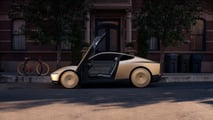
That said, he did give the audience one small piece of interesting information: the Tesla Cybercab will charge wirelessly through an inductive charger, and not by plugging in a cable into a charge port. In fact, it doesn’t even have a charge port, according to Musk, who very briefly touched on the subject during last night’s event
“Something we're also doing is, and it's really high time we did this, is inductive charging.,” he said. “So, The robotaxi has no plug. It just goes over the inductive charger and charges. So, yeah, that's kind of how it should be. Thanks, guys. I love you, too.”
The quote was extracted from the live stream embedded below:
But that’s everything we know on the matter, and it’s not much. A lot of unanswered questions remain, like how much time it takes to recharge, how big is the inductive charger or how much it costs to buy the charger. These are all valid questions considering Tesla’s idea of the Cybercab is people will be able to buy one (or several) and operate a personal fleet of driverless cabs from the comfort of their homes. This essentially shifts the responsibility from the company to the individual and it also raises the costs associated with running such a fleet.
Musk mentioned that the Cybercab would be a great solution for people who are currently working for Uber and Lyft. In metropolitan areas, a lot of rideshare drivers already use electric vehicles, so they’re accustomed to charging an EV and taking care of it. But if they need to buy three inductive chargers for a small fleet of Cybercabs, the initial costs will likely be higher than expected.
Gallery: Tesla Cybercab
27





Source: Tesla
What do you think?
View
Comments
There’s also the issue of charging speeds. Current inductive charging solutions usually top out at around 20 kilowatts, which is significantly lower than the 250 kW maximum rate available at Tesla’s own Superchargers. Granted, there are wireless charging pad prototypes out there that reached 270 kW, but they’re still years away from becoming mainstream products.
So, how would this work, exactly? If it takes a whole night to recharge the Cybercab and then expect it to run all day doing trips, someone is going to have a bad time. Downtime is essential in the ride-hailing industry. Unless Tesla figures out a way to ship a wireless charging pad that’s affordable and capable of delivering enough juice to add significant range in a short amount of time, this isn’t going to work.

Get the best news, reviews, columns, and more delivered straight to your inbox.
back
Subscribe For more info, read our Privacy Policy & Terms of Use.
We want your opinion!
What would you like to see on Insideevs.com?
Take our 3 minute survey.
- The InsideEVs team
Share this Story
- (https://twitter.com/intent/tweet?url=https%3A%2F%2Finsideevs.com%2Fnews%2F736961%2Ftesla-robotaxi-charge-port%2F&text=Tesla%27s%20Robotaxi%20Won%27t%20Have%20A%20Charge%20Port.%20It%27s%20Wireless%20Charging%20Only&via=InsideEVs)
- copy
GO TO COMMENTS
(
)
Got a tip for us? Email: tips@insideevs.com
View all comments ( )
Trending
Diesel Prices Are Surging. This Electric Trucking Company Is Seeing More Interest
Tesla Opens Self-Driving Cybercab Orders To 'Select Customers' At $29,990
Solid-State Cells Can Make The U.S. Competitive In Batteries Again: CEO
I Took A Rivian R2 On A Camping Trip To The Middle Of The Desert
Latest Stories
- BMW’s iX5 Beat The Lucid Gravity On Highway Range. Not On Efficiency Nov 16 - Range / Efficiency -
- Tesla Just Bumped The Cheapest Model Y’s Range, But The Price Stays The Same Nov 16 - Range / Efficiency -
- Tesla Drivers Can Now Plug In And Charge Automatically at Ionna Stations Nov 16 - Charging -
- Diesel Prices Are Surging. This Electric Trucking Company Is Seeing More Interest Nov 14 - News -
- Tesla Opens Self-Driving Cybercab Orders To 'Select Customers' At $29,990 Nov 13 - News -
- Do EVs Wear Tires Faster? Here's What The Studies Show Nov 13 - Features -
- The VW ID. Buzz Is Getting A New Job As A Robotaxi Nov 13 - News -
RECOMMENDED FOR YOU
Tesla Just Bumped The Cheapest Model Y’s Range, But The Price Stays The Same
Do EVs Wear Tires Faster? Here's What The Studies Show
Tesla Drivers Can Now Plug In And Charge Automatically at Ionna Stations
The VW ID. Buzz Is Getting A New Job As A Robotaxi
Diesel Prices Are Surging. This Electric Trucking Company Is Seeing More Interest
Audi A4 EV Delayed Amid VW Group Financial Troubles: Report
Tesla Opens Self-Driving Cybercab Orders To 'Select Customers' At $29,990