
Autopark For Tesla Vision Is Very Slow But Parallel Parks Like A Pro
The revamped suite of parking features needs some improvements but gets the job done when you need it most.

In 2021, Tesla began removing the ultrasonic sensors in the Model 3 and Model Y that powered the Autopark, Summon, and Smart Summon features of Autopilot. By 2022, no model was shipped with the necessary hardware.
However, Tesla indicated that these features would eventually return using Tesla Vision. According to the automaker’s FAQ on this topic, “once these features achieve performance parity to vehicles equipped with USS, vision-based vehicles will have these features restored via a series of over-the-air software updates.”

Some parking assist features have rolled out in the time since, and we have also seen vison-only versions of Autopark in the past. In other words, the feature has been spotty over the years. In March of this year, Tesla CEO Elon Musk indicated that some exciting updates were coming soon to the parking assist features.
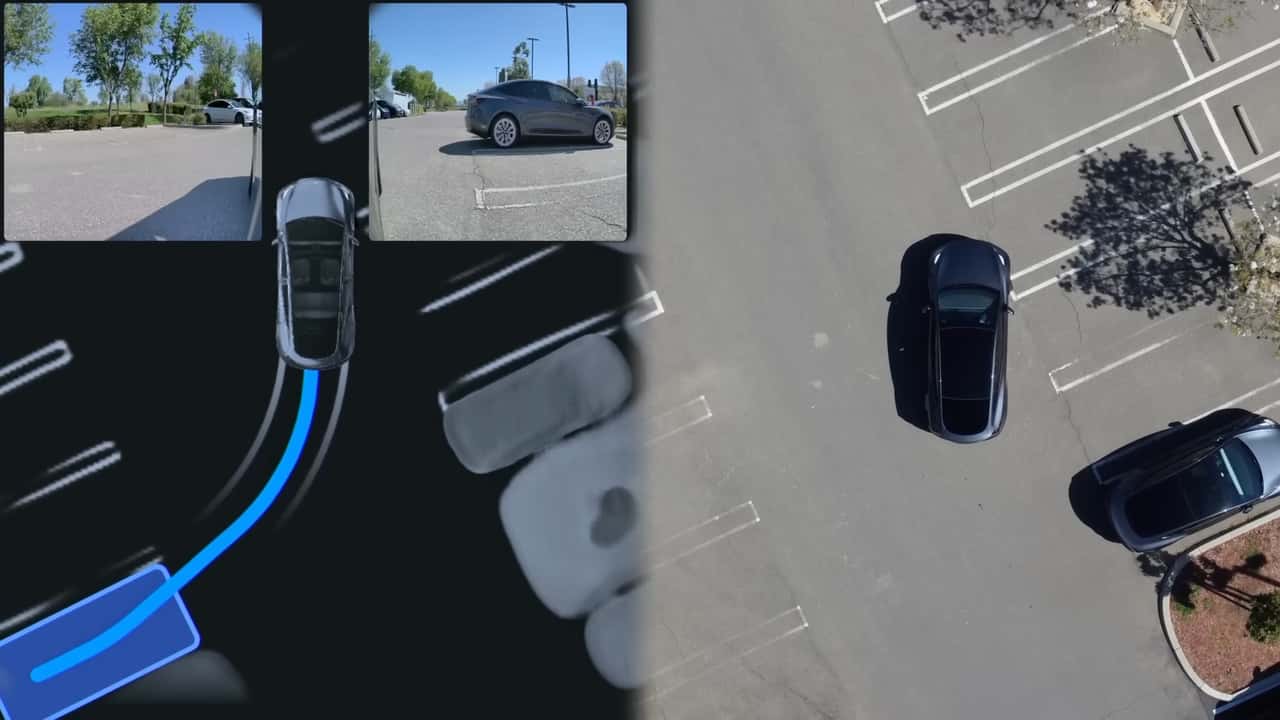
YouTube channel AI DRIVR has received the latest updates for Autopark (now called Banish, apparently) and has captured footage of the feature in action on his "Highland" Model 3. His video features some excellent overhead footage of the parking feature in action as well as the view from the inside of the vehicle. This is one of the best demonstrations of the features on the web, it's highly recommended to view the entire thing.
Initially, he was not impressed with the feature. Some new aspects were very nice including the ability to select the parking spot of your choice. But the practicality seemed limited since even when parking in wide-open lots, the feature was very slow and overly cautious, correcting itself even when there was nothing to correct.
Many nice features also have major caveats. For instance, parking lots with no lines or faded lines will still show up as designated “spots”. However, due to the limitations of the visualizer, it can result in very crooked parking jobs. Other times it will not recognize these as spots even when it has plenty of context to know they are.

The car also seems to favor parking between the parking spot lines, ignoring proximity to other cars. This can lead to situations where the vehicle parks very close to another vehicle, making it impossible to actually exit the car. While a human driver would have centered between the cars rather than between the lines.
Another major limitation is the fact that Autopark is completely unable to pull into spots that are pull-in only and at odd angles. Because the new Autopark only seems to be able to back into spots rather than pull forward into them, it ignores these spots completely.
However, as he pushed the system, useful situations began to present themselves. One particularly difficult parallel parking job between two vehicles was very tight. The car was able to squeeze its way in, coming within an inch or two from one of the vehicles. These are the type of situations where features like this really shine, because for more typical parking jobs the driver is going to do as good or better in half the time.
“Overall, I’ve been very impressed with this new version of Autopark.” He says. “It is a bit slow right now, and I won’t be using it for basic parking situations until it’s a little faster. But for more difficult spaces and parallel parking, it does a fantastic job.”
Have you tried out the newest version of Autopark yet? If you also own an older Tesla model, how does it compare to the versions? Let us know your thoughts in the comments below.
More About Autopark
RECOMMENDED FOR YOU
Used Tesla Model S Prices Have Fallen Dramatically. But Their Batteries Are Holding Up Great
'Most Companies Are Struggling': Executive Shares An Uncomfortable Truth About Solid-State EV Batteries
I Drove An Original Tesla Model S To See If It's Still Worth Buying In 2026
This New All-In-One Range Extender Is Ready To Go Into Any Electric Truck
One Owner Just Did What Tesla Couldn't: Upgrade An Older Car To HW4
Chinese Regulators Recall Millions Of EVs Because Their Mechanical Door Handles Are Too Hard To Find
Tesla’s New Three-Row EV Is The Longest-Range Model Y Tested By Edmunds