Home
News
Pricing
Price Parity Between EVs And ICEs Was A Moving Target In November
The average transaction price for new EVs was $52,345, 8.5% higher than the industry average price of $48,247, according to KBB data.

Dan Mihalascu 
By: Dan Mihalascu
Dec 20, 2023 at 3:00pm ET
Add InsideEVs as a preferred source in Google
- (https://twitter.com/intent/tweet?url=https%3A%2F%2Finsideevs.com%2Fnews%2F701765%2Fprice-parity-between-evs-ices-was-moving-target-november%2F&text=Price%20Parity%20Between%20EVs%20And%20ICEs%20Was%20A%20Moving%20Target%20In%20November&via=InsideEVs)
- copy
Share
Comment
Achieving price parity between electric vehicles and internal combustion cars is generally seen as a key objective for EV makers, and for good reason.
When America's average price for a new EV matches the average price for a new ICE car, it means that one key obstacle toward EV adoption will have been removed. The day a Toyota Corolla costs the same as a Tesla Model 3, we will see many buyers migrate from the Japanese sedan to the American EV.
Get Fully Charged
How soon can this goal be accomplished?
If EVs achieve price parity with gas cars, then sales would likely increase significantly. However, it seems that hitting this objective is easier said than done, especially as many countries are reducing EV incentives in 2024—or eligibility in the case of the United States.
But how far are we from EV price parity? According to Kelley Blue Book's November average transaction price data for new vehicles, we're slowly getting there—but only as far as 2023 is concerned. The next year brings a lot of uncertainty as many EV models are losing the federal tax credit.
The average price paid in the U.S. for a new electric vehicle in November was $52,345, whereas the industry average price—all types of propulsion combined—was $48,247. The average transaction price (ATP) for EVs was therefore 8.5% higher than the overall ATP. Mind you, EVs were actually closer to price parity in October, when the EV ATP was $51,715 while the overall ATP was $47,944 (a difference of 7.8%).
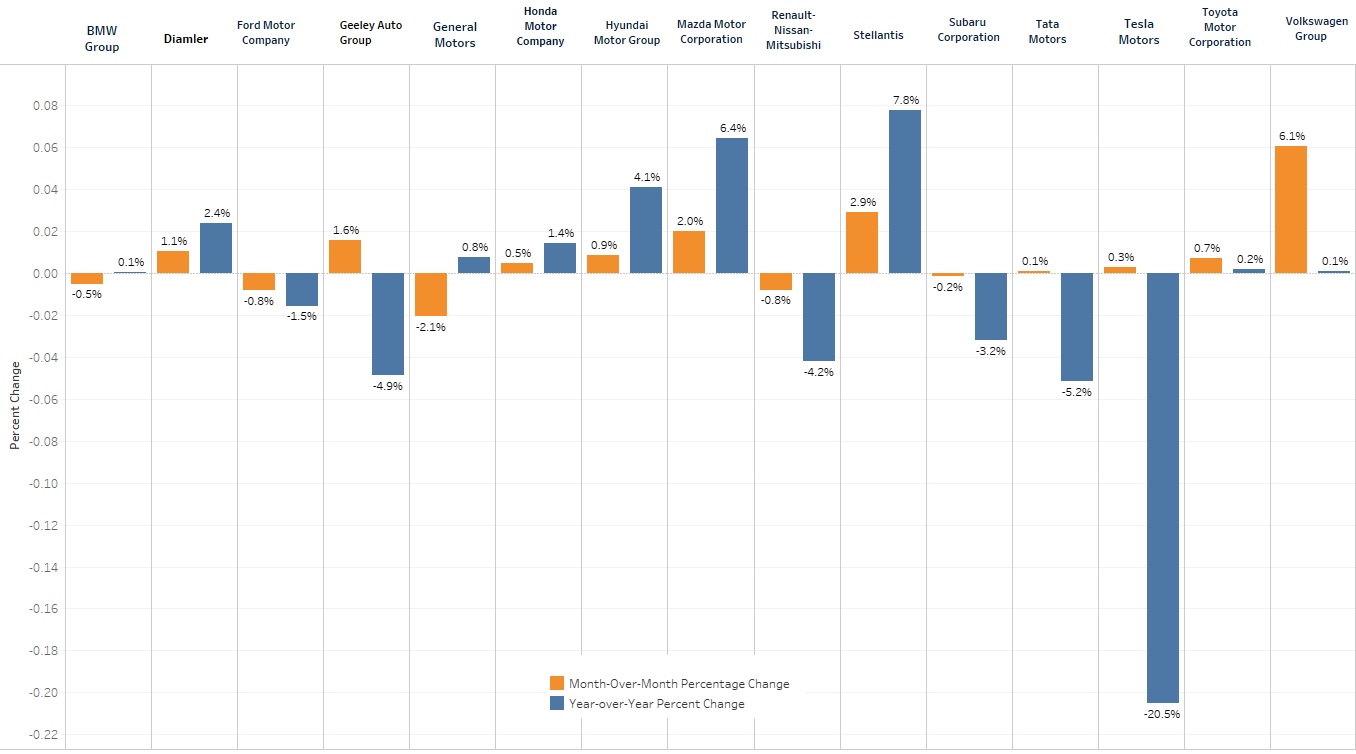
Price change percentage by automaker November 2023
It's also worth noting that the rise in EV ATP last month happened despite the fact it was "supported by incentive levels well above the industry average," according to KBB. More specifically, EV incentives in November reached their highest point of 2023 at 8.9% of the average transaction price (ATP); a year ago, EV incentives were less than 2% of ATP.
"In recent months, price parity between EVs and ICE has almost seemed possible," said Stephanie Valdez-Streaty, director of Strategic Planning at Cox Automotive. "It is a complicated measure with plenty of variables, but newer products and higher discounts have brought down average EV prices, even before potential tax incentives. A year ago, the EV premium was more than 30%. Today, it's less than 10%."
KBB did not reveal what the ATP for ICE cars was in November; its data did include the average purchase price for hybrids/alternative energy cars, which was $49,680. Still, since the vast majority of new-vehicle sales in the U.S. consists of cars powered by internal combustion engines (including hybrids), the gap in average prices for EVs vs ICEs was actually higher; unfortunately, we don't know the exact percentage.
More stories on price parity between EVs and ICEs
 EV Price Parity With Gas-Powered Cars May Not Come Until After 2030: Ford CEO
Renault CEO Doubts EVs And ICEs Will Reach Price Parity Anytime Soon
What do you think?
View
Comments
Another interesting takeaway from this data set is that Tesla saw the highest year-over-year price change percentage of all the automakers: minus 20.5%. That's obviously due to the many price cuts the EV maker has made since December 2022.
However, compared to October, Tesla's ATP in November remained almost unchanged at $53,756 versus $53,606 (a 0.3% increase). To learn more about the average transaction prices for automakers, brands, or various categories of vehicles, check out the data tables.
We want your opinion!
What would you like to see on Insideevs.com?
Take our 3 minute survey.
- The InsideEVs team
Share this Story
- (https://twitter.com/intent/tweet?url=https%3A%2F%2Finsideevs.com%2Fnews%2F701765%2Fprice-parity-between-evs-ices-was-moving-target-november%2F&text=Price%20Parity%20Between%20EVs%20And%20ICEs%20Was%20A%20Moving%20Target%20In%20November&via=InsideEVs)
- copy
GO TO COMMENTS
(
)
Got a tip for us? Email: tips@insideevs.com
View all comments ( )
Trending
Kia EV3 Lease Deals Are Here, And It’s Cheaper Than The Chevy Bolt And Nissan Leaf
I Let Android Auto Plan My EV Roadtrip. Here’s How It Worked
This Chevy Bolt Has 470,000 Miles. Here’s How Much A New Battery Was
Here's What It's Like To Take Delivery Of A Rivian R2
latest articles
- How Much Range Do EVs Lose When Parked? (And How to Stop It) Oct 20 - EV 101 -
- This Chinese EV Is Now Made In Europe. More Are Coming Oct 20 - News -
- GM Is Closing Its Detroit EV Battery Plant Oct 20 - Industry -
- The 2027 Lexus NX Plug-In Hybrid Gets A Bigger Battery And Fast Charging Oct 20 - Official -
- Kia EV3 Lease Deals Are Here, And It’s Cheaper Than The Chevy Bolt And Nissan Leaf Oct 20 - Pricing -
- Here's What It's Like To Take Delivery Of A Rivian R2 Oct 19 - News -
- Used EVs Hit A Record Share Of Overall Used Car Sales In September Oct 19 - Sales -
RECOMMENDED FOR YOU
Kia EV3 Lease Deals Are Here, And It’s Cheaper Than The Chevy Bolt And Nissan Leaf
This Chinese EV Is Now Made In Europe. More Are Coming
The Volkswagen ID.4 Just Got Up to $12,500 Cheaper in America
GM Is Closing Its Detroit EV Battery Plant
‘The Trend Is Clear’: How EVs Are Closing In On Gas Car Prices
The 2027 Lexus NX Plug-In Hybrid Gets A Bigger Battery And Fast Charging
The 2027 Karma Gyesera Is $35,000 Cheaper Than The Revero It Replaces