
Woman Orders Waymo In Los Angeles For Her Daughter. When She Gets In, There’s A Man Already Inside … The Trunk
“They just put me in here … the people.”
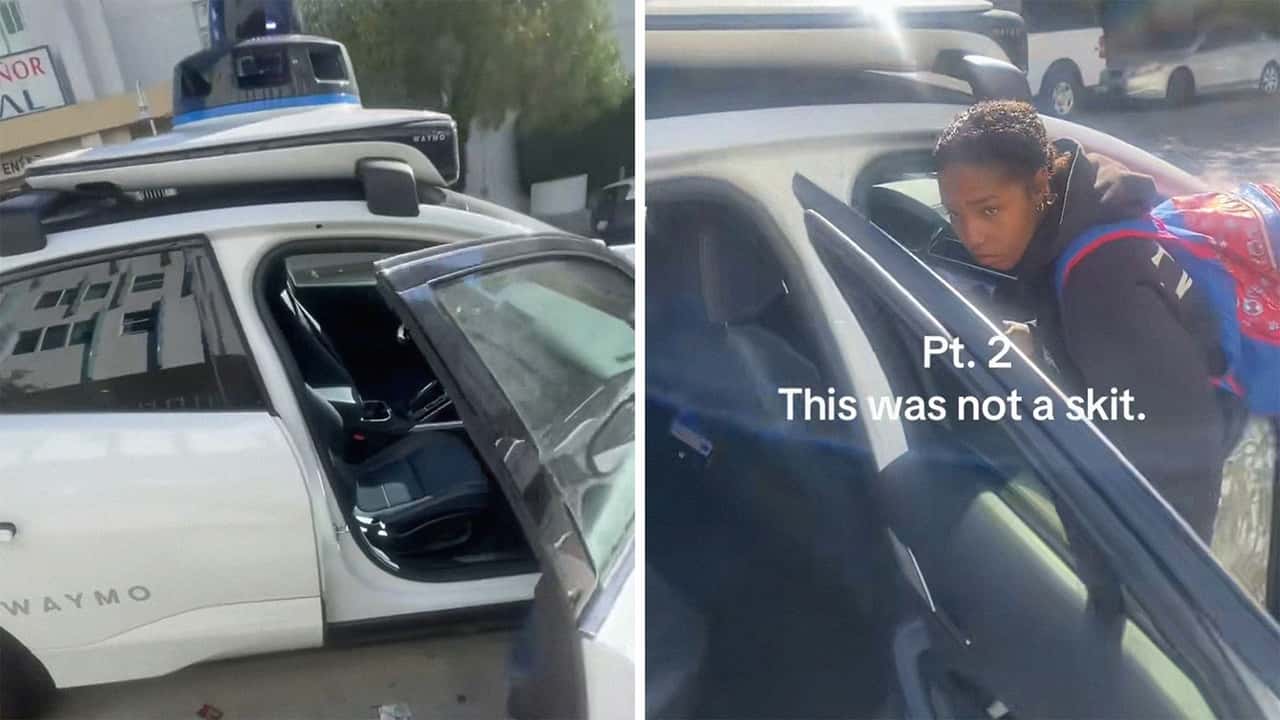

Waymo’s self-driving cars are engineered to try to manage lots of difficult tasks: navigate traffic, avoid pedestrians and drive safely through complex intersections. But nothing in the system seems designed for what one rider discovered: a man hiding in the trunk when her ride arrived.
The viral clip from creator luckythurman (@luckythurman), which has been viewed more than 6.3 million times, cuts to an unbelievable, chaotic scene in Los Angeles near MacArthur Park, where she discovers a strange man seemingly trapped in the trunk of the Waymo taxi she’d called for her daughter.
She’s understandably confused and in disbelief at the man’s claims that “They just put me in here … the people.” In a follow-up clip, we see the man being questioned by police, while the creator and her daughter try to process what they’ve just seen.
A Ride No One Expected
In the initial clip, the woman stands at the open rear passenger door, filming as the man shifts awkwardly inside the cargo area. He appears disoriented and unsure of how long he has been in the vehicle. When she asks who put him there, his answer of “the people” only heightens the tension and confusion. The creator says she had ordered the autonomous taxi for her teenage daughter, intending it to be a safe, straightforward pickup. Instead, she found herself documenting something she and millions of viewers had no framework for: a fully driverless vehicle arriving with an unknown person already onboard.
According to news reports, Waymo issued the following statement: “We're committed to keeping our riders safe and earning the trust of the communities where we operate. This experience was unacceptable, and we are actively implementing changes to address this."
If the situation inside the Waymo was strange, the reaction online was its own spectacle. TikTok commenters swung wildly between alarm and gallows humor, with many focusing on the man’s cryptic line about “the people” who “put” him in the trunk. Others leaned into wordplay, joking that the mom showed “waymo patience than me,” or suggesting she “sue them and get waymo money” to cope with the shock.
Alongside the jokes, an unmistakable thread of fear ran through the reaction. Some viewers insisted the man was attempting to ambush the next passenger. Others worried he was a victim himself. A handful suggested a more mundane possibility: that he was a rider from a previous trip who either hid or got stuck in the cargo area as the car advanced to its next assignment. One commenter pointed out that trunk emergency latches are not always obvious, and that a rider could easily be trapped if the vehicle departed too quickly for them to exit.
FROM THE TRENDING NEWS DESK
Viral bits from across the social media landscape
Our team of experts tracks what's trending so you don't have to—from viral videos to online debates that have everyone talking.
What struck many viewers most was the sheer unpredictability of an incident that didn’t involve a traffic decision or sensor failure, but a human factor that AV systems may not be built to detect.
Waymo, a subsidiary of Alphabet, operates fully driverless vehicles in several U.S. cities, including Phoenix, San Francisco, and Los Angeles. The company describes its vehicles as equipped with an array of cameras, lidar, radar, and onboard computing designed to assess road conditions, identify nearby objects, and ensure the safety of passengers and pedestrians.
Inside the cabin, Waymo vehicles also use cameras and weight sensors to confirm that seats are occupied and seat belts are buckled, triggering alerts or halting rides if something appears unsafe.
But these detection systems are oriented toward the seating area. Cargo compartments, which are not considered passenger zones, typically lack the same level of sensor coverage. Federal Motor Vehicle Safety Standards require emergency trunk releases in traditional cars (NHTSA FMVSS 401), but those mechanisms are manually operated and are not integrated into robotaxi rider-count systems.
Experts have long noted that autonomous vehicles struggle most when humans behave unpredictably or outside expected norms. A 2024 RAND Corporation analysis of AV safety challenges found that atypical human behavior remains among the hardest scenarios for autonomous systems to classify and act upon. A person hiding in a trunk qualifies as precisely the kind of low-probability, high-impact scenario AV developers cannot always anticipate.
Waymo, for its part, has previously stated that human remote operators do not monitor vehicle interiors in real time and instead receive alerts only when the system detects anomalous conditions. A person in a trunk, invisible to seat sensors and cabin cameras, may not trigger any system response at all.
The Bigger Safety Question
Incidents involving unusual human behavior around autonomous vehicles have drawn scrutiny in recent years. Waymo and Cruise have both faced regulatory setbacks following high-profile failures, including blocked emergency vehicles, unexpected stops in traffic and difficulties navigating construction zones. The National Highway Traffic Safety Administration opened multiple investigations into autonomous systems in 2023 and 2024, citing concerns about how AVs handle “complex road user interactions.”
But this case touches a different nerve, assuming it’s found to be legitimate. It is not about a system misjudging a turn or failing to yield. It is about what autonomous taxis owe riders beyond driving: physical security, interior monitoring and assurance that no one is on board before pickup.
For parents using services like Waymo to ferry children, these questions are especially charged. Waymo advertises safety as a core advantage over human-driven ride-hail services, citing its collision statistics and consistent driving behavior. But as the viral clip shows, not all risks are in the software stack.
The episode is already adding to the debate about the blind spots in vehicles that rely on a blend of sensors and algorithms to assess rider safety. If autonomous taxis are to function as family-friendly transportation and be trusted enough to carry teenagers alone, questions about securing the entire cabin, not just the seats, will likely grow louder.
For now, the internet is left with a surreal moment: a robotaxi that arrived not empty but occupied by a man who wasn’t supposed to be there, and a rider trying to make sense of technology that didn’t seem to notice him at all.
InsideEVs has reached out to the creator via direct message and comment on the clip. We’ll update this if they respond.
RECOMMENDED FOR YOU

Woman Buys Cadillac EV. Then They Offer Her A Deal On EVgo
Drivers Are Not Happy With Their Cars' Screens
"The Motor Is Supposed To Last 1 Million Miles": Man Hits 360,000 Miles On His Model 3. Is That The Norm?
Lucid Cosmos And Earth: Everything We Know About The Tesla Model Y Rivals
"Dealerships Are Shady": Man Says Texas Toyota Dealership Agreed To Sell Highlander Hybrid For $26,900, Then Jacked Up The Price
This Chinese SUV Sold 100,000 Units In Seven Months For A Good Reason
Can Waze Still Track The Police?