
‘The More You Learn The Less You Earn’: Mechanics Say They Make Less Money With An EV Certification. Is It True?
“I'll be replacing batteries and electric drive motors in about a month, pray for me”
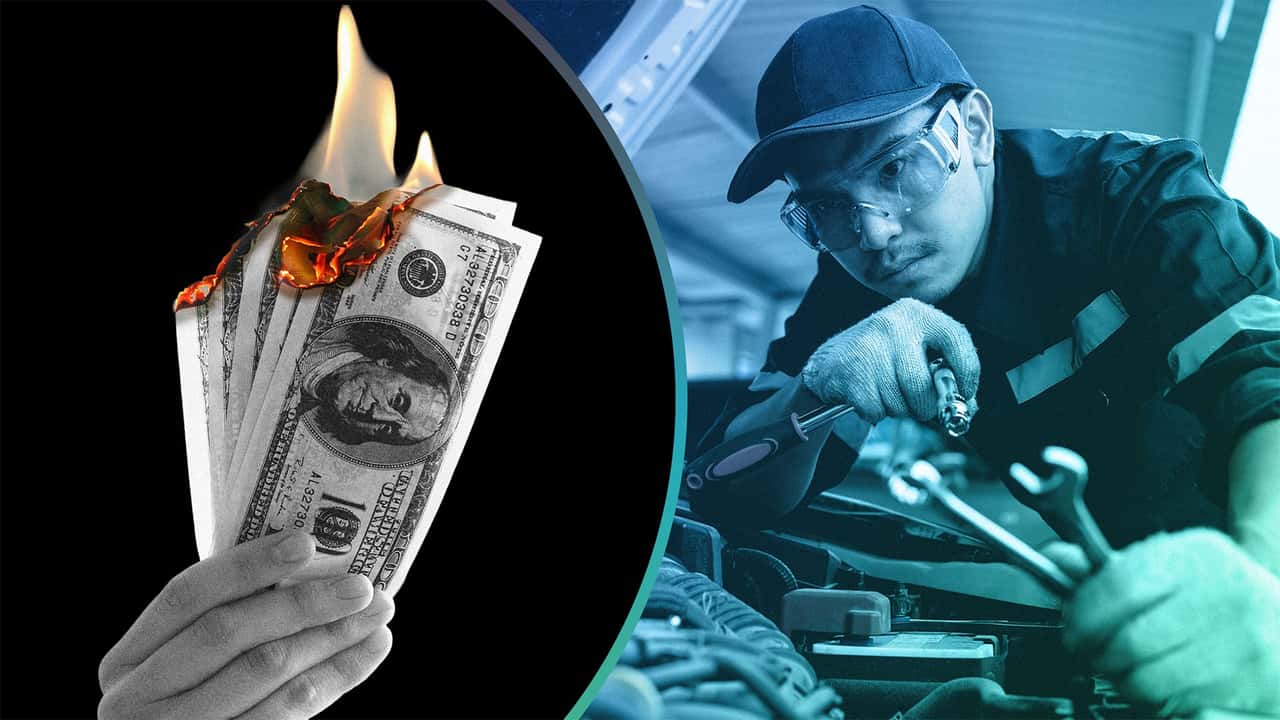

A shiny new badge on a mechanic’s shirt once meant better pay. Now, some technicians joke that every certificate is another step down the wage ladder, and EV training may be the steepest drop yet.
In a viral Facebook Reel that has been viewed more than 300,000 times, creator and lube tech The POV Mechanic (@thepovmechanic) doesn’t seem optimistic that his career trajectory will improve after becoming certified to work on electric vehicles. “I'll be replacing batteries and electric drive motors in about a month, pray for me,” he notes in the caption to the clip.
Payments Out Of Step
The irony is hard to miss. In many trades, expanding your credentials is supposed to open doors to better pay and more advanced work. However, the frustration evident in comment threads under that Reel suggests that many EV-certified mechanics feel the opposite has happened. One technician laments, “The more you learn the less you earn.” Another adds, “Learning how to use a lab scope was a bad idea.” Several blame warranty jobs and diagnostic-heavy work areas as being more common with EV service, which they say drives down their effective earnings.
To understand why these complaints resonate so widely, one must first examine the way many auto technicians are paid: the flat-rate or flat-hour model. Instead of being compensated for the time spent, technicians are paid according to pre-set time allowances for specific jobs (the “book time”), regardless of how long the work actually takes. When performing warranty work, this time the manufacturer often dictates allowances and tends to be more restrictive than comparable customer-pay estimates. Under those constraints, a complex EV task such as a battery replacement, module diagnostics or software calibration may last far longer than the allotted time, but the technician is paid no more.
Now Trending
The problem reflects a lag in compensation models keeping pace with evolving vehicle architectures. As vehicles become more software-intensive and electrified, the nature of repair shifts: fewer oil changes and brake jobs, more battery, electric drive, wiring and software work. Yet many dealerships and shops still rely on flat-rate systems built for mechanical, repeatable labor, which penalize time-intensive, variable or diagnostic tasks.
But some mechanics do report success. One commenter, Jake Casto, said EVs are “clean, easy, and … pay more.” Others mention employers who place higher value on EV skills and reward accordingly. There are service centers at EV brands and specialized independent shops that offer competitive wages to attract certified techs, capitalizing on the shortage of qualified EV repair professionals.
FROM THE TRENDING NEWS DESK
Viral bits from across the social media landscape
Our team of experts tracks what's trending so you don't have to—from viral videos to online debates that have everyone talking.
EV Techs Are Badly Needed
Meanwhile, the industry is keenly aware that demand for qualified technicians is rising.
According to the TechForce Foundation’s recent Supply & Demand reports, the U.S. will need roughly 795,000 new transportation technicians over the next five years. Their 2024 report suggests that growth in technician employment is outpacing the general U.S. labor force, yet the gulf between demand and supply remains crucial. In fact, in late 2024 TechForce adjusted its estimate further upward: It now expects nearly 971,000 total technician roles across automotive, diesel, collision and aviation to need filling through 2028. The automotive sector alone remains under pressure even as more graduates enter the workforce.
If EVs require less routine mechanical maintenance (for example, no oil changes, fewer fluid flushes, fewer moving parts), their part of the repair cake shrinks. That limits volume opportunities for work. Indeed, one of TechForce’s own methodology footnotes says that battery electric vehicles (BEVs) have lower scheduled maintenance costs per mile compared to gas-powered vehicles. In other words, fewer routine maintenance tasks mean fewer guaranteed hours across the board.
So, while the need for specialists rises, the nature of the work means that many tasks are one-off, diagnostic or warranty-related—categories that are poorly compensated under traditional flat-rate systems. That creates a financial squeeze for the very mechanics being trained to support the shift. As one industry article puts it: “Flat-rate technicians have been forced to cut corners” to focus on completing as many jobs as possible, which can reduce collaboration and overall customer experience.
Pressure for regulatory and legislative change is already bubbling. In New York State, a new law aims to close the two-tier compensation gap by requiring that warranty and recall labor be compensated at the same labor time allowances as those used for non-warranty work. If that reform spreads, it could realign incentives for technicians working under warranty schedules in EV-centric shops.
The crux of the issue is this: EV training is neither inherently bad nor a bad idea. The issue is the mismatch between evolving technical complexity and antiquated pay models. Techs are becoming better educated, more specialized and more capable, and yet the system still rewards them based on a clockwork grid that assumes repetitive mechanical labor.
In the end, the mechanic who quips, “I get my EV certification just to lose money,” may not be joking until compensation evolves.
InsideEVs reached out to the creator via email. We’ll be sure to update this if they respond.

RECOMMENDED FOR YOU

Woman Buys Cadillac EV. Then They Offer Her A Deal On EVgo
The U.S. Strongarms Polestar Out Of The American EV Market
"The Motor Is Supposed To Last 1 Million Miles": Man Hits 360,000 Miles On His Model 3. Is That The Norm?
The Production McMurtry Speirling Will Not Look Like The Prototypes
"Dealerships Are Shady": Man Says Texas Toyota Dealership Agreed To Sell Highlander Hybrid For $26,900, Then Jacked Up The Price
Tesla Is Giving Away Free Supercharging. Here's How To Win.
Can Waze Still Track The Police?