Home
Tesla
Model 3
News
Tesla Model 3 With 50,000 Miles: Battery Degradation?
We finally have some hard data for the Model 3.

EVANNEX 
By: EVANNEX
Oct 9, 2019 at 9:47am ET
Add InsideEVs as a preferred source in Google
- (https://twitter.com/intent/tweet?url=https%3A%2F%2Finsideevs.com%2Fnews%2F375459%2Ftesla-model-3-50k-miles-battery-degradation%2F&text=Tesla%20Model%203%20With%2050%2C000%20Miles%3A%20Battery%20Degradation%3F&via=InsideEVs)
- copy
Share
Comment
The question of how much battery capacity will be lost over time arises with most potential (and new) electric vehicle owners. Now, we have some hard data from existing Tesla Model 3 owners which can help uncover the answer.
Related Content:
 Tesloop Explains Various Causes For Tesla Battery Degradation
- This article comes to us courtesy of EVANNEX (which also makes aftermarket Tesla accessories). Authored by Iqtidar Ali. The opinions expressed in these articles are not necessarily our own at InsideEVs.

Above: Tesla's Model 3 (Source: Tesla)
Elon Musk stated earlier this year that the Tesla Model 3 drive unit and body was designed to last one million miles. The battery, however, has a minimum lifespan of 1,500 charge cycles which should translate to 300,000+ miles (standard range/standard range plus) to 500,000 miles (long-range variants).
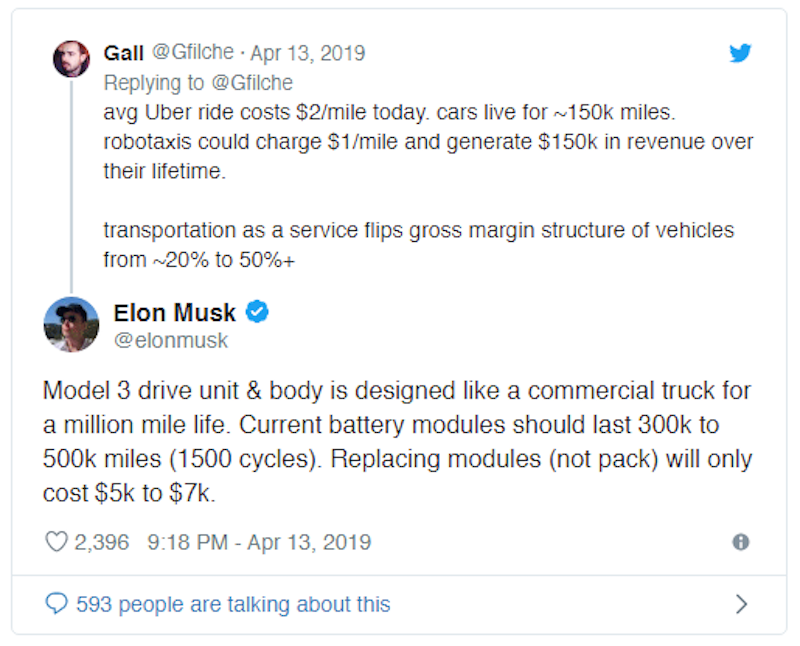
Above: Elon Musk responds to Galileo Russell's tweet about Tesla battery life and charge cycles (Twitter: Elon Musk)
The math in Musk’s tweet is straightforward enough:
- Standard Range Plus Model 3 has 240 miles of range, so 240 x 1500 = 360,000 miles
- Long-Range Model 3 variants have 310 to 325 miles of range, therefore 310 x 1500 = 465,000 miles
A charge cycle is when you've used 100% of rated battery capacity. And, keep in mind, it's not necessary to deplete the battery from 100% – 0% in one trip. To that end, we can understand a charge cycle via a simple example: let’s assume you've driven your car 120 miles today (50% depletion on SR+) and plugged-in for the night and charged it to 100% and you went on a 120 mile road trip the next day, using 50% of the battery again — this would be counted as ‘one cycle’ according to Apple Inc.

Above: Another look at Tesla's Model 3 (Twitter: @Yazvec)
To put things in perspective, according to the US Department of Transportation Federal Highway Administration, Americans drive an average of 13,476 miles a year. Therefore, reaching 300,000 – 500,000 miles will take quite a bit of time for the average Joe (see table below for a detailed breakdown by age and gender).

Table: Average annual miles driven by age group in the United States. Tap/Click to open full-size chart (Source: FHWA via X Auto)
Tesla's warranty covers Model 3 battery packs ‘8 years or 120,000 miles’ for long-range variants and ‘8 years or 100,000 miles’ for standard and standard range plus variants. So, based on the table above, it takes around 3.7 years for the average Joe to drive 50,000 miles. That means Tesla’s 100,000 – 120,000 mile warranty is plenty sufficient to cover 6-8 years for most typical drivers out there.
But not everybody drives like the average Joe. Twitter user, @TeslaMiles, gathers data for the highest mileage Tesla owners via his Tesla High Mileage Leaderboard. The 76 highest mileage Model 3 owners on his list have accumulated 2.9 million miles which translates to an average of 39,372 miles driven for each car.

Above: Tesla Model 3 high mileage leaderboard (Twitter: @TeslaMiles).
One of the those highly ranked Model 3 owners on the list (#8) is Matthew from the YouTube channel, Tech Forum. Matthew shared his thoughts on how much battery degradation he's seen in his Model 3 after driving more than 50,000 miles.
Above: Model 3 battery degradation at 50,000 miles (YouTube: Tech Forum)
It turns out that Matthew lost only around 2% of the total battery capacity after completing his first 50,000 miles. In the video, he explains that the first 50,000 miles of battery degradation tends to be the biggest hit. After that, the drop in lost capacity appears to be consistently low.

Above: A visual representation of Tesla Battery Degradation gathered from 2,636 Tesla owners. Tap/Click to open graph in a new tab (Source: Teslanomics by Ben Sullins)
Okay, but what about battery degradation when you hit 100,000 miles, or say, 200,000 miles? Teslanomics analyzed battery degradation using data from 2,636 Teslas. If you note the cluster of blue above, most Teslas retain above 90% battery capacity even after they've reached 100,000 miles. Sure, battery degradation may continue at 200,000 miles but you'd be surprised how many epic Tesla road trips are still being enjoyed by those high-mileage, all-electric road warriors out there.
What do you think?
View
Comments
===
Written by: Iqtidar Ali. An earlier version of this article was originally published on X Auto.
- InsideEVs Editor’s Note: EVANNEX, which also sells aftermarket gear for Teslas, has kindly allowed us to share some of its content with our readers, free of charge. Our thanks go out to EVANNEX. Check out the site here.
Source: Evannex
We want your opinion!
What would you like to see on Insideevs.com?
Take our 3 minute survey.
- The InsideEVs team
Share this Story
- (https://twitter.com/intent/tweet?url=https%3A%2F%2Finsideevs.com%2Fnews%2F375459%2Ftesla-model-3-50k-miles-battery-degradation%2F&text=Tesla%20Model%203%20With%2050%2C000%20Miles%3A%20Battery%20Degradation%3F&via=InsideEVs)
- copy
GO TO COMMENTS
(
)
Got a tip for us? Email: tips@insideevs.com
View all comments ( )
Trending
GM's Next-Generation EV Platform Has 30% Less Wiring And 20% Less Battery
Can The BMW iX3 Take Down The Tesla Model Y L And Rivian R2?
GM's OnStar AI Assistant Debuts In The Cadillac Lyriq
Electrify America’s Largest EV Charging Station Is Missing One Big Thing
latest articles
- The 2027 Ford Mustang Mach-E Has More Range As Standard Oct 22 - Official -
- BMW’s Electric M3 Had To First Win Over One Of Its Own Oct 22 - News -
- Seattle Is Installing Hundreds Of Curbside EV Chargers Oct 22 - Charging -
- Spotify’s First Native In-Car App Is Hitting Audi EVs First Oct 22 - Software -
- Tesla Says 75% Of New Car Buyers Subscribe To FSD In North America Oct 21 - News -
- 'End Of The Year': Tesla Says Cybercab Customer Deliveries Will Begin Soon Oct 21 - News -
- The Midterms Won't Mean Much For EV Policy, Analysts Say Oct 21 - News -
RECOMMENDED FOR YOU
The Best Affordable Electric Cars In 2026: Cheap, Reliable Options For Everyone
Seattle Is Installing Hundreds Of Curbside EV Chargers
The Boring Company Uses Tesla Model 3 Sleds To Shuttle Shipping Containers Through Its Tunnels
Spotify’s First Native In-Car App Is Hitting Audi EVs First
The Longest-Range EVs You Can Buy In 2026
Tesla Says 75% Of New Car Buyers Subscribe To FSD In North America
The Tesla Model 3 And Model Y Can Now Power Your Home In A Blackout