Home
Tesla
Model 3
News
Watch Tesla Model 3 In Snow: FWD Vs RWD Vs AWD Comparison
The Performance version of the car was tested in the Track Mode with 100% rear, 100% front or 50/50 power distribution.

Mark Kane 
By: Mark Kane
Jan 23, 2022 at 10:34am ET
Add InsideEVs as a preferred source in Google
- (https://twitter.com/intent/tweet?url=https%3A%2F%2Finsideevs.com%2Fnews%2F562467%2Ftesla-snow-fwd-rwd-awd%2F&text=Watch%20Tesla%20Model%203%20In%20Snow%3A%20FWD%20Vs%20RWD%20Vs%20AWD%20Comparison&via=InsideEVs)
- copy
Share
Comment
Here is an interesting test and comparison of winter driving in front-wheel drive (FWD), rear-wheel drive (RWD) and all-wheel drive (AWD) car on snow.
Tyre Reviews recently had an opportunity to test a Tesla Model 3 Performance on a test track. This version of the car is dual-motor, all-wheel-drive.
However, thanks to the Track Mode, the driver can change settings of power distribution between the front and rear in 10% steps, including 100% rear or 100% front. This allows testing the same car with FWD, RWD and AWD (50/50) settings.
** Despite FWD/RWD settings, the car still might use the other axle, for example, to accelerate faster.*
"Please note we were unable to do traction testing as the Tesla defaults back to AWD when the car is straight, even if it's set to 100% rear wheel drive mode only. This will come at a later date."
Each of the three settings was tested on the track at -7°C on a car fitted with all-season tires (Michelin Pilot Sport All Season 4).
As it turns out, the lap times are similar between the FWD and RWD, while AWD is slightly faster:
- FWD: 101.3 seconds
- RWD: 99.1 seconds
- AWD (50/50): 94 seconds
More important are the insights. FWD is considered boring, but safe. The RWD is very enjoyable and turned out to be marginally quicker. The AWD is also nice and provides the best driving capabilities.
More about tires:
"Ordinarily the Model 3 Performance fits 20” wheels, Michelin have modified their car to accept the base OE 18” wheels which we used for the testing.
Also, the OE 18” tire size is 235/45R18, whereas we were only able to get 245/40R18 tires in time for this test. We ran the tires at the OE pressure of 42 psi."
Is AWD enough for snow?
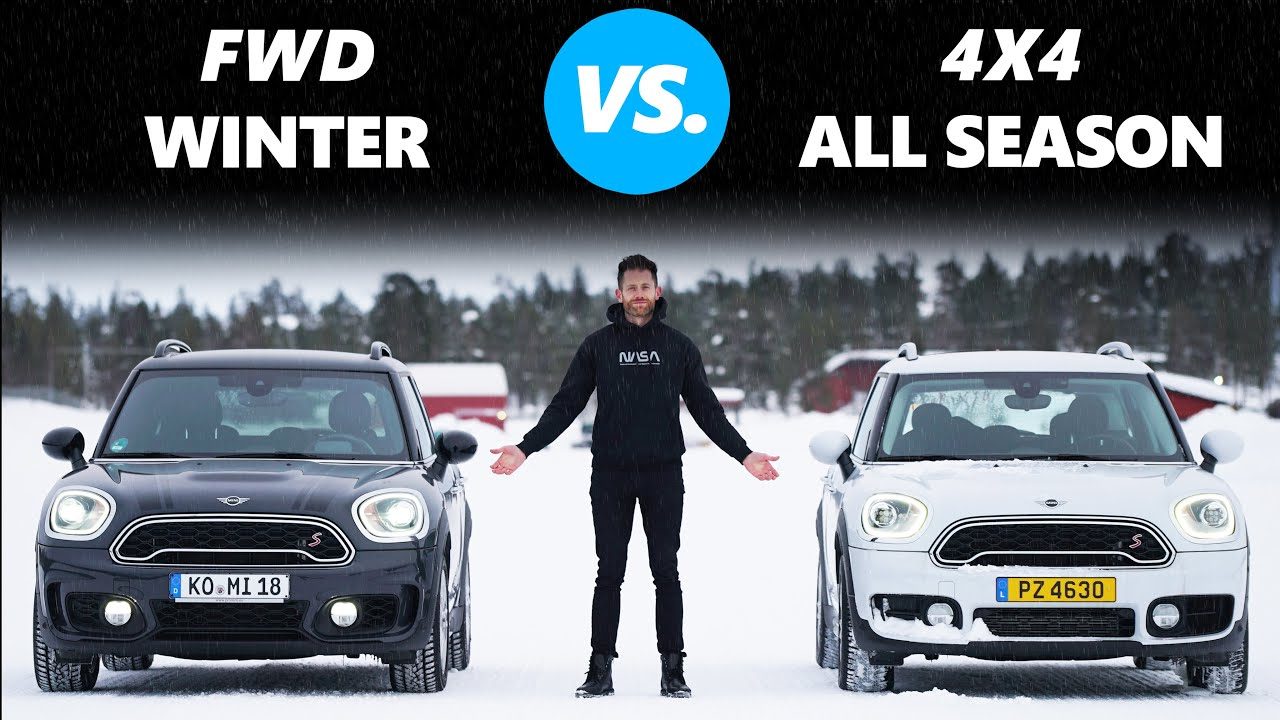
Speaking of tires, one might wonder whether AWD with all-season tires is good enough for winter driving. Well, it was not presented, but in a previous Tyre Reviews' video, we can see a comparison of conventional cars (Mini Countryman S) with:
- AWD and all season tires (Goodyear Vector 4Season Gen 3)
- FWD and winter tires (Goodyear UltraGrip Performance+)
What do you think?
View
Comments
The results show a huge advantage for AWD (all-season tires) in terms of accelerating, driving and starting uphill, while the winter tires (FWD) are better in terms of braking and turning.
It would indicate that AWD and all-season tires would be enough as a basic solution, especially if the winter period is relatively short and if the speed on snow is limited and in flat areas (not much downhill braking).
See also
 Watch Tesla Model Y Vs Icy Incline: Is It Possible To Go Up?
Volvo C40 Winter Range Test Ends With Severely Limited Power
We want your opinion!
What would you like to see on Insideevs.com?
Take our 3 minute survey.
- The InsideEVs team
Share this Story
- (https://twitter.com/intent/tweet?url=https%3A%2F%2Finsideevs.com%2Fnews%2F562467%2Ftesla-snow-fwd-rwd-awd%2F&text=Watch%20Tesla%20Model%203%20In%20Snow%3A%20FWD%20Vs%20RWD%20Vs%20AWD%20Comparison&via=InsideEVs)
- copy
GO TO COMMENTS
(
)
Got a tip for us? Email: tips@insideevs.com
View all comments ( )
Trending
Lucid Is Slashing $15,000 Off The Gravity, But The Deal Won’t Last Long
The Remnants Of The Electric Saab That Never Was Are Going Up For Auction
What We Both Thought After Driving The Rivian R2
Aptera Finally Built Its First Car For Customer Delivery
Latest Stories
- The U.S. Let Volvo Keep Selling Cars. Polestar Got A No. What About Mercedes? Nov 22 - News -
- Tesla FSD V15 Makes Your Drive Look Like Grand Theft Auto Nov 22 - News -
- Waymo Is Recalling Its Robotaxis Because They're Not Great At Dealing With Human Instructions Nov 21 - Autonomous Vehicles -
- This EV-Swapped 1967 Porsche 912 Has 300 HP And A Split Battery Pack Nov 21 - News -
- This Plug-In Hybrid SUV Towed A Boeing 747 On Only 2 Wheels. Yes, Really. Nov 21 - Towing -
- BYD's Latest SUV Can Hide Its Steering Wheel When You Don't Need It Nov 20 - China -
- What We Both Thought After Driving The Rivian R2 Nov 20 - Podcast -
RECOMMENDED FOR YOU
The Best EV Lease And Finance Deals In November 2026
The U.S. Let Volvo Keep Selling Cars. Polestar Got A No. What About Mercedes?
Tesla Model 3 Maintenance Guide: What Needs Servicing And What Doesn't
Waymo Is Recalling Its Robotaxis Because They're Not Great At Dealing With Human Instructions
Tesla FSD V15 Makes Your Drive Look Like Grand Theft Auto
This EV-Swapped 1967 Porsche 912 Has 300 HP And A Split Battery Pack
Tesla's Driverless Cybercab Is Now Available In Dallas