Home
News
Autonomous Vehicles
YouTuber Fools Tesla Autopilot With A Painted Wall (Updated)
Call it the "Road Runner test." And it shows the weaknesses of Tesla's camera-only approach to autonomous driving.

Photo by: InsideEVs
Patrick George 
By: Patrick George
Mar 16, 2025 at 2:00pm ET
Add InsideEVs as a preferred source in Google
- (https://twitter.com/intent/tweet?url=https%3A%2F%2Finsideevs.com%2Fnews%2F753642%2Ftesla-autopilot-road-runner-test%2F&text=YouTuber%20Fools%20Tesla%20Autopilot%20With%20A%20Painted%20Wall%20%28Updated%29&via=InsideEVs)
- copy
Share
Comment
Update: As The Verge pointed out today, Rober's video contains a number of potential issues. Those include the apparent lack of Autopilot being switched on during portions of the test, the use of multiple takes and the fact that Luminar itself promoted the video. We have reached out to Rober for comment and will update if we hear back. Our original story follows below.
Tesla CEO Elon Musk is adamant that the company's future isn't so much matching competitors like BYD at making electric vehicles—it's in cars that can fully drive themselves. Yet Tesla's approach to autonomous driving technology is a unique and controversial one because it relies solely on cameras and artificial intelligence, not additional sensors like radar and lidar.
But a new video from YouTuber and engineer Mark Rober is a good illustration of the weaknesses of this approach. On his channel, the former NASA engineer and CrunchLabs founder outlines a test that's lifted straight from an old Looney Tunes short: can a fake, painted wall "fool" a Tesla on Autopilot into crashing?

Get the best news, reviews, columns, and more delivered straight to your inbox.
back
Subscribe For more info, read our Privacy Policy & Terms of Use.
Unfortunately, since Tesla's engineers haven't yet invented a way to zoom through the fake tunnel like the Road Runner, the car does, in fact, slam right into the wall like Wile E. Coyote would.
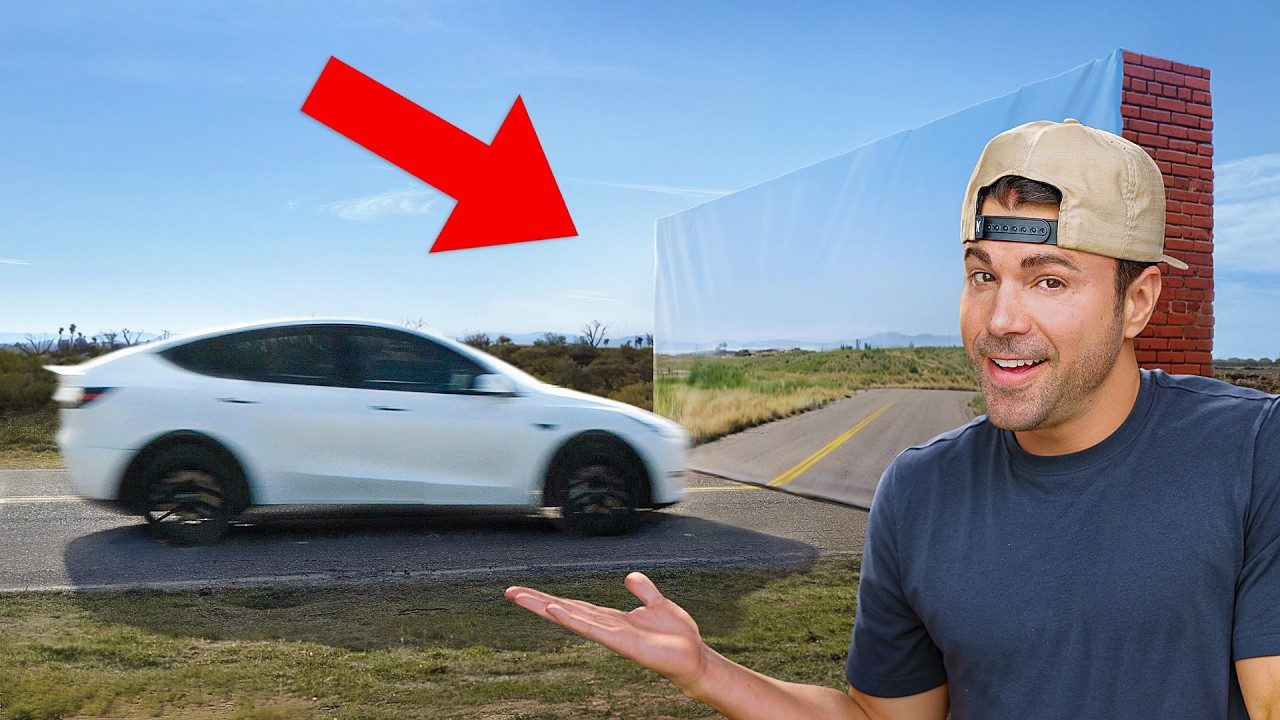
The relevant testing begins midway through this video. For comparison's sake, Rober enlists the help of a lidar-equipped Lexus SUV test vehicle from the company Luminar. At first, both vehicles pass the same test: stopping when a simulated child pops up in front of them during driving. Rober then shows the differences between how the two vehicles "see" the world.
But the real moment of truth comes later when Rober and his crew deploy the wall, which is painted up to look just like the road, sky and surrounding area.

Photo by: YouTube
The lidar-equipped Lexus detects the wall and stops ahead of it. The Tesla, unfortunately, does not. "I can definitively say for the first time in the history of the world, Tesla's optical camera system would absolutely smash through a fake wall without even a slight tap on the brakes," Rober said.
While Tesla's Autopilot and Full Self-Driving systems have improved dramatically over the years, they remain linked to dozens of crashes, some of them fatal, and have sparked a number of state and federal investigations. Yet many longtime autonomy experts say that Tesla's camera-based approach—which Musk touts because it's similar to how humans drive cars—will always be inadequate if the goal is to create self-driving cars that are safer and better than humans.
What do you think?
View
Comments
It's unlikely that you'll accidentally drive into any fake walls, since you aren't a cartoon character. But this video makes you wonder what else Tesla's camera-based system might miss if future cars don't even come with steering wheels or pedals.
Contact the author: patrick.george@insideevs.com
More Autopilot News
BYD's Answer To Tesla Autopilot Is Way, Way Cheaper
What Tesla Autopilot And Full-Self Driving Can And Can't Do
Tesla Just Released Autopilot Crash Data. We Have Doubts
Tesla Bet On 'Pure Vision' For Self-Driving. That's Why It's In Hot Water
Tesla Autopilot Trainers Were Told To Ignore ‘No Turn On Red’ Signs: Report
Tesla Reports Fewer Crashes, Incidents With Full Self-Driving In 2023 Vs. 2022
We want your opinion!
What would you like to see on Insideevs.com?
Take our 3 minute survey.
- The InsideEVs team
Share this Story
- (https://twitter.com/intent/tweet?url=https%3A%2F%2Finsideevs.com%2Fnews%2F753642%2Ftesla-autopilot-road-runner-test%2F&text=YouTuber%20Fools%20Tesla%20Autopilot%20With%20A%20Painted%20Wall%20%28Updated%29&via=InsideEVs)
- copy
GO TO COMMENTS
(
)
Got a tip for us? Email: tips@insideevs.com
View all comments ( )
Trending
Kia EV3 Lease Deals Are Here, And It’s Cheaper Than The Chevy Bolt And Nissan Leaf
I Let Android Auto Plan My EV Roadtrip. Here’s How It Worked
This Chevy Bolt Has 470,000 Miles. Here’s How Much A New Battery Was
Here's What It's Like To Take Delivery Of A Rivian R2
latest articles
- How Much Range Do EVs Lose When Parked? (And How to Stop It) Oct 20 - EV 101 -
- This Chinese EV Is Now Made In Europe. More Are Coming Oct 20 - News -
- GM Is Closing Its Detroit EV Battery Plant Oct 20 - Industry -
- The 2027 Lexus NX Plug-In Hybrid Gets A Bigger Battery And Fast Charging Oct 20 - Official -
- Kia EV3 Lease Deals Are Here, And It’s Cheaper Than The Chevy Bolt And Nissan Leaf Oct 20 - Pricing -
- Here's What It's Like To Take Delivery Of A Rivian R2 Oct 19 - News -
- Used EVs Hit A Record Share Of Overall Used Car Sales In September Oct 19 - Sales -
RECOMMENDED FOR YOU
How Tesla Is Pressuring European Regulators To Approve FSD
This Chinese EV Is Now Made In Europe. More Are Coming
Hyundai CEO's Answer For The EV Slowdown: Build Robotaxis
GM Is Closing Its Detroit EV Battery Plant
Lucid And Bolt Want To Put 25,000+ Robotaxis On European Roads
The 2027 Lexus NX Plug-In Hybrid Gets A Bigger Battery And Fast Charging
Tesla Says The Cybercab Is Street Legal. Regulators Want To Know How.