Home
Features
EV 101
Every EV Motor Type Explained: Not All EV Motors Needs Rare Earth Magnets
Not all EV motors have permanent magnets. Some replace them with powered coils or induction.
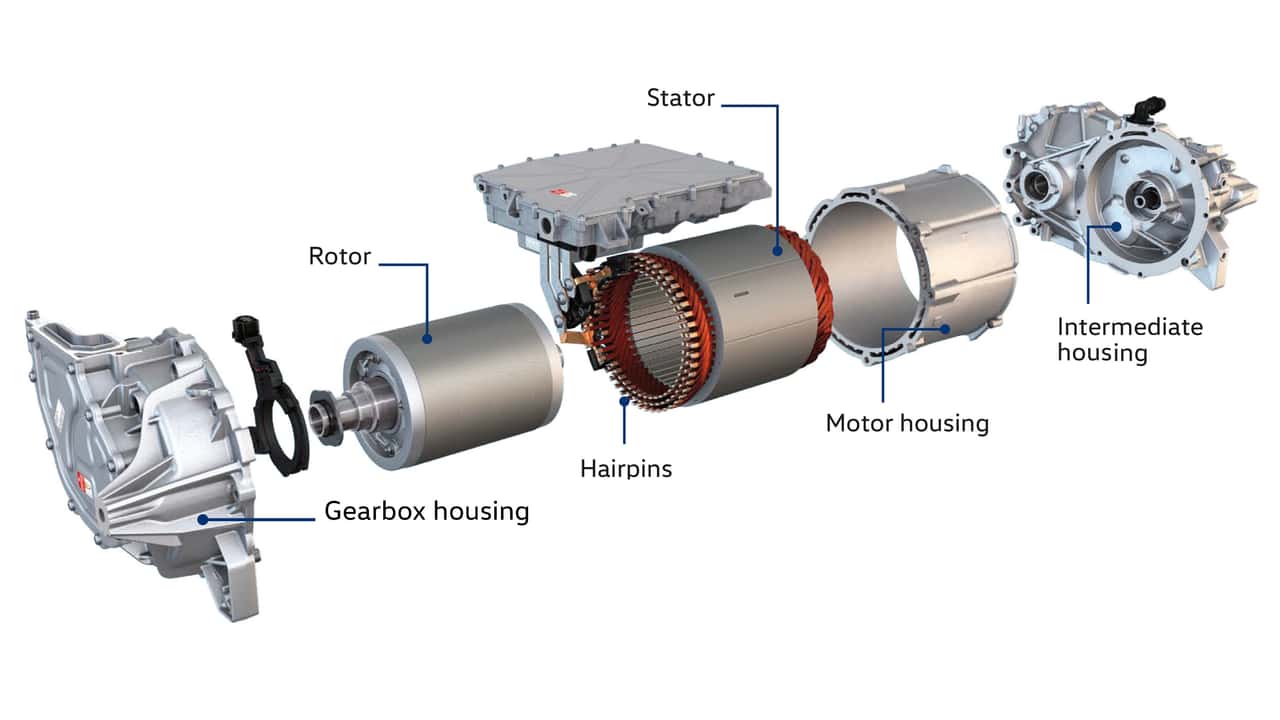
Photo by: Volkswagen
Andrei Nedelea 
By: Andrei Nedelea
Nov 17, at 12:04pm ET
Add InsideEVs as a preferred source in Google
- (https://twitter.com/intent/tweet?url=https%3A%2F%2Finsideevs.com%2Ffeatures%2F815764%2Fall-types-ev-motors-explained%2F&text=Every%20EV%20Motor%20Type%20Explained%3A%20Not%20All%20EV%20Motors%20Needs%20Rare%20Earth%20Magnets&via=InsideEVs)
- copy
Share
Comment
Electric motors don’t get nearly as much attention as batteries, but they're just as interesting and important. There’s a lot more going on inside them than “electricity goes in, rotor spins, wheels turn.” Automakers use different designs—sometimes on the same vehicle—to balance efficiency, performance, packaging, and cost.
The biggest difference is surprisingly easy to understand: where the rotor (the spinning part) gets its magnetism. Some motors have permanent magnets, while others create that magnetic field using electricity. They all use magnetism, but they generate and use it differently.
Here’s What Makes Electric Motors Spin

An electric motor's stator
An EV motor has two main parts: a stationary outer section called the stator and a rotating inner section called the rotor. The rotor is connected to a shaft that sends power to the wheels through reduction gearing, and it needs direct current (DC) from the battery.
An inverter converts that into controlled alternating current (AC), feeding the stator’s coils in a sequence that creates a rotating magnetic field. Try to picture the magnetic pull moving around a circle and the rotor following it.
The term ‘synchronous’ refers to a motor whose rotor spins at the same speed as that magnetic field. Permanent-magnet and electrically excited motors are in the synchronous motor category. Induction motors work with a speed difference between the stator and rotor.
Permanent-Magnet Motors: Bring Your Own Magnetism
Volkswagen Group's APP550 rear-wheel drive unit
In a permanent-magnet synchronous motor (PMSM), magnets attached to or embedded in the rotor provide the magnetic field. It's the stator’s rotating magnetic field that pulls the rotor around.
Picture a compass needle following a magnet you move around it. Now imagine that happening continuously, with a controlled field doing the pulling. For this type of motor, the rotor’s magnets don’t need an electrical supply to stay magnetic. That makes it preferable for efficiency reasons, as it avoids the losses associated with powering rotor windings.

Stay informed with our newsletter every weekday
back
Subscribe For more info, read our Privacy Policy & Terms of Use.
Its plus points include high efficiency and plenty of power from a compact, relatively lightweight package. Most EVs use permanent magnet motors for their main drive motors.
This comes at a cost. The powerful magnets typically used in EV motors contain rare earth elements, which can expose manufacturers to sourcing challenges and price fluctuations. “Permanent magnet” doesn’t necessarily mean “rare earth,” but that’s the material choice behind most such motors used for automotive applications.
Induction Motors: Always Chasing
Mercedes-Benz C-Class EV front motor
Photo by: Mercedes-Benz
An induction motor, also called an asynchronous motor, replaces those magnets with conductive bars inside the rotor. This design is often called a “squirrel cage” because the bars are joined by rings at both ends, resembling a rodent’s exercise wheel.
The moving magnetic field drives current through the rotor’s metal bars. That current creates the rotor’s magnetic field, allowing it to produce torque without permanent magnets or an electrical connection feeding the rotor.
As an EV equipped with one of these motors drives, the rotor turns slightly slower than the stator’s magnetic field. That difference, known as slip, is necessary to induce current. If the rotor caught up completely, induction (and its torque) would disappear.
Mercedes-Benz C-Class EV rear motor
Photo by: Mercedes-Benz
The design is robust and avoids rare-earth magnets, but generating current in the rotor produces heat and reduces efficiency. Unlike permanent-magnet motors, though, when it doesn’t receive power, it can spin with very little drag.
Audi cites this advantage for the Q6 E-tron Quattro’s front induction motor, which provides additional propulsion when needed; rear motor is permanent-magnet. This is a common setup in all-wheel-drive EVs, which use permanent magnet motors for their larger, permanently engaged drive axles, but less potent induction motors for the other axle. Many Tesla and GM EVs use this strategy, for instance.
Electrically Excited Motors: Make The Magnet Adjustable
Renault 5 drive unit
Photo by: Renault
An electrically excited synchronous motor, or EESM, takes a third approach. Its rotor carries coils supplied with electricity, turning it into an electromagnet. Unlike an induction motor, it doesn’t rely on slip to create its rotor field.
Think of the permanent-magnet design again, but instead of fixed magnets, you have electromagnets whose strength can be adjusted. “Excited” simply means energized by electricity. That ability to adjust power gives engineers another way to optimize operation as speed and load change.
BMW employs these motors in its latest sixth-generation EV powertrains, saying they use energy efficiently in everyday driving and keep delivering strong power even when spinning very fast. Renault uses this approach in vehicles including the Renault 5 E-Tech and explicitly points to a reduced need for rare earths and magnet suppliers as a reason for choosing wound rotors.
The compromise is that producing the rotor’s field consumes electricity, while its windings and power supply add complexity. Avoiding permanent magnets comes at a cost.
Why Choose Just One?
Geely SPA2 platform
The Audi Q6 E-tron Quattro is just one example of an EV using two types of motors. It illustrates why these designs exist (and coexist). The permanent-magnet rear motor handles propulsion efficiently, while its front induction motor adds performance and traction when required, with little drag when inactive.
What do you think?
View
Comments
BMW’s new all-wheel-drive setup instead pairs an electrically excited rear motor with a front induction motor. Other EVs, like the new ones from Mercedes-Benz, have a permanent-magnet front motor but can mechanically disconnect it from the wheels when it isn’t needed, avoiding the drag and energy losses of keeping it spinning and thus improving efficiency.
Choosing the right EV motor is as much about saving energy when it isn’t needed as making power when it is. That's why you'll continue to see a variety of motor designs in future EVs.
Every Kind Of Hybrid Explained: Parallel, Series, EREV, PHEV, MHEV
How Much Range Do EVs Lose When Parked? (And How to Stop It)
Coasting Vs. Regenerative Braking: What Saves EV Range The Most?
What Is One-Pedal Driving In An EV And Why Does It Matter?
We want your opinion!
What would you like to see on Insideevs.com?
Take our 3 minute survey.
- The InsideEVs team
Share this Story
- (https://twitter.com/intent/tweet?url=https%3A%2F%2Finsideevs.com%2Ffeatures%2F815764%2Fall-types-ev-motors-explained%2F&text=Every%20EV%20Motor%20Type%20Explained%3A%20Not%20All%20EV%20Motors%20Needs%20Rare%20Earth%20Magnets&via=InsideEVs)
- copy
GO TO COMMENTS
(
)
Got a tip for us? Email: tips@insideevs.com
View all comments ( )
Trending
I Tried Mercedes' Answer To Tesla FSD. Here's How It Went
Driven: BMW's Electric M3 Is The Real Deal
Tesla Opens Self-Driving Cybercab Orders To 'Select Customers' At $29,990
Tesla Model 3 Maintenance Guide: What Needs Servicing And What Doesn't
Latest Stories
- Every EV Motor Type Explained: Not All EV Motors Needs Rare Earth Magnets Nov 17 - EV 101 -
- DJI Made A Commuter E-Bike. I Tested It, And It's Really, Really Good Nov 17 - E-Bike Reviews -
- Every Kind Of Hybrid Explained: Parallel, Series, EREV, PHEV, MHEV Nov 17 - EV 101 -
- BYD Is Winning Over Japan With A Very Japanese Kind Of EV Nov 17 - News -
- Bentley’s First EV Is Already Sold Out, And Production Hasn’t Even Started Nov 17 - Sales -
- The Electric Baby Land Rover Defender And Range Rover GT Will Begin Production Next Year Nov 16 - News -
- Mercedes Is Bringing Hands-Free Driving To Certain U.S. Highways In 2027 Nov 16 - News -
RECOMMENDED FOR YOU
Every Kind Of Hybrid Explained: Parallel, Series, EREV, PHEV, MHEV
DJI Made A Commuter E-Bike. I Tested It, And It's Really, Really Good
The Best Affordable Electric Cars In 2026: Cheap, Reliable Options For Everyone
BYD Is Winning Over Japan With A Very Japanese Kind Of EV
How Much Range Do EVs Lose When Parked? (And How to Stop It)
Bentley’s First EV Is Already Sold Out, And Production Hasn’t Even Started
The Best Compact Electric SUVs To Buy In 2026 (Updated)