
The Roadster Will Have Tesla’s Most Advanced Battery Pack Yet
It’s also the fastest-charging Tesla ever.
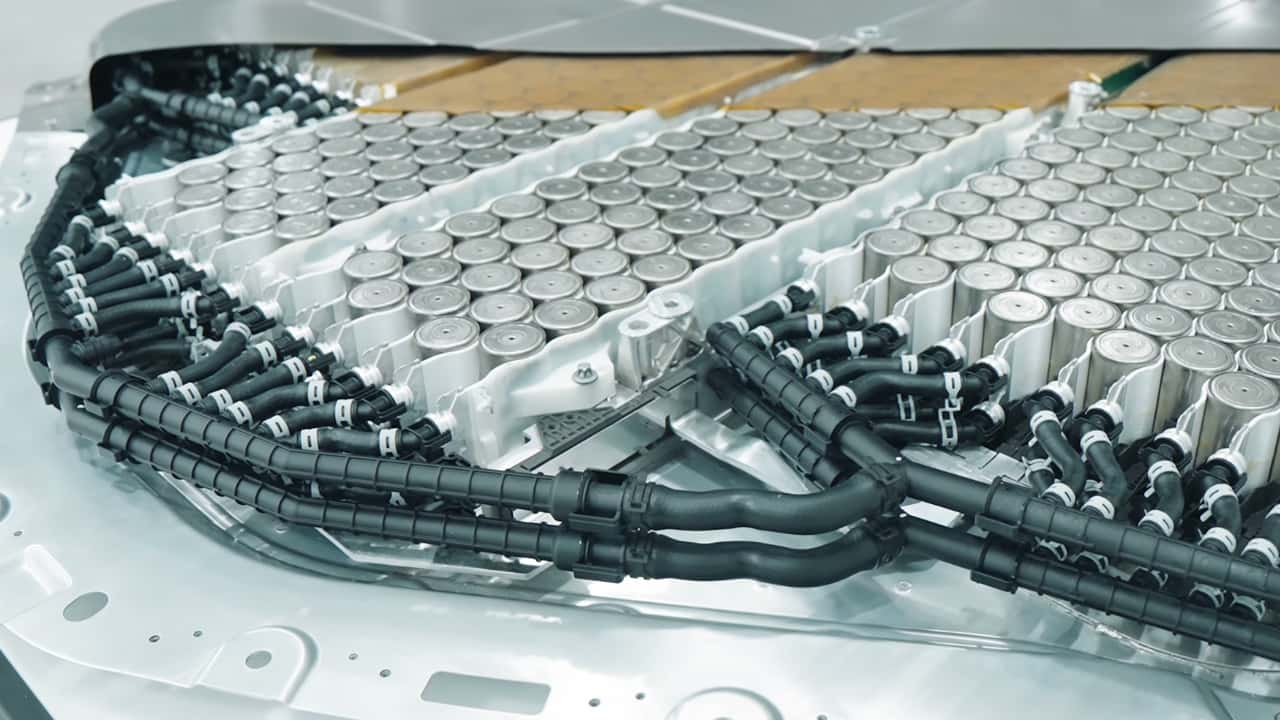

While the SpaceX-developed cold gas thrusters and powerful suction system grabbed most headlines around the Tesla Roadster's epic reveal, the supercar also needs solid EV fundamentals to deliver the kind of on-road performance the automaker is after. Tesla has taken care of that with its most advanced high-voltage battery pack yet.
While its ground-effect fans and make it drive upside down and jump over obstacles, it still needs solid fundamentals and as an EV for strong everyday performance. “It’s everything we learned at Tesla for 20+ years making electric vehicles put into one,” Lars Moravy, Tesla’s vice president of engineering told Hagerty’s Henry Catchpole, referring to the Roadster’s battery.

While we don’t know the pack’s size yet, Tesla said it will deliver more than 300 miles of range, plus serious charging and discharging performance. While batteries in its mass market models like the Model Y and Model 3 are geared toward longevity, Moravy said, the Roadster’s cells really prioritize power density and performance.
The automaker is using its own in-house developed 4680 cylindrical cells on the Roadster. Moravy called it a “bespoke chemistry for high power throughput” in a Top Gear video, but said the materials were still lithium-ion and nickel-based.
The more interesting bit, however, might be the battery’s thermal management system. The dual rear motors together generate a peak output of 1,341 horsepower and 1,032 pound feet of torque on the top trim. That means the battery cells can heat up very quickly if the cooling system isn’t good enough. To manage this heat, Moravy said the company used double-sided coolant tubes for each cell.
The cells themselves are made with aluminum cans, which he said are lighter than steel cans and are better at dissipating heat. There’s also a titanium upper plate over the entire pack, a lighter and thinner alternative to steel with better thermal insulation. The lower plate at the vehicle’s underbody continues to be aluminum for dent and impact resistance. As a result, the cells can not only discharge really fast, but also recharge within minutes.
Moravy said the Roadster will charge from 15-85% in just about 10 minutes, which is right up there with some of the fastest-charging EVs from Western automakers currently. The new battery-powered Mercedes-AMG GT can go from 11-80% in just 11 minutes, thanks to its peak charging rate of 600 kilowatts. More typical charging times for the latest high-end EVs are in the realm of 16-20 minutes for a 10-80% charge.
The Roadster’s exact peak charging speed isn’t clear. Moravy said it handle somewhere between 500 kW and a megawatt, which is confusing because that’s a really broad range. The exact voltage architecture is similarly unclear, with Tesla putting it at somewhere between 800 and 1,000 volts.
The Roadster's EV credentials seem superb, but it'll come with a high price tag to match. Let's hope some of this technology trickles down to its mass-market models.
Related Stories
RECOMMENDED FOR YOU
Tesla's Kickflipping Roadster Looks Like A Great Way To Lose Your Lunch
Ford's Radical New EV Manufacturing Process Is Already Building Trucks
Tesla 'Cannot Guarantee' Your Roadster Pre-Order Will Ever Be Delivered
Mercedes' Answer To Tesla FSD Requires Hands On The Wheel. Does That Make It Better Or Worse?
Tesla Just Revealed The Roadster With A Truly Insane Demo. Here's What You Need To Know
This New EV Motor Spins To 30,000 RPM. It’s Designed For Normal Cars
The Tesla Roadster Has 1,341 HP And Half The Range Elon Musk Once Promised. Here Are The Full Specs