Home
Volkswagen
ID. Buzz
Features
Volkswagen ID.Buzz Winter Road Trip: ‘A Total Train Wreck’
It’s not necessarily the car’s fault, though. Here’s why.

Photo by: TFLEV
Iulian Dnistran 
By: Iulian Dnistran
Dec 22, 2024 at 10:00am ET
Add InsideEVs as a preferred source in Google
- (https://twitter.com/intent/tweet?url=https%3A%2F%2Finsideevs.com%2Ffeatures%2F745142%2Fvw-id-buzz-winter-road-trip%2F&text=Volkswagen%20ID.Buzz%20Winter%20Road%20Trip%3A%20%E2%80%98A%20Total%20Train%20Wreck%E2%80%99&via=InsideEVs)
- copy
Share
Comment
- The Volkswagen ID.Buzz has a maximum EPA-rated range of 234 miles in the United States.
- But range is just one part of the equation when planning a road trip.
- The Fast Lane EV drove 500 miles in the ID.Buzz during a winter storm to see what it's like.
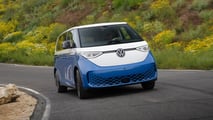
The Volkswagen ID.Buzz electric minivan is one cool EV. It looks fantastic, which isn’t something you can usually say about minivans, but VW has managed to blend enough nostalgia and new stuff into the ID.Buzz’s design that it just works.
However, since the U.S. specs of the reimagined Microbus hit the interwebs, a lot of people can’t move past one figure: 234 miles. That’s the maximum driving range of the 2025 Volkswagen ID.Buzz, as per the EPA, and it’s a huge pain point for those who were looking to get VW’s electric minivan for the purpose of cross-country travel.
The original Microbus from the 1950s and 1960s was far from a luxury vehicle, but it made a name for itself as a great road-tripping machine. So, can the new ID.Buzz live up to its ancestor’s legacy? Well, it’s complicated.
More ID.Buzz Stuff
 The VW ID. Buzz Beats Its EPA Range Rating In The Real World
Volkswagen ID. Buzz Dealer Markups Are Here, Even Though VW Said 'Don't'
2025 Volkswagen ID. Buzz Review: Where’s The Vision?
VW ID. Buzz Configurator Goes Live: $71,545 Top Trim Comes With Rear Drum Brakes
Our friends from The Fast Lane EV traded in their Tesla Cybertruck and got a brand-new Volkswagen ID.Buzz thinking they would use it for long and very long road trips. But a dodgy charging experience, freezing temperatures and a snowstorm made the car’s inaugural road trip a “total train wreck.”
As you can see in the video embedded below, the team set out to travel roughly 500 miles. They set off from a hotel that supposedly had EV chargers on site, but those turned out to be Tesla Superchargers, which the ID.Buzz can’t use yet. So, with 15% juice left in the battery, the first charging stop was an Electrify America DC fast charging station, where the ID.Buzz can charge for free for the first 500 kilowatt-hours.

However, all the stalls were broken and couldn’t be fixed remotely, according to an EA call center worker who said that a service team was booked to go to the site and make it operational once again.
The next stop was an EVgo station 11 miles away that was thankfully online and working. After this first successful top-up, the driver gave up using the built-in navigation system and turned to PlugShare to plan the next charging stops. The EVgo stop took 41 minutes during which nearly 70 kWh of energy was dispensed.
The next charging stop was at a Shell, which required a separate smartphone app to start using the stall because there was no credit card reader on the charger. Not great, but the team was able to recharge here.
Gallery: US-Spec 2025 Volkswagen ID. Buzz LWB
62


What do you think?
View
Comments
Almost 100 miles later, another charging stop was necessary, this time at an Electrify America station. This time, the stalls worked, and because the ID.Buzz has Plug&Charge, there was no need to use a credit card or an app because the EV communicates with the network automatically. Several charging stops were made during the trip and at the end, 12 hours were needed to go 500 miles. The average efficiency was around 2 miles/kilowatt-hour, which is slightly worse than the EPA-rated 2.4 miles/kWh.
At the end of the day, the car is “way cool” but the route planning is way behind what Tesla is doing with their Supercharger network and the non-Tesla charging infrastructure is still lackluster–although it is rapidly improving across the country. Next year, EVs made by Volkswagen, Audi, Porsche and Scout will gain access to the Tesla Supercharger network in the U.S., which should make road trips much easier, but a concrete timeline has not yet been disclosed.

Get the best news, reviews, columns, and more delivered straight to your inbox.
back
Subscribe For more info, read our Privacy Policy & Terms of Use.
We want your opinion!
What would you like to see on Insideevs.com?
Take our 3 minute survey.
- The InsideEVs team
Share this Story
- (https://twitter.com/intent/tweet?url=https%3A%2F%2Finsideevs.com%2Ffeatures%2F745142%2Fvw-id-buzz-winter-road-trip%2F&text=Volkswagen%20ID.Buzz%20Winter%20Road%20Trip%3A%20%E2%80%98A%20Total%20Train%20Wreck%E2%80%99&via=InsideEVs)
- copy
GO TO COMMENTS
(
)
Got a tip for us? Email: tips@insideevs.com
View all comments ( )
Trending
I Took A Rivian R2 On A Camping Trip To The Middle Of The Desert
Solid-State Cells Can Make The U.S. Competitive In Batteries Again: CEO
BYD's Futuristic EV Charger Can Run On Sunshine And Batteries
Google’s Gemini AI Assistant Now Works On Apple CarPlay
Latest Stories
- Do EVs Wear Tires Faster? Here's What The Studies Show Nov 13 - Features -
- The VW ID. Buzz Is Getting A New Job As A Robotaxi Nov 13 - News -
- Audi A4 EV Delayed Amid VW Group Financial Troubles: Report Nov 13 - News -
- Tesla Just Killed Its Cheapest All-Wheel-Drive Model Y Nov 13 - News -
- A Record Number Of Uber Miles Are Happening In EVs Nov 13 - News -
- Slate Is Selling A $30 'Screenless GPS' For Its Low-Tech Truck Nov 12 - News -
- America's Top 3 SUVs Are About To Be Hybrid Or Electric Nov 12 - News -
RECOMMENDED FOR YOU
The VW ID. Buzz Is Getting A New Job As A Robotaxi
Do EVs Wear Tires Faster? Here's What The Studies Show
The Next VW ID. Buzz Could Get More Tech And A Lower Price Tag
Audi A4 EV Delayed Amid VW Group Financial Troubles: Report
The Best EV Lease And Finance Deals In November 2026
Tesla Just Killed Its Cheapest All-Wheel-Drive Model Y
Gas Prices Got You Down? This 261-MPG Volkswagen Solves That—For $140,000