Home
Lexus
ES
News
I Let Android Auto Plan My EV Roadtrip. Here’s How It Worked
Route planning on Android Auto makes battery-powered road trips an absolutely breeze.
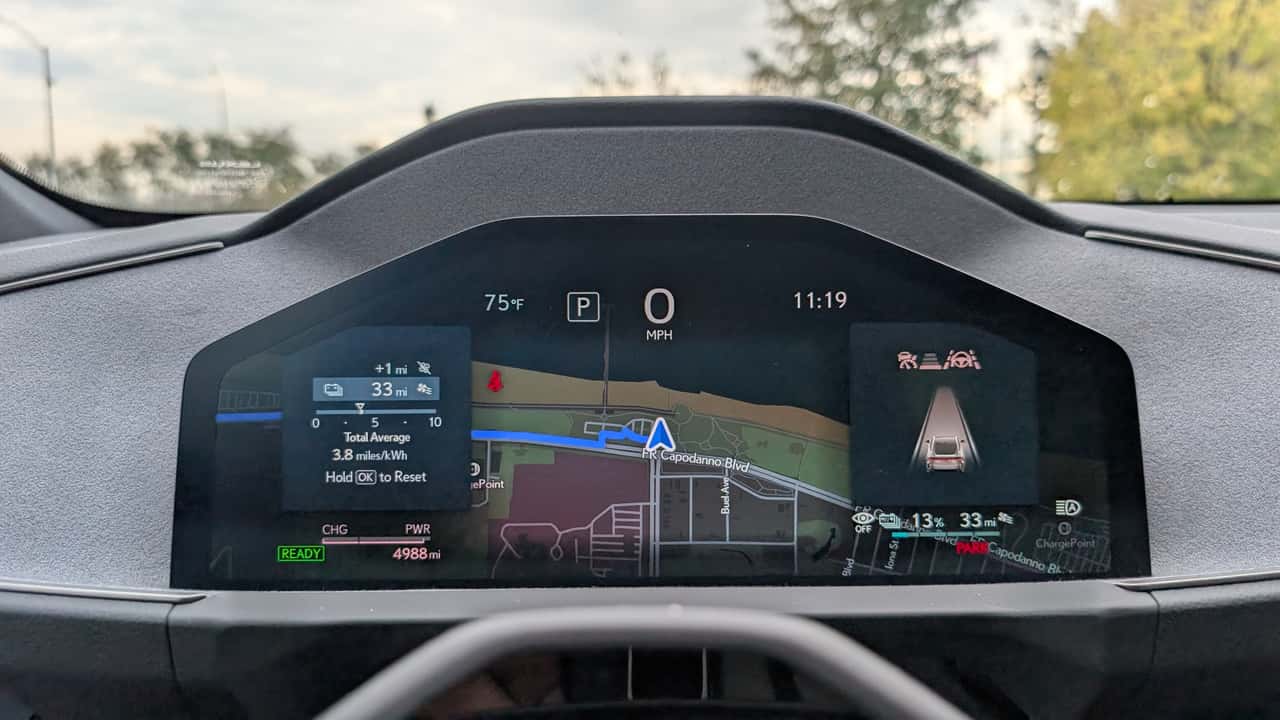
Photo by: Suvrat Kothari
Suvrat Kothari 
By: Suvrat Kothari
Oct 19, at 1:17pm ET
Add InsideEVs as a preferred source in Google
- (https://twitter.com/intent/tweet?url=https%3A%2F%2Finsideevs.com%2Fnews%2F812134%2Fandroid-auto-google-maps-ev-route-planning-lexus%2F&text=I%20Let%20Android%20Auto%20Plan%20My%20EV%20Roadtrip.%20Here%E2%80%99s%20How%20It%20Worked&via=InsideEVs)
- copy
Share
Comment
Google is taking the guesswork out of long electric vehicle road trips by rolling out route planning on Android Auto. The tech giant first made the announcement in March, and the feature is coming to EVs from more than a dozen automakers. I got to try it out this week in the Lexus ES 350e, and it's genuinely useful, albeit slightly inaccurate.
Route planning basically suggests charging stops along your way, so you don’t have to waste time calculating how much range you need to reach your destination. The EV can do that for you based on its battery percentage and range.
Many EVs already offer this capability through their factory navigation systems. Tesla and Rivian have offered integrated route planning for years. Neither of them support Apple CarPlay or Android Auto, but their native systems work so brilliantly that you barely ever have to think about charging while covering longer distances, since the EVs literally tell you where and how long to stop to recharge.

Photo by: Suvrat Kothari
However, Android Auto has the potential to democratize route planning in a way that’s never been done before. It can support EVs old and new, across price brackets and segments. Google said the roll out will support more than 15 brands to begin with, and more will be added over time.
It’s kind of a big deal, especially for drivers on the fence about going electric, as it can eliminate the task of finding plugs yourself. The update came to the ES 350e while I had it for testing, and it removed the psychological barrier of charging anxiety, even though I knew there were plenty of charging options along my usual test routes.
How To Activate EV Routing On Android Auto
Because Android Auto is only a smartphone mirroring system, and not connected to your vehicle’s on board diagnostics, Google Maps won’t know your range and battery percentage by itself. Thankfully, getting EV routing up and running just takes two simple steps.
First, open Google Maps on your smartphone, tap your profile icon in the upper-right corner, and navigate to Settings, followed by Your Vehicle. Enter your EV's make, model, model year, and trim, then select its compatible charging connector. Depending on your vehicle, the available options include CCS or Tesla-style NACS connector. You also have other options like CHAdeMO or J1772.
Photo by: Suvrat Kothari
Registering your vehicle helps Google Maps account for its specifications and identify compatible charging stations along your route. You can also choose whether to include Level 2 charging stations or DC fast chargers, depending on how time you have to kill.
When you enter a destination on the vehicle’s screen, entering your battery percentage prompts Android Auto to suggest charging stops along your way. Unless you're regularly switching between different EVs (like us car journalists do), you only need to configure your vehicle once. After that, entering your vehicle's starting battery percentage is all it takes to get going.
Android Auto Vs. Native EV Route Planning: Which Is Better?
There's a catch, though. Don't expect Google Maps on Android Auto to predict your EV's remaining range or charging needs with pinpoint accuracy. Because it doesn't have direct access to the car's battery management system, it can't account for every variable affecting energy consumption, or adjust on-the-fly to real-world power consumption.
If you have something on your roof or a trailer in tow, Maps won't factor that in, so you'll have to adjust to real-world surprises yourself. It also doesn't offer the same ability to set a minimum battery percentage for arrival that some integrated systems provide.
I compared Google's estimates against the Lexus ES 350e's native EV route-planning system, and the results were noticeably different.
The Lexus ES 350e is the first EV from Toyota to feature built-in route planning.
Photos by: Suvrat Kothari
Google Maps on Android Auto is now rolling out EV route planning.
Photos by: Suvrat Kothari
For a roughly 350-mile drive from South Brooklyn to Rochester, New York, Android Auto estimated a total journey time of 7 hours and 48 minutes, including charging stops. The Lexus' built-in navigation system shaved 46 minutes from that, recommending what appeared to be quicker and more efficient charging stops along the way.
Google Maps also showed 307 miles of EPA range for the ES 350e on the app. While that’s true for the Premium trim, the press tester was a Luxury trim with 21-inch wheels, with a range of 292 miles. So I'm not sure if every trim and spec is accurately represented in Google's calculations.
Still, Google Maps has some advantages of its own. Its energy-consumption predictions draw on vehicle specifications and factors such as traffic, elevation, and weather to estimate how much range you'll need. Its familiar, easy-to-read interface is also a plus, particularly if you're already accustomed to using Google Maps for everyday navigation. I’d use the Google system over a native navigation any day, unless that too is based on Android Automotive OS, like on General Motors and Volvo cars.
Photo by: Suvrat Kothari
Unless you’re hypermiling and running your EV to 0% between charging stops, or hauling extra stuff, Android Auto’s ballpark estimate should be good enough. And it is also worth noting that both systems try to constantly optimize for the best charging stop while you’re driving. Native ones can use real-time data, but even without it, Maps will still alert you if it calculates that you're low on battery. It just won't be quite as accurate as native systems.
What do you think?
View
Comments
So Android Auto's route planning may not be perfect, but it's still helping to tear down the barriers to electric road trips. With better software tools, longer-range vehicles, and more charging stations coming online all the time, it's never been easier to do an EV road trip.
Contact the author: suvrat.kothari@insideevs.com
Related Stories
Slate Opened Its First Showroom Where You Can Test Drive Its $24,950 Electric Pickup Truck
Canadians Are Holding Out For Chinese EVs
The Electric Porsche Cayenne Just Torched The V8-Powered Audi RS Q8
A BMW i3 EV Went 753 Miles On A Single Charge. Its Energy Consumption Was Astonishing
We want your opinion!
What would you like to see on Insideevs.com?
Take our 3 minute survey.
- The InsideEVs team
Share this Story
- (https://twitter.com/intent/tweet?url=https%3A%2F%2Finsideevs.com%2Fnews%2F812134%2Fandroid-auto-google-maps-ev-route-planning-lexus%2F&text=I%20Let%20Android%20Auto%20Plan%20My%20EV%20Roadtrip.%20Here%E2%80%99s%20How%20It%20Worked&via=InsideEVs)
- copy
GO TO COMMENTS
(
)
Got a tip for us? Email: tips@insideevs.com
View all comments ( )
Trending
Kia EV3 Lease Deals Are Here, And It’s Cheaper Than The Chevy Bolt And Nissan Leaf
I Let Android Auto Plan My EV Roadtrip. Here’s How It Worked
This Chevy Bolt Has 470,000 Miles. Here’s How Much A New Battery Was
Here's What It's Like To Take Delivery Of A Rivian R2
latest articles
- This Chinese EV Is Now Made In Europe. More Are Coming Oct 20 - News -
- GM Is Closing Its Detroit EV Battery Plant Oct 20 - Industry -
- The 2027 Lexus NX Plug-In Hybrid Gets A Bigger Battery And Fast Charging Oct 20 - Official -
- Kia EV3 Lease Deals Are Here, And It’s Cheaper Than The Chevy Bolt And Nissan Leaf Oct 20 - Pricing -
- Here's What It's Like To Take Delivery Of A Rivian R2 Oct 19 - News -
- Used EVs Hit A Record Share Of Overall Used Car Sales In September Oct 19 - Sales -
- Nio's Little Electric Car Has A Cool Party Trick: Upgradeable Range Oct 19 - News -
RECOMMENDED FOR YOU
The 2027 Lexus NX Plug-In Hybrid Gets A Bigger Battery And Fast Charging
This Chinese EV Is Now Made In Europe. More Are Coming
Over 60% Of Toyotas Sold In Q3 Were Electrified
GM Is Closing Its Detroit EV Battery Plant
The 2027 Lexus TZ Will Cost $65,000 But Have Way Less Power Than Expected
Kia EV3 Lease Deals Are Here, And It’s Cheaper Than The Chevy Bolt And Nissan Leaf
America Now Has More Than 80,000 Public Fast Charging Ports