Home
News
News
High-Mileage EVs May Hold Up Better Than Gas Cars: Study
Are concerns about EV longevity overblown? According to a new study of 47 million vehicle inspections in the U.K., the answer is yes.

Photo by: InsideEVs
Rob Stumpf 
By: Rob Stumpf
Sep 22, at 1:28pm ET
Add InsideEVs as a preferred source in Google
- (https://twitter.com/intent/tweet?url=https%3A%2F%2Finsideevs.com%2Fnews%2F809127%2Fev-durability-gas-uk-study%2F&text=High-Mileage%20EVs%20May%20Hold%20Up%20Better%20Than%20Gas%20Cars%3A%20Study&via=InsideEVs)
- copy
Share
Comment
- A new study shows that high-mileage EVs likely aren't as scary as you think.
- EVs exhibited fewer overall defects as mileage accumulated than combustion-powered cars.
- They also showed a 55% lower road exit rate at 15 years old.
High-mileage cars have scared off potential buyers since the early days of car buying. After all, wear and tear does break down components over time, which means that some buyers will see a high number on the odometer and treat it as evidence that the vehicle is moments away from heading to the scrap yard.
Now used EVs? That's a whole different ball game. With electric propulsion tech being newer to modern cars (and so much false information about battery longevity being spread around for the better part of a decade), many buyers might look at an electric car and expect it to be as disposable as an iPhone. It turns out that's not the case at all.

Photo by: Ralph Hermens
EVs actually have fewer major safety and emissions issues than gas cars, according to a new study of more than 47.4 million vehicle inspections in the UK. The data shows that EVs are actually less likely to fail the British MOT's roadworthiness test when pinned up against their comparable gas and diesel-powered counterparts.
The study examined vehicles between three and eight years old with between 90,000 and 120,000 miles on the odometer. It found that EVs were 25% less likely to fail the UK's annual MOT inspection. On average, EVs had a failure rate of 16.5% versus ICE cars averaging around 22.1%.
Beyond 120,000 miles, the gap between EVs and ICE vehicles actually widened to 32%. EV failures dropped to 16% while ICE vehicles climbed to 23.5%. And when age is considered, the study concludes that at 15 years, half as many EVs were removed from service compared to gas cars (5.4% versus 11.9%).
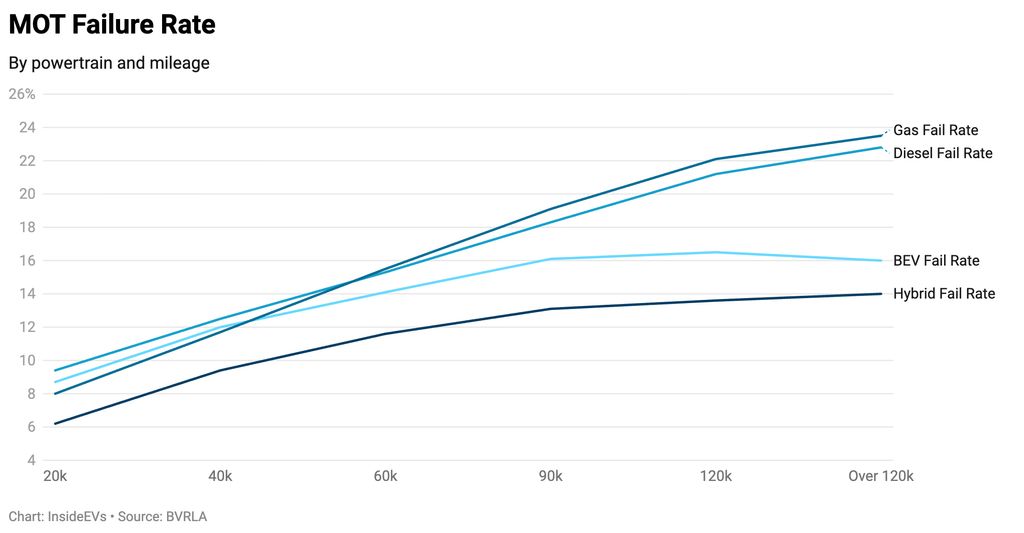
Photo by: InsideEVs
For those in the U.S., the MOT is similar to an annual safety and emissions inspection in some U.S. states. The vehicle's fitness to be on the road is assessed, checking things like tire tread, brakes, suspension components, lighting, emissions control components, and more. Essentially, it's confirming that the car meets the minimum required condition to operate legally on public streets. It doesn't assess the health of all components like the vehicle's drivetrain or battery, but a vehicle must move under its own power to pass. And a check engine light is an immediate fail.
The test showed that EVs were 1.8 times more likely to carry a risk of elevated tire wear compared to an ICE car—which is to be expected, given an EV's increased weight—however, suspension-related failures actually decreased with mileage compared to gas-powered cars. Brake defects were also significantly less, with 66% fewer defects over 90,000 miles in EVs. Again, this tracks, as modern EVs rarely engage their friction brakes, so excess wear is unlikely to be an issue.
Of course, this isn't a full picture of EV or gas car reliability. Cars with issues can still pass MOT. But other tests have shown in the past that EVs are still significantly less likely to break down versus ICE cars. That's logical, especially considering how many fewer moving powertrain parts and emission components can fail when put up against a combustion engine. Battery degradation has also proven to be a far less worrisome issue than originally thought, and one electric car brand even ranks above 26 other automakers when assessing the likelihood of reaching 250,000 miles.

Stay informed with our newsletter every weekday
back
Subscribe For more info, read our Privacy Policy & Terms of Use.
What do you think?
View
Comments
To be abundantly clear, and as a stakeholder in the study points out, this data isn't an argument that you shouldn't do your homework before buying a used car, let alone a used EV. A vehicle's service history, battery health, and common platform issues should all be considered before signing over the title.
One thing is certain, though: with a clean bill of health, a high-mileage EV shouldn't scare anyone. In fact, this data shows that a cheaper, high-mileage EV purchase might be more compelling now than ever.
More Used EV News
Dacia’s Answer To Cheap Chinese EVs Used To Be One. Now It’s European
EV Myth Busted: No, They're Not 'Dirtier' Than Gas Cars, Even If You Use Fossil Fuel Power
Used Tesla Model S Prices Have Fallen Dramatically. But Their Batteries Are Holding Up Great
The Used EV Market Just Got Weirder
We want your opinion!
What would you like to see on Insideevs.com?
Take our 3 minute survey.
- The InsideEVs team
Share this Story
- (https://twitter.com/intent/tweet?url=https%3A%2F%2Finsideevs.com%2Fnews%2F809127%2Fev-durability-gas-uk-study%2F&text=High-Mileage%20EVs%20May%20Hold%20Up%20Better%20Than%20Gas%20Cars%3A%20Study&via=InsideEVs)
- copy
GO TO COMMENTS
(
)
Got a tip for us? Email: tips@insideevs.com
View all comments ( )
Trending
Lucid Is Slashing $15,000 Off The Gravity, But The Deal Won’t Last Long
The Remnants Of The Electric Saab That Never Was Are Going Up For Auction
What We Both Thought After Driving The Rivian R2
Aptera Finally Built Its First Car For Customer Delivery
Latest Stories
- The U.S. Let Volvo Keep Selling Cars. Polestar Got A No. What About Mercedes? Nov 22 - News -
- Tesla FSD V15 Makes Your Drive Look Like Grand Theft Auto Nov 22 - News -
- Waymo Is Recalling Its Robotaxis Because They're Not Great At Dealing With Human Instructions Nov 21 - Autonomous Vehicles -
- This EV-Swapped 1967 Porsche 912 Has 300 HP And A Split Battery Pack Nov 21 - News -
- This Plug-In Hybrid SUV Towed A Boeing 747 On Only 2 Wheels. Yes, Really. Nov 21 - Towing -
- BYD's Latest SUV Can Hide Its Steering Wheel When You Don't Need It Nov 20 - China -
- What We Both Thought After Driving The Rivian R2 Nov 20 - Podcast -
RECOMMENDED FOR YOU
The U.S. Let Volvo Keep Selling Cars. Polestar Got A No. What About Mercedes?
Waymo Is Recalling Its Robotaxis Because They're Not Great At Dealing With Human Instructions
Tesla FSD V15 Makes Your Drive Look Like Grand Theft Auto
This Plug-In Hybrid SUV Towed A Boeing 747 On Only 2 Wheels. Yes, Really.
This EV-Swapped 1967 Porsche 912 Has 300 HP And A Split Battery Pack
BYD's Latest SUV Can Hide Its Steering Wheel When You Don't Need It
Hyundai’s N Vision 74 Was One Of The Coolest Car Designs In Recent Memory. Now It's Shelved