Home
News
Battery Tech
Watch Donut Lab's Mysterious Solid-State Battery Charge In An Actual EV
The Verge TS Pro, equipped with a solid-state battery, was plugged in at a fast-charging station. Here's how it performed.

Photo by: Donut Lab
Suvrat Kothari 
By: Suvrat Kothari
Mar 16, at 6:21pm ET
Add InsideEVs as a preferred source in Google
- (https://twitter.com/intent/tweet?url=https%3A%2F%2Finsideevs.com%2Fnews%2F790194%2Fdonut-lab-verge-motorcycles-solid-state-battery-charging%2F&text=Watch%20Donut%20Lab%27s%20Mysterious%20Solid-State%20Battery%20Charge%20In%20An%20Actual%20EV&via=InsideEVs)
- copy
Share
Comment
- Donut Lab's weekly solid-state battery tests are finally out of the lab.
- The company showcased its battery charging out in the wild, on the Verge TS Pro.
- The battery is claimed to be air-cooled, which is rare on modern EVs.
There's a new chapter in the Donut Lab saga, and this time it involves a real-world charging test on an actual electric vehicle. The Finnish startup plans to supply what it claims is the world's first production solid-state battery pack to Estonian company Verge Motorcycles starting this spring.
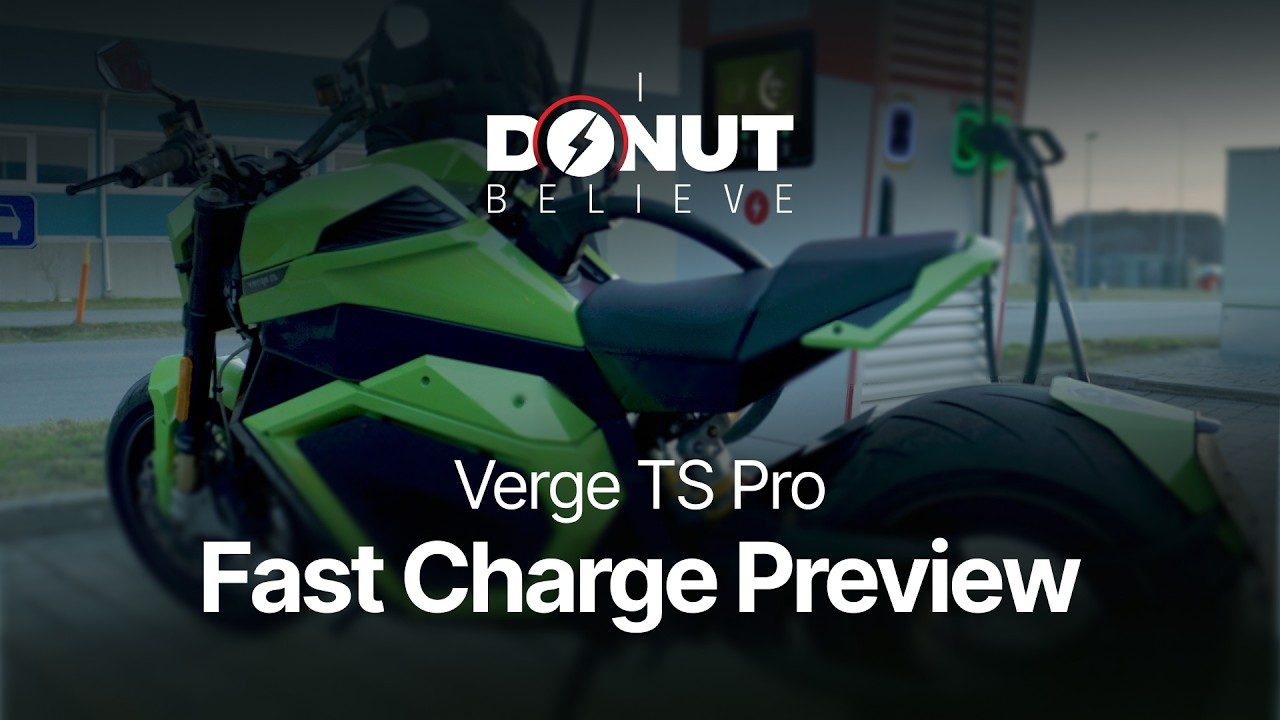
Until now, we had only seen lab-level tests on individual cells that didn't reveal much about the battery's real-world performance. That changed this Monday, as the companies showcased a Verge TS Pro test mule charging at a public DC fast-charging station. The motorcycle was claimed to be equipped with an 18 kWh (nominal) solid-state battery pack, with a manufacturer-estimated range of 217 miles.
“The battery has an industry-defining 5C charging rate at the pack level, while only shockingly having air cooling,” Donut Lab CEO Marko Lehtimaki said in a YouTube video. To decode that jargon, a 1C rate would charge a battery in an hour, 2C means 30 minutes, and so on. At a 5C rate, a battery can theoretically fully charge in about 12 minutes.
Gallery: Verge Motorcycles TS Pro

15


Source: Verge Motorcycles
If you’re new to the Donut Lab drama, here’s a quick recap of what has happened so far. The company made sweeping claims of a solid-state battery breakthrough at the Consumer Electronics Show this year: 400 watt-hours per kilogram of energy density, 100,000 charge cycles, and zero use of rare-earth materials.
Battery experts and industry executives pushed back hard, calling out the lack of proof, validation results, or patents. The company then began slowly releasing third-party test results, none of which have so far confirmed that the battery chemistry is actually solid-state or that the energy density reaches the 400 Wh/kg figure.
What we did see was an ultra-fast charging test, and a single cell surviving temperatures as high as 100 degrees Celsius. We also know that it's not a supercapacitor. All three tests, though, were conducted at the cell level in a lab, not at the pack level on a vehicle.
Photo by: Donut Lab
That brings us to today’s test. The Verge test mule was plugged in at 9% state of charge, after which it quickly started drawing about 103 kilowatts of power. For context, modern electric cars in the U.S. today can charge at much higher speeds, but 100+ kW is a pretty strong charging speed for motorcycles, where tight packaging leaves little room for sophisticated thermal management systems.
More than 100 kW of charging power also seems unusually high for a tiny battery pack relative to cars. Smaller battery packs usually charge more slowly because they contain fewer cells sharing the current, so limiting current helps extend their lifespan. They also typically run at lower voltages and are subject to packaging constraints.
It's also worth noting that 103 kW is roughly half of the 200 kW peak that Donut Lab claimed at CES. Whether that gap is due to charger limitations or the motorcycle's own architecture remains unclear.
From there, the numbers seem compelling. The EV reached about 50% state of charge in five minutes, adding about 7 kWh of energy. Then 80% in 12 minutes, adding roughly 13 kWh total. All of this, Donut Lab emphasized, was without active liquid cooling, just two fans pushing air over heat sinks on either side of the pack.
A similarly sized lithium-ion battery pack on the previous-generation Verge TS Pro takes about 35 minutes to charge from 0% to 80%, according to independent reviews. And a LiveWire One, which is Harley-Davidson's electric spinoff, takes 40 minutes to reach 80% on a fast charger. If Verge Motorcycles can demonstrate those speeds on its production bikes, it may have an edge over its rivals.
Batteries that rely solely on air cooling are largely a thing of the past in modern EVs, which use sophisticated liquid cooling—as well as some air cooling—to manage heat from fast-charging and hard acceleration. Studies suggest that solid-state batteries are inherently more thermally stable. They don’t use flammable liquid electrolytes, which means less heat is generated, potentially making simpler cooling viable.
That said, the company indicated that the motorcycle may not be fully production-ready yet. “Verge is doing system-level optimization and fine-tuning the charge profile on this new battery pack,” Lehtimaki said.
What do you think?
View
Comments
Above all, some of the most pressing questions still remain unanswered. Donut Lab is still tight-lipped about the actual battery chemistry, and there's no indication of whether this pack can realistically last 100,000 charging cycles. With deliveries set to start soon, it may only be a matter of time before curious owners take their motorcycles apart to uncover what's inside.
Contact the author: suvrat.kothari@insideevs.com
Related Stories
Donut Lab's Latest Solid-State Battery Test Proves It Isn't A Supercapacitor
What Donut Lab’s Latest Solid-State EV Battery Test Actually Reveals
Donut Lab's Solid-State Battery Charges Fast. But Experts Still Have Questions
Donut Lab Says It Cracked Solid-State Batteries. Experts Have Questions.
We want your opinion!
What would you like to see on Insideevs.com?
Take our 3 minute survey.
- The InsideEVs team
Share this Story
- (https://twitter.com/intent/tweet?url=https%3A%2F%2Finsideevs.com%2Fnews%2F790194%2Fdonut-lab-verge-motorcycles-solid-state-battery-charging%2F&text=Watch%20Donut%20Lab%27s%20Mysterious%20Solid-State%20Battery%20Charge%20In%20An%20Actual%20EV&via=InsideEVs)
- copy
GO TO COMMENTS
(
)
Got a tip for us? Email: tips@insideevs.com
View all comments ( )
Trending
I Drove The Electric And Gas-Powered BMW X5. I Know Which One I'd Pick.
The 2027 Ford Mustang Mach-E Has More Range As Standard
GM's Next-Generation EV Platform Has 30% Less Wiring And 20% Less Battery
Can The BMW iX3 Take Down The Tesla Model Y L And Rivian R2?
latest articles
- ‘Propulsion-Agnostic’: GM Wants To Bring Tesla-Style Software Features To Its Gas SUVs, Too Oct 22 - Features -
- Want The Best Range Rover? Get The Electric One: First Drive Oct 22 - First Drives -
- I Drove The Electric And Gas-Powered BMW X5. I Know Which One I'd Pick. Oct 22 - First Drives -
- The Ferrari Luce Officially Starts At $560,800 Oct 22 - News -
- The 2027 Ford Mustang Mach-E Has More Range As Standard Oct 22 - Official -
- BMW’s Electric M3 Had To First Win Over One Of Its Own Oct 22 - News -
- Seattle Is Installing Hundreds Of Curbside EV Chargers Oct 22 - Charging -
RECOMMENDED FOR YOU
The Roadster Will Have Tesla’s Most Advanced Battery Pack Yet
‘Propulsion-Agnostic’: GM Wants To Bring Tesla-Style Software Features To Its Gas SUVs, Too
Tesla Supplier Reports Record Earnings From EV And Energy Storage Batteries
Want The Best Range Rover? Get The Electric One: First Drive
China Wants Mass-Produced Solid-State Batteries By 2030. CATL Knows That's Hard
I Drove The Electric And Gas-Powered BMW X5. I Know Which One I'd Pick.
How Geely's New Battery Handles A Megawatt Of Charging Power Without Crazy Degradation