Home
News
Battery Tech
What Donut Lab’s Latest Solid-State EV Battery Test Actually Reveals
The Donut Lab solid-state battery was heated to the boiling point of water. Here’s what happened next.
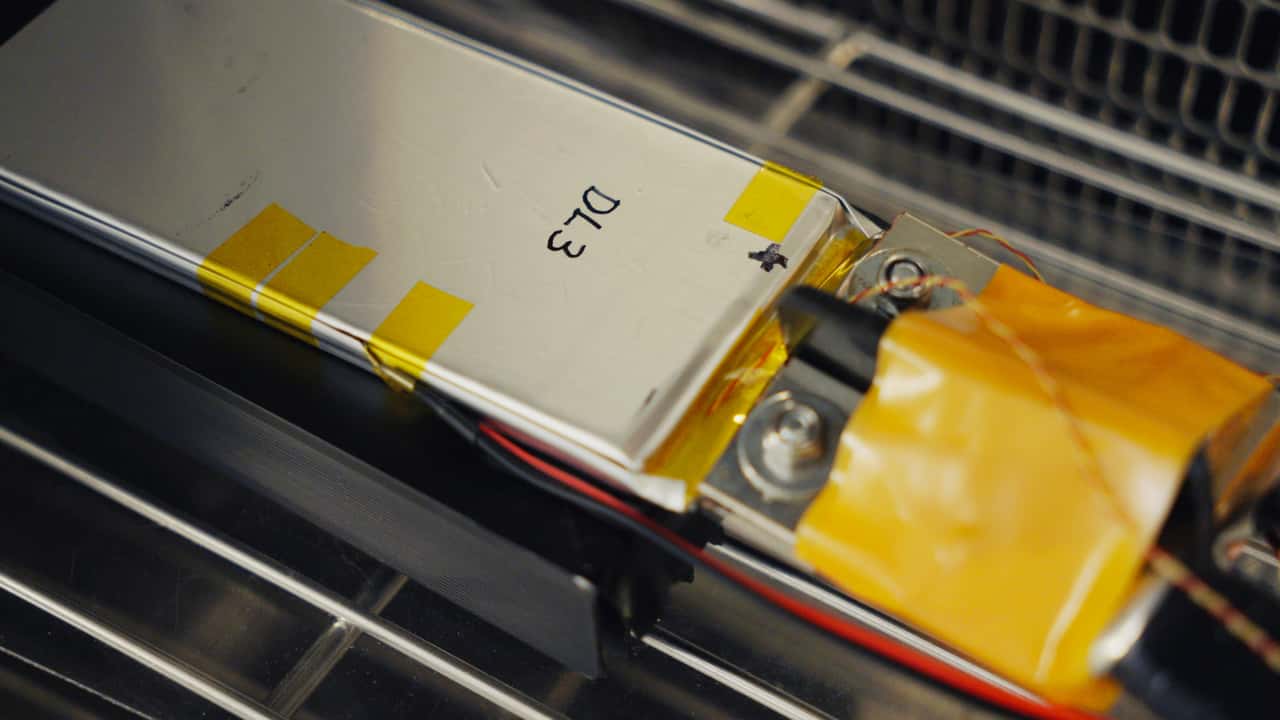
Photo by: Donut Lab
Suvrat Kothari 
By: Suvrat Kothari
Mar 3, at 5:16pm ET
Add InsideEVs as a preferred source in Google
- (https://twitter.com/intent/tweet?url=https%3A%2F%2Finsideevs.com%2Fnews%2F788870%2Fdonut-lab-solid-state-battery-excessive-swell%2F&text=What%20Donut%20Lab%E2%80%99s%20Latest%20Solid-State%20EV%20Battery%20Test%20Actually%20Reveals&via=InsideEVs)
- copy
Share
Comment
- Donut Lab released its second independent solid-state battery test result Monday.
- The pouch cell was subjected to extreme temperatures as high as 212 degrees Fahrenheit.
- It appeared to perform well at elevated heat, but one battery scientist said the limited data revealed little about its real-world performance.
Finnish startup Donut Lab has released its second independent test result for what it claims is the world's first all-solid-state battery. Once again, the data is raising as many questions as it answers.
This latest test puts the cell through its paces at high-temperatures of 80 and 100 degrees Celsius (176-212 degrees Fahrenheit), roughly double the maximum operating temperature of conventional lithium-ion batteries.
On the surface, the results look promising. But experts urged caution, pointing to data they say is far too thin to mean much. Some of Donut's biggest claims, like all-important battery chemistry and energy density, are still unverified.
Eric Wachsman, a professor at the University of Maryland's Department of Materials Science and Engineering who specializes in solid-state batteries and solid oxide fuel cells, said the insufficient data does not represent real-world usage in automotive applications.
“The cells are not violating any law of thermodynamics,” Wachsman told me in an email. “But the data presented leaves a lot to be desired for many reasons,” he said.

A 2.4 kilogram steel plate was placed on the Donut Lab solid-state cell for mechanical pressure while charging and discharging.
Photo by: Donut Lab
Researchers say solid-state batteries are a “holy grail” technology that can unlock superior driving range compared to today’s lithium-ion batteries, while substantially reducing charging times and fire risk. At least on paper, the technology has the potential to vanquish range and charging anxieties and unlock broader EV adoption.
Battery companies and automakers are racing to develop the technology, but mass manufacturing of solid-state batteries without defects is extremely challenging. Several solid-state battery startup CEOs InsideEVs has interviewed have said it’s an unresolved problem.
That’s why Donut Lab’s claims took the internet by storm early this year. The Helsinki-based startup says it has developed the world’s first all-solid-state battery that’s production-ready. It will power Verge Motorcycles EVs starting this quarter.
The specs it's put forward are extraordinary: 400 watt-hours of energy density (roughly double today's lithium-ion cells), a five-minute charge time, an operating range of -30C to 100C (-22F to 212F), a 100,000-cycle lifespan, and zero rare earth materials.
Photo by: Donut Lab
The announcement was met with deep skepticism from industry experts for making bold claims without providing any proof, patent disclosures, or live demonstrations. The company is now responding to the blowback by releasing independent test results from the VTT Technical Research Centre of Finland.
After demonstrating its fast-charging capabilities in a lab test last week, the company released a second independent test on Monday. This one showcases the cell’s apparent stability at temperatures as high as 80C and 100C (176F and 212F).
At 80C (176F), the cell appeared to have delivered more energy than at 20C (68F), reaching 110.5% of its normal capacity. It basically suggests that the chemistry is possibly running more efficiently at elevated heat. After the high-temperature discharge, it recharged without any visible damage, indicating normal performance.
The battery was then pushed even harder. The agency raised the temperature of the testing chamber to 100C (212F), which is the boiling point of water. Again, the cell performed better than it did at room temperature, delivering 107% of its normal capacity. And it was able to charge up normally again thereafter.
That's impressive because regular lithium-ion batteries don't handle heat all that well. As temperatures climb, they lose efficiency. And if you push far enough, they can become unstable or sustain permanent damage. Studies suggest that the optimal operating range for lithium-ion batteries is between 25-40C (77-104F). The Donut Lab cell was able to survive in temperatures over twice of that.
However, there was one notable development after the 100C test: the Donut battery's outer pouch lost its “vacuum.” Wachsman said the pouch issue was a potential red flag. The loss of vacuum, he explained, may indicate that the cell lost its "hermetic seal," the barrier that keeps outside air away from the sensitive internal chemistry.
“Pouch cells will tend to expand due to internal pressure as they can give off gas during cycling,” Wachsman said. “It's clear they experienced excessive swell after a few cycles,” he said after comparing the fast-charging images from last week's test to this week's high-temperature results.
Potential swelling on the Donut Lab solid-state EV battery cell after a discharge test at 100 degrees Celsius (212 degrees Fahrenheit)
Whether this is a major safety issue or something that’s expected on solid-state cells remains unclear. However, the broader consensus is consistent among experts. Neither test reveals meaningful pack-level performance over the thousands of cycles that actually matter for real-world use.
"To be commercially relevant, the cells need to be stable with less than 10-20% of capacity fade for thousands of cycles,” Wachsman said. “Without that, the tests are essentially meaningless."
What do you think?
View
Comments
Donut Lab says more independent results are coming in the weeks ahead. Energy density figures and battery chemistry disclosures remain the two things worth watching for. Until those surface, the jury is firmly still out.
Contact the author: suvrat.kothari@insideevs.com
Related Stories
Donut Lab's Solid-State Battery Charges Fast. But Experts Still Have Questions
Donut Lab Remains Defiant About Its Solid-State Battery, Saying Proof Is Coming Soon
Donut Lab Says It Cracked Solid-State Batteries. Experts Have Questions.
The First Production All-Solid-State Battery Is Here, And It Promises 5-Minute Charging
We want your opinion!
What would you like to see on Insideevs.com?
Take our 3 minute survey.
- The InsideEVs team
Share this Story
- (https://twitter.com/intent/tweet?url=https%3A%2F%2Finsideevs.com%2Fnews%2F788870%2Fdonut-lab-solid-state-battery-excessive-swell%2F&text=What%20Donut%20Lab%E2%80%99s%20Latest%20Solid-State%20EV%20Battery%20Test%20Actually%20Reveals&via=InsideEVs)
- copy
GO TO COMMENTS
(
)
Got a tip for us? Email: tips@insideevs.com
View all comments ( )
Trending
The Mercedes-Benz EQS Sedan, EQS SUV, And EQE SUV Soldier On For 2027
The BMW iX5 Was Driven Until It Died. It Had A Surprising Amount Of Hidden Range Left
What We Both Thought After Driving The Rivian R2
Aptera Finally Built Its First Car For Customer Delivery
Latest Stories
- Ford Has A Dedicated Battery Abuse Team. It Obsesses Over How Cells Fail Nov 23 - Battery Tech -
- This Little Electric Truck Looks Like France's Answer To The Slate Nov 23 - News -
- Tesla's EVs Could Get One Big Upgrade Next Year Nov 23 - News -
- Hyundai Ioniq 5 Maintenance Guide: What Needs Servicing And What Doesn’t Nov 23 - News -
- 2027 Mercedes GLA Electric First Drive: A Big Upgrade Nov 23 - Car Reviews -
- China’s SC01 EV Sports Car Will Get Its Own Factory In Europe Nov 23 - Europe -
- The BMW iX5 Was Driven Until It Died. It Had A Surprising Amount Of Hidden Range Left Nov 23 - Range / Efficiency -
RECOMMENDED FOR YOU
Ford Has A Dedicated Battery Abuse Team. It Obsesses Over How Cells Fail
This Little Electric Truck Looks Like France's Answer To The Slate
Ford Just Started Fathom LFP Battery Production In Michigan. It's A Big Deal
Tesla's EVs Could Get One Big Upgrade Next Year
Solid-State Cells Can Make The U.S. Competitive In Batteries Again: CEO
Hyundai Ioniq 5 Maintenance Guide: What Needs Servicing And What Doesn’t
Ford Tested 36,000 Mustang Mach-E Batteries. Here’s How They Held Up After 100,000 Miles