Home
News
Charging
Here’s Why You Shouldn’t Buy A Knockoff NACS To CCS Adapter
It might look the same as a product from a more established company on the outside, but it’s a different story inside.

Photo by: Auto Buyers Guide | Alex On Autos
Iulian Dnistran 
By: Iulian Dnistran
Dec 2, 2024 at 6:14am ET
Add InsideEVs as a preferred source in Google
- (https://twitter.com/intent/tweet?url=https%3A%2F%2Finsideevs.com%2Fnews%2F742873%2Fnacs-to-ccs-dc-to-dc-adapter-cheap-vs-expensive%2F&text=Here%E2%80%99s%20Why%20You%20Shouldn%E2%80%99t%20Buy%20A%20Knockoff%20NACS%20To%20CCS%20Adapter&via=InsideEVs)
- copy
Share
Comment
- DC-to-DC charging adapters are needed to recharge a CCS-equipped EV on the Tesla Supercharger network.
- The number of NACS to CCS adapter models is increasing
Almost every car manufacturer that sells electric vehicles in the United States will get access to Tesla’s expansive Supercharger network of DC fast chargers. New models will come out of the factory gates with Tesla’s NACS plug starting next year, but owners of existing EVs will have to use an adapter to top up at Superchargers across the United States and Canada.
As a result, there’s a growing number of companies out there that are selling NACS to CCS DC fast charging adapters. But as always, not all of them are created equal and the devil is in the details.
For starters, you should know that automakers’ stance on using third-party adapters is simple: don’t use one. Ford, Rivian, General Motors, Hyundai, Kia and all the others claim they won’t repair a vehicle under warranty if something went wrong during a charging session where a non-approved adapter was used.
More Charging Stories
 The Hyundai Ioniq 9 Will Come With Tesla's NACS Plug
Lectron May Be Producing More NACS To CCS Adapters Than Tesla
Tesla Sued This Startup. Getting It To Drop The Case Was ‘A Guessing Game’
This Is Why Tesla's NACS Plug Revolution Is A Big Deal
That said, you might not want to pay hundreds of dollars for an approved product and instead go for the cheaper, knockoff version. Save a couple of bucks and be done with it. They look roughly the same as the more established units out there, so why bother? Well, as you’ll see in the Auto Buyers Guide video below, you might want to hold off on that no-name purchase.
Safety is the name of the game here. Most well-regarded DC-to-DC charging adapters are rated at 1,000 volts and 500 amps, which comes out to 500 kilowatts. That’s a lot of power to go through a hand-held device, so some temperature monitoring is required.
Both the Tesla-supplied NACS to CCS adapter and the Lectron-made unit come with a pair of thermal sensors that cut off the flow of electricity if the temperature of the power pins exceeds 185 degrees (85 degrees Celsius). The sensors are placed right next to the pins and, when triggered, send a command to the communications pin to end the charging session. The same happens when pressing the unlatch button–there’s a contact inside that sends a signal to end the flow of electricity.
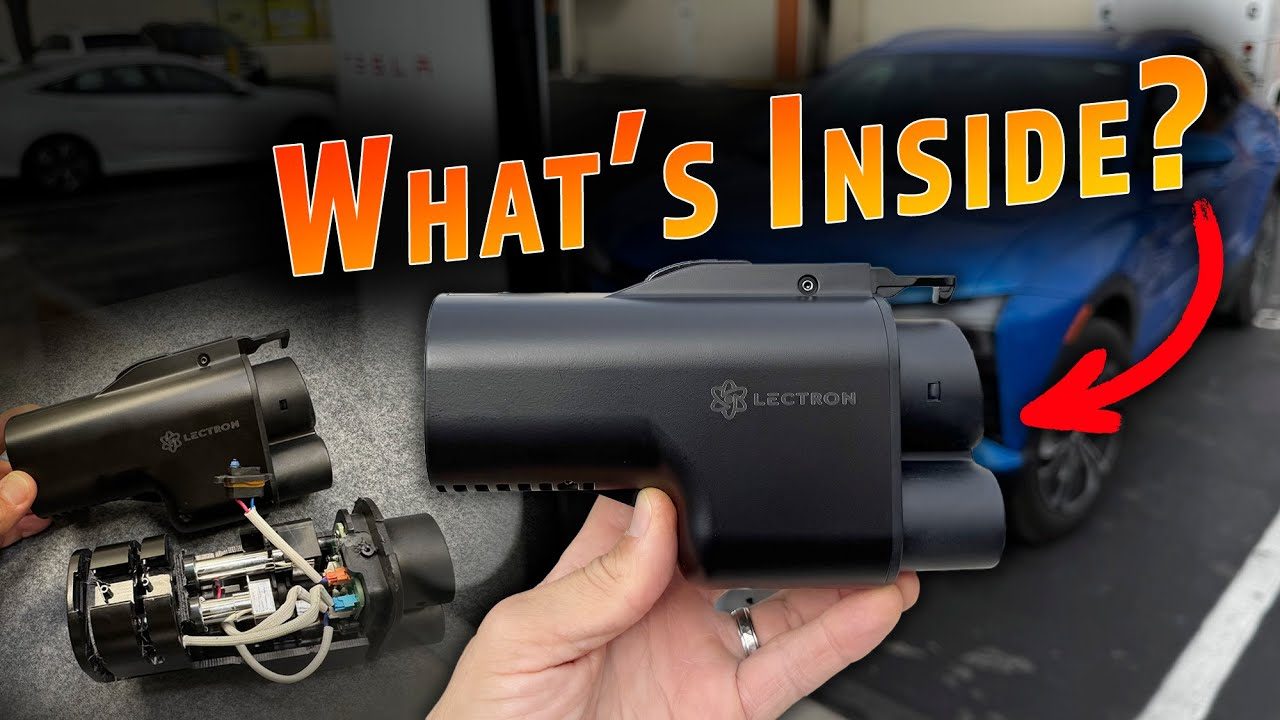
The DC pins are massive on these units. They’re also made out of copper and coated with silver to improve conductivity.
What do you think?
View
Comments
As for the cheap knockoff adapters, things are slightly different, in a bad way. The unit that was disassembled in the video had two temperature sensors, just like the Lectron adapter, but the wires were just dangling inside the housing. They were not firmly placed next to the DC pins, so if they were to get very hot, the sensors would not cut off the flow of electricity and the adapter housing could melt. Furthermore, the power pins themselves are slimmer than on the more expensive products and they’re plated with tin, not silver, so the conductivity is smaller.
An interesting discovery after tearing apart a couple of these adapters is that neither the charging provider nor the car manufacturer has any way of knowing what type of adapter is being used. There’s no communication between the adapter and the car or between the charging stall and the adapter–the thermal sensors and latch contacts are just cutoff switches.

Get the best news, reviews, columns, and more delivered straight to your inbox.
back
Subscribe For more info, read our Privacy Policy & Terms of Use.
We want your opinion!
What would you like to see on Insideevs.com?
Take our 3 minute survey.
- The InsideEVs team
Share this Story
- (https://twitter.com/intent/tweet?url=https%3A%2F%2Finsideevs.com%2Fnews%2F742873%2Fnacs-to-ccs-dc-to-dc-adapter-cheap-vs-expensive%2F&text=Here%E2%80%99s%20Why%20You%20Shouldn%E2%80%99t%20Buy%20A%20Knockoff%20NACS%20To%20CCS%20Adapter&via=InsideEVs)
- copy
GO TO COMMENTS
(
)
Got a tip for us? Email: tips@insideevs.com
View all comments ( )
Trending
Diesel Prices Are Surging. This Electric Trucking Company Is Seeing More Interest
Tesla Opens Self-Driving Cybercab Orders To 'Select Customers' At $29,990
Solid-State Cells Can Make The U.S. Competitive In Batteries Again: CEO
I Took A Rivian R2 On A Camping Trip To The Middle Of The Desert
Latest Stories
- Diesel Prices Are Surging. This Electric Trucking Company Is Seeing More Interest Nov 14 - News -
- Tesla Opens Self-Driving Cybercab Orders To 'Select Customers' At $29,990 Nov 13 - News -
- Do EVs Wear Tires Faster? Here's What The Studies Show Nov 13 - Features -
- The VW ID. Buzz Is Getting A New Job As A Robotaxi Nov 13 - News -
- Audi A4 EV Delayed Amid VW Group Financial Troubles: Report Nov 13 - News -
- Tesla Just Killed Its Cheapest All-Wheel-Drive Model Y Nov 13 - News -
- A Record Number Of Uber Miles Are Happening In EVs Nov 13 - News -
RECOMMENDED FOR YOU
BYD's Futuristic EV Charger Can Run On Sunshine And Batteries
Diesel Prices Are Surging. This Electric Trucking Company Is Seeing More Interest
Mercedes’ EV Charging Network Hit 100 Locations After 3 Years In The U.S.
Tesla Opens Self-Driving Cybercab Orders To 'Select Customers' At $29,990
Toyota Quietly Gave The 2027 Toyota RAV4 PHEV A Big Upgrade
Do EVs Wear Tires Faster? Here's What The Studies Show
BMW Is Giving New EV Buyers $500 In Free Charging