Home
Stellantis
News
China's Xiaomi Just Smashed Another Tesla Record
Plus, China's CATL would build a U.S. plant (if allowed) and Stellantis bets big on synthetic graphite.
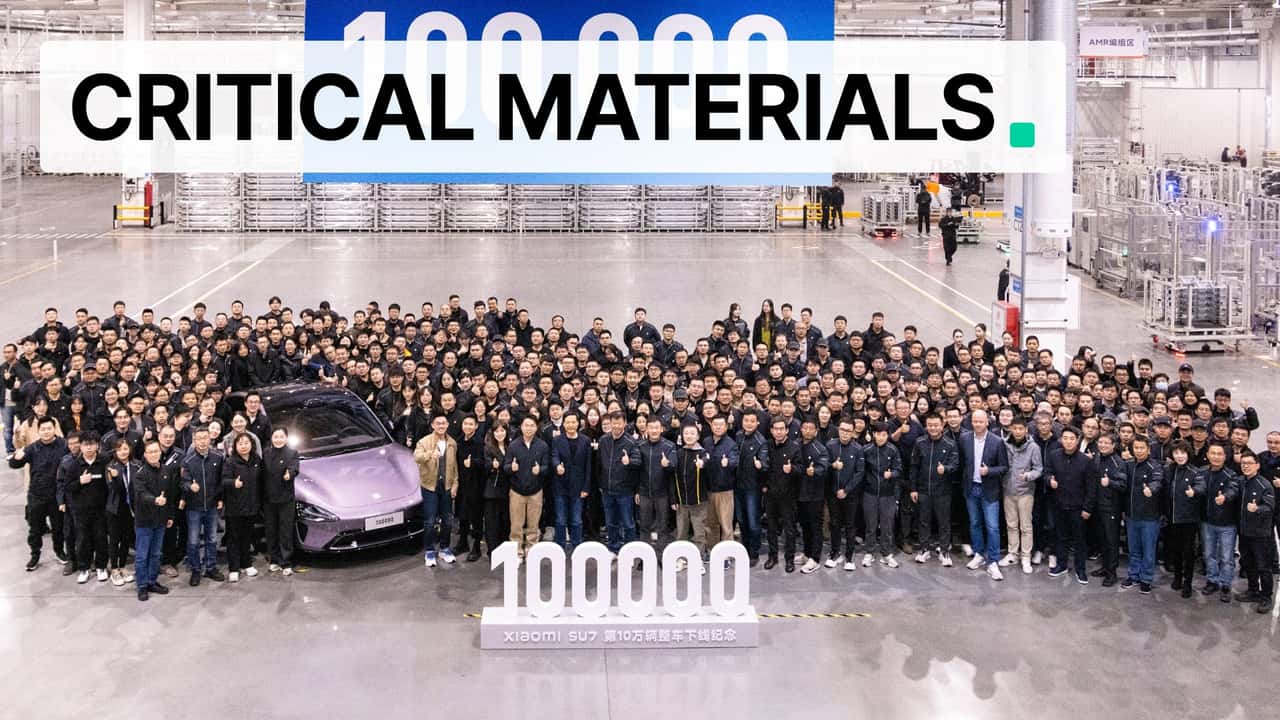
Photo by: Xiaomi
Rob Stumpf 
By: Rob Stumpf
Nov 14, 2024 at 10:30am ET
Add InsideEVs as a preferred source in Google
- (https://twitter.com/intent/tweet?url=https%3A%2F%2Finsideevs.com%2Fnews%2F740918%2Fxiaomi-su7-100000-tesla-cm%2F&text=China%27s%20Xiaomi%20Just%20Smashed%20Another%20Tesla%20Record&via=InsideEVs)
- copy
Share
Comment
If building cars were easy, everybody would do it. Well, just about every electronics maker has thought about it—Apple, Dyson, Sony, to name a few. But Chinese electronics giant Xiaomi lived out its dreams, and now it's got some real bragging rights.
Welcome back to Critical Materials, your daily roundup for all things EV and automotive tech. Today, we're chatting about Xiaomi smashing Tesla's production speed run record, CATL eyeing up the U.S. for a plant, and Stellantis bets big on synthetic graphite. Let's jump in.
30%: China's 'Apple Car' Is Already A Massive Hit

Two-hundred and thirty days. That's how long it took Chinese cellphone czar Xiaomi to build 100,000 units of its first-ever electric car, the SU7.
The celebratory SU7 rolled off the assembly line on Wednesday, blowing past the Tesla Model 3 production record by a mile. Quite literally, Xiaomi halved the time it took Tesla to reach the same production milestone—464 days. This isn't just fast, it's lightning speed for a company that had never made a car before. By the time Tesla did the same, it was on its fourth vehicle. Rivian? Try 919 days.
Xiaomi didn't just quietly debut the SU7 either. The company came out swinging against Tesla, Ford, Sony, Apple—basically any company that builds cars or electronics. Nobody is safe.
And to top it off, the public's reception has been absolutely off the charts. Xiaomi has been selling every example of the SU7 that it builds, which makes this production goal a testament to just how damn popular the SU7 really is. Gobs of tech, nearly 500 miles of range, and futuristic flair give the car a unique style in a world of battery-powered blobs. Oh, and it starts at just $29,990. It's no wonder why the car has been as successful as it is.
And with other players in the personal electronics space (ahem—Sony) looking to get into the mix, it's a clear indication that more and more companies could look at getting into the EV game. That also means some smaller companies are definitely looking to copy Xiaomi's homework. And as for Apple and its now-canceled car project? Well, chalk it up as a missed opportunity.
Xiaomi originally anticipated to build 100,000 units by the end of 2024, but after some careful recalculations, it actually upped its production goal to 120,000 units. Can it reach that in the last 49 days of the year? Some quick napkin math tells me yes—and with a few days to spare. Look out, world.
60%: CATL Would Build U.S. Plan If Trump Signs Off
Photo by: InsideEVs
Since we're already talking China, let's pivot from car production to just battery production for a second. Enter China's—well, the world's, really—largest battery manufacturer: CATL.
The U.S. has been on a bit of a warpath with China lately. Between cutting Chinese tech and materials from being eligible for the federal EV tax credit to slapping imports with a 100% tariff, an expansion of China's manufacturing segment into the U.S. seemed rather unlikely. Instead, companies like CATL have been expanding their footprint by licensing their manufacturing tech and partnering with domestic automakers like General Motors and Ford.
However, now that Donald Trump is set to sit back in the Oval Office come January, CATL seems a bit less burdened—and the automaker is ready to spend some serious cash to get into the U.S. market if Trump's new administration signs off on it.
"Originally, when we wanted to invest in the U.S., the U.S. government said no," said Chinese billionaire and CATL founder, Robin Zeng, in an interview with Reuters. "For me, I’m really open-minded."
Zeng's comments were the first from any Chinese automotive supplier since the U.S. election.
Trump's stance on tariffs and EVs has been a rather complex topic as of late. Following a blossoming bromance with Tesla CEO Elon Musk, Trump seems to be more open to the idea of electric cars. But, as Trump has said in interviews, foreign automakers are welcome to sell cars in the U.S., if they "build plans here and [...] hire our workers." Naturally, this is what seems to have piqued Zeng's interest.
For CATL, this isn't just about setting up shop in the States. It's about direct access to the entirety of the North American market without having to tiptoe through the tariffs and tough trade talks. Recent protectionist measures have locked CATL out of the market, but if Trump's agenda shifts these policies to allow for more foreign investments on U.S. soil, CATL could soon be breaking ground on a plant in your backyard.
90%: Stellantis Is Betting $1 Billion On A U.S. Battery Material Supplier
Stellantis CEO Carlos Tavares has been pretty straightforward when it comes to EVs: build it and they will come. This cool and confident approach has been the face of the auto giant's stance on battery power recently, even if its brands haven't yet had the numbers to back it up. Now Stellantis is betting a cool billion on a U.S.-based startup that would give it domestic access to a critical component needed for building batteries.
The automaker signed a supply contract with Novonix covering a purchasing agreement for up to 115,000 metric tons of synthetic graphite—the material used to make a battery's anode, or negative terminal—produced by the Tennessee-based company over the next six years. And with that investment, Stellantis is sending a clear message to those in politics: it's continuing to invest in EVs, regulatory headwinds be damned, and it's moving forward with building domestic EVs regardless of who is sitting in the White House or what incentives might be available for new car buyers.
The automaker didn't say exactly how much it was spending on the contract. That means we need to use some industry-wide figures to determine just how much Stellantis could be spending on this much material. Given the average cost of U.S.-produced synthetic graphite is around $10,000 per metric ton, it puts the contract somewhere in the neighborhood of between $860 million and $1.15 billion assuming prices hold steady.
The average EV battery needs between 110 to 220 pounds of synthetic graphite, according to Reuters. Let's call it 165 pounds. This means the supply contract could supply enough graphite to build around 1.5 million EVs through 2031.
Of course, there's some fine print in the details, like beginning supply in 2026. This helps Stellantis to see exactly how U.S. policies will shake out during President-elect Donald Trump's first year back in office. Should tariffs and trade policies see any many shakeups as expected, the contract could put Stellantis in a good spot while other automakers play catch-up in the sourcing department.
Stellantis' contract highlights a more important industry-wide struggle. Automakers are uncertain about how the future of EVs will play out but need to hedge their bets. On one hand, if they slack now, brands could find themselves struggling to compete in the near future. But if an "EV winter" sets across the States with the uncertain future of federal subsidies and private funding, then Stellantis and just about every other automaker could be in for a rather long financial hibernation.
What do you think?
View
Comments
100%: What Electronics Company Should Build An EV?
Photo by: InsideEVs
You know, I touched on this earlier, but I can't get the thought out of my head. Everybody wants to be a carmaker. Well, they think they want to be. Some have had manufacturing partners, others tried to do it on their own. So far, only Sony looks to be actually pursuing something worthwhile with the Afeela brand.
That being said, what non-automotive company would you like to see build a car? Whether that be a concept or something that makes it onto the road. Your reasoning could be the design language, brand direction, or just because you like the brand—let me know your pick in the comments.
More EV News
We'll See An Updated Sony-Honda Afeela Prototype At CES
We’ll See Jaguar’s More Upmarket, Pure Electric Face In December
EV And PHEV Sales Set A New Record Last Month
‘He Doesn’t Know How To Make A Battery’: China’s CATL Chief Blasts Elon Musk
Anti-Elon Musk Tesla Bumper Sticker Sales Booming Post-Election
America Is In The Middle Of A Secret Battery Boom
We want your opinion!
What would you like to see on Insideevs.com?
Take our 3 minute survey.
- The InsideEVs team
Share this Story
- (https://twitter.com/intent/tweet?url=https%3A%2F%2Finsideevs.com%2Fnews%2F740918%2Fxiaomi-su7-100000-tesla-cm%2F&text=China%27s%20Xiaomi%20Just%20Smashed%20Another%20Tesla%20Record&via=InsideEVs)
- copy
GO TO COMMENTS
(
)
Got a tip for us? Email: tips@insideevs.com
View all comments ( )
Trending
Lucid Is Slashing $15,000 Off The Gravity, But The Deal Won’t Last Long
The Remnants Of The Electric Saab That Never Was Are Going Up For Auction
What We Both Thought After Driving The Rivian R2
Aptera Finally Built Its First Car For Customer Delivery
Latest Stories
- The U.S. Let Volvo Keep Selling Cars. Polestar Got A No. What About Mercedes? Nov 22 - News -
- Tesla FSD V15 Makes Your Drive Look Like Grand Theft Auto Nov 22 - News -
- Waymo Is Recalling Its Robotaxis Because They're Not Great At Dealing With Human Instructions Nov 21 - Autonomous Vehicles -
- This EV-Swapped 1967 Porsche 912 Has 300 HP And A Split Battery Pack Nov 21 - News -
- This Plug-In Hybrid SUV Towed A Boeing 747 On Only 2 Wheels. Yes, Really. Nov 21 - Towing -
- BYD's Latest SUV Can Hide Its Steering Wheel When You Don't Need It Nov 20 - China -
- What We Both Thought After Driving The Rivian R2 Nov 20 - Podcast -
RECOMMENDED FOR YOU
This Chinese EV Is Now Made In Europe. More Are Coming
The U.S. Let Volvo Keep Selling Cars. Polestar Got A No. What About Mercedes?
Jeep’s Parent Company Is Considering Building Chinese EVs In North America
Tesla FSD V15 Makes Your Drive Look Like Grand Theft Auto
Stellantis Plans $70 Billion Comeback With LFP Batteries And A Tesla FSD Challenger
Waymo Is Recalling Its Robotaxis Because They're Not Great At Dealing With Human Instructions
Crank Windows And No Radio: Why American Cheap EVs May Be Far More Spartan Than Chinese Ones