Home
Features
Features
This $400,000 RV Delivers EV Camping Without The Range Anxiety
The $400,000 mobile home brings electrification to the RV space in a whole new way.
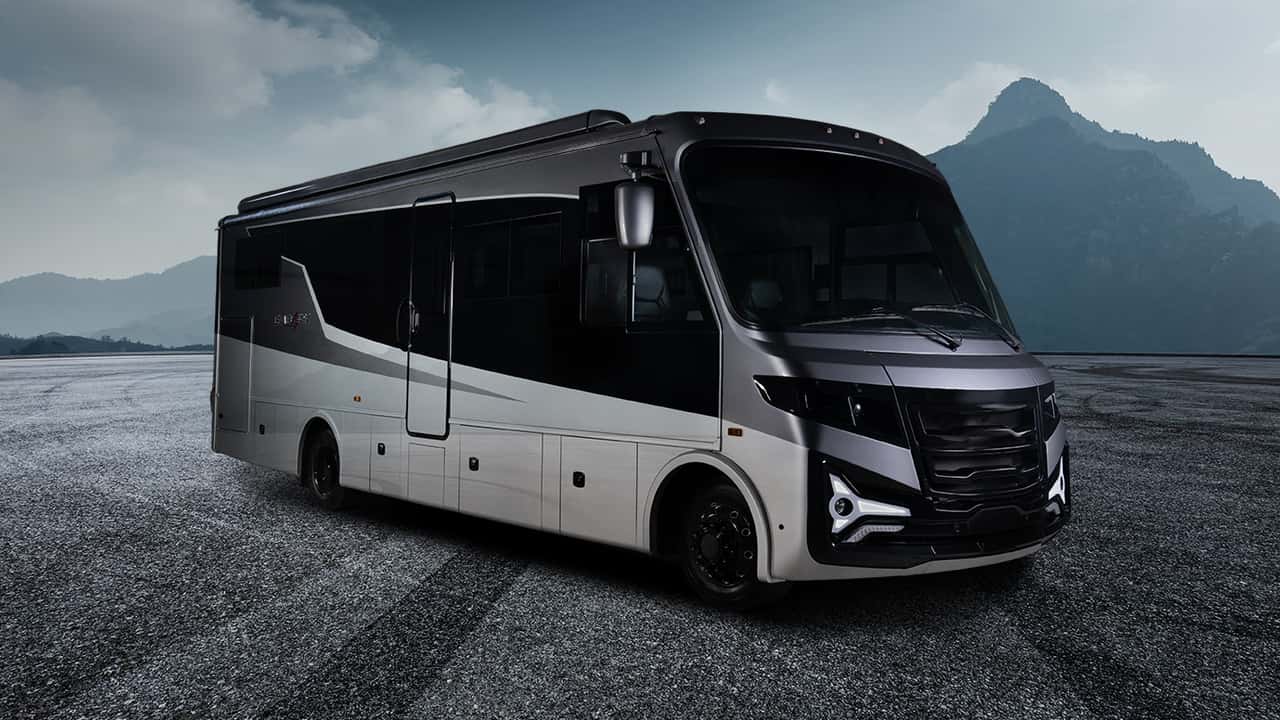
Photo by: Jayco
Brett Berk 
By: Brett Berk
Oct 25, at 9:00am ET
Add InsideEVs as a preferred source in Google
- (https://twitter.com/intent/tweet?url=https%3A%2F%2Finsideevs.com%2Ffeatures%2F813127%2Fentegra-coach-electric-rv-range-extender%2F&text=This%20%24400%2C000%20RV%20Delivers%20EV%20Camping%20Without%20The%20Range%20Anxiety%0A&via=InsideEVs)
- copy
Share
Comment
At this year’s iteration of The Quail—a flagship new exotic car show, held during Monterey Car Week—there were very few electric vehicles on offer. But on the far side of the field there was one, and it really stood out. Intended to go on sale in 2027 at a price of around $400,000, it was nearly 30 feet long, weighed 18,000 lb, and seats (well, sleeps) four people comfortably. The t-shirts on offer in the booth told the full story, cheekily. Emblazoned on their front was the company’s motto: “Quiet Luxury.”
The Entegra Coach Embark is not a giant supercar but a Class-A motorhome. Constructed by the Jayco family of recreational vehicles and built atop a commercial chassis developed by California-based startup Harbinger, it is powered by a 140-kilowatt-hour battery mated to a 440-horsepower electric motor. This is good for around 110 miles on a charge. But in order to relieve any anxiety surrounding this rather limited range, it also features a puny 1.6-liter four-cylinder engine which acts as a generator, pumping electrons into the pack. Though the combustion motor doesn’t drive the wheels directly, its presence allows the big RV to travel nearly 450 miles on a full battery and a full tank of gas.
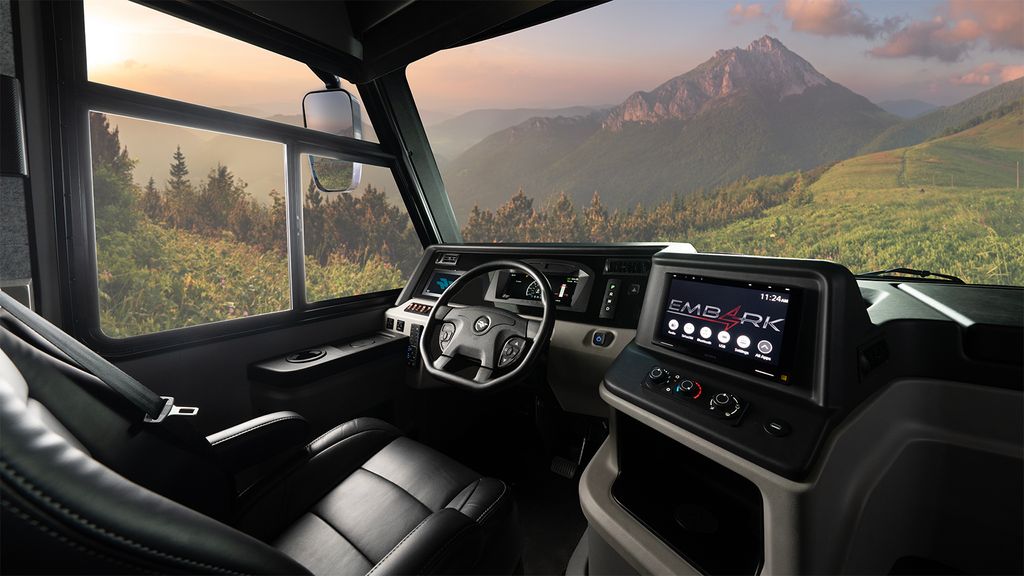
The interior of the 2026 Entegra Coach Embark, an electric RV with a gas range extender.
Photo by: Jayco
According to Harbinger co-founder John Harris, this makes it the first extended range electric recreational vehicle, or ERERV. “It’s a brand new category,” Harris says.
This drivetrain layout is well-suited to the needs of its intended audience. “If you think about a typical RV use case, you’re driving kind of a long ways, and then very little distance at all for days, but while you’re there, you’re running air conditioners and TVs and kitchen appliances and all this stuff,” says Harris.
A traditional RV, built on a typical heavy-duty truck chassis, would use a large 7-plus-liter engine to move its mass from place to place, and another engine, in the form of an auxiliary generator, to power a large onboard battery to run its accessories when parked. Of course, it would also have a battery to start the engine and power the vehicle electronics. And then ports, plugs, and inverters in case you wanted to plug into a power source offered at a camp site. The Embark simplifies these layered-up and inefficient systems, Harris says.
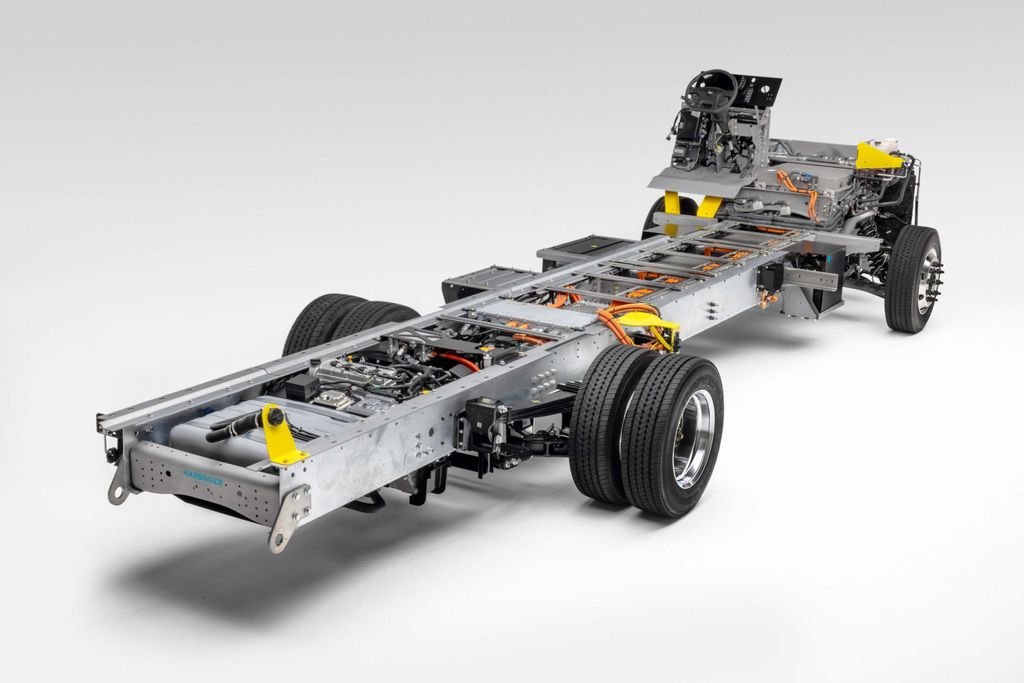
EV startup Harbinger builds the Thor Hybrid Chassis that the Entegra Coach Embark uses.
Photo by: Harbinger Motors
“With the hybrid platform, you drive it as a hybrid, you go 400-plus miles, you get there, and the 140-kWh battery that runs the vehicle is now your house battery. You can run your RV for a week or more. You don’t have another generator. So if you want to charge your battery back up when you’re in the campground, you flip the engine on, and run it in Camp Mode,” he says. You can also recharge it by plugging it into a campground’s electrical hookup. And no need to question whether or how your onboard power is being created, or if it’s direct or inverted, a common RVer issue when shifting between plugging into “shore” power provided by a campsite and using your generator. With the Embark, you park, push a button, a blue light comes on, and you’re ready to go.
The benefits are myriad. The tiny engine means that the coach achieves far superior fuel economy than one powered by a typical hulking V8—Harris had just taken it on a cross-country trip and averaged 16 mpg, about 2-3 times that of an average RV. Tailpipe emissions are reduced significantly as well. Because it sports regenerative brakes, it can recoup any electric energy it expends going up into the mountains on the way back down.
All of this allows users to camp at more remote locations, regardless of what power structure or plug-ins are or are not on offer. “We can go farther out in the back country, or at a farm harvest host. And we don’t have to run the generator all night, which is quieter and makes us a better neighbor,” says Mitch Johnson, head of the electric division at Jayco. “You could realistically camp for multiple weeks without a hookup, without having to move. So, true boondocking. Go deeper, stay longer.”
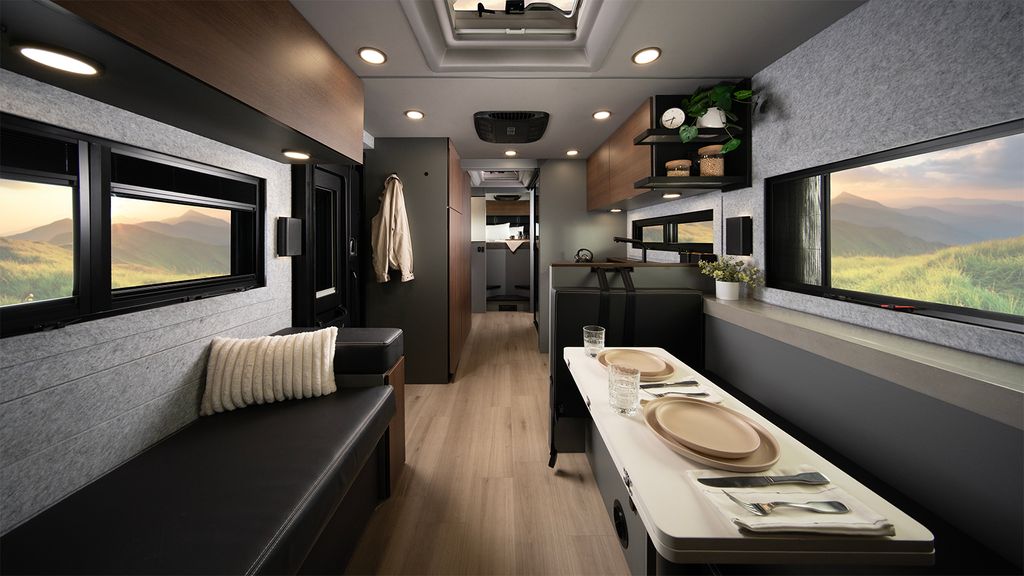
The living space in the Entegra Coach Embark EREV RV.
Photo by: Jayco
The drawbacks are seemingly minimal. Entegra is concerned with nailing the customer experience, making sure the user interface on the dash works and that the customer knows what’s going on with the chassis at any given time. Much of this planned engagement is oriented around alleviating range anxiety. “That is very real. Anybody who’s driven an EV experiences that, especially at first. And now we’re potentially bringing that into the camping experience, where people are far from civilization,” he says. “So we need to make sure that the customer has all the information they need to make good decisions while they’re camping.”
The Embark is also a bit smaller, footprint wise, than other Class A RVs, lacking “slides,” the sections that power-slide out from the sides of other large motor coaches to expand their living area. “That’s intentional,” says Johnson, who says this is to reduce weight and increase range, as well as offer improved durability, weather sealing, and thermal comfort. But, he adds, “our interior amenities are very high-end, so it’s akin to what you would see in the nicest RVs out there, in everything from the materials to the electronics onboard.” A tour of the prototype proved this to be true. It felt more like an AirBnB than the typical RV’s Hampton Inn aesthetic.

Stay informed with our newsletter every weekday
back
Subscribe For more info, read our Privacy Policy & Terms of Use.
Jayco first showed the vehicle in January 2025, and, according to Johnson, “market response has been great.” But because it’s such a new entry into the category, the company wanted to be very intentional with the rollout, and not rush into production. “We really wanted to focus on making sure it’s something that will be a better driving experience, and a better camping experience, for the customer,” Johnson says. This meant additional testing and validation, especially around the user experience.
In order to get real-world feedback, Jayco loans its prototype to its development team and other internals, who have taken it on dozens of camping trips. It has also given a pair of the vehicles to an RV rental partner, THL, in Los Angeles, where it can be leased short-term by regular consumers. This yields useful data. “We’re able to collect customer feedback, and to track usage, so we can see how much people are charging when they charge, how low they let the battery deplete, how long it takes to charge, and things like that, through telematics,” Johnson says. Jayco is currently fine-tuning vehicle design and the user interface based on this feedback.
You Might Enjoy...
 I Tried The Future Of EV Camping In The Pebble Flow
A New Kind Of Hybrid Is Coming. See The 10 Extended-Range EVs Hitting America Soon
What do you think?
View
Comments
The $400,000 price tag may be a sticking point for some potential buyers, given that the vehicle is not quite as big as the petroleum-powered vehicles in the category, and that many RV buyers are accustomed to paying for their motorhomes by the foot or square foot. But Harris counters, noting that the Embark brings huge long-term operational savings in terms of far lower per-mile and maintenance costs. “It’s basically what you would spend for a nice RV,” he says. “But you’re getting so much more flexible capability.”
The relative silence in the cabin, and in the woods, is also a tangible benefit. “We were driving through Utah, and we saw some absolutely beautiful scenery,” says Johnson. “And instead of having the background being a loud engine, the background was just the guys I was with saying, ‘Oh my gosh. This is so beautiful.’”
We want your opinion!
What would you like to see on Insideevs.com?
Take our 3 minute survey.
- The InsideEVs team
Share this Story
- (https://twitter.com/intent/tweet?url=https%3A%2F%2Finsideevs.com%2Ffeatures%2F813127%2Fentegra-coach-electric-rv-range-extender%2F&text=This%20%24400%2C000%20RV%20Delivers%20EV%20Camping%20Without%20The%20Range%20Anxiety%0A&via=InsideEVs)
- copy
GO TO COMMENTS
(
)
Got a tip for us? Email: tips@insideevs.com
View all comments ( )
Trending
Tesla Opens Self-Driving Cybercab Orders To 'Select Customers' At $29,990
Solid-State Cells Can Make The U.S. Competitive In Batteries Again: CEO
I Took A Rivian R2 On A Camping Trip To The Middle Of The Desert
Google’s Gemini AI Assistant Now Works On Apple CarPlay
Latest Stories
- Tesla Opens Self-Driving Cybercab Orders To 'Select Customers' At $29,990 Nov 13 - News -
- Do EVs Wear Tires Faster? Here's What The Studies Show Nov 13 - Features -
- The VW ID. Buzz Is Getting A New Job As A Robotaxi Nov 13 - News -
- Audi A4 EV Delayed Amid VW Group Financial Troubles: Report Nov 13 - News -
- Tesla Just Killed Its Cheapest All-Wheel-Drive Model Y Nov 13 - News -
- A Record Number Of Uber Miles Are Happening In EVs Nov 13 - News -
- Slate Is Selling A $30 'Screenless GPS' For Its Low-Tech Truck Nov 12 - News -
RECOMMENDED FOR YOU
Do EVs Wear Tires Faster? Here's What The Studies Show
Tesla Opens Self-Driving Cybercab Orders To 'Select Customers' At $29,990
Mercedes' Answer To Tesla FSD Requires Hands On The Wheel. Does That Make It Better Or Worse?
The VW ID. Buzz Is Getting A New Job As A Robotaxi
I Like Electric Sedans. But Riding In The Back Of One Sucks
Audi A4 EV Delayed Amid VW Group Financial Troubles: Report
Rivian’s ‘Boring’ Commercial Van Is Turning Into A Secret Weapon