Home
Tesla
Features
Why Used Tesla Prices Are Tanking
And why used electric cars could get a lot cheaper in 2026.

Photo by: InsideEVs
Tim Levin 
By: Tim Levin
Oct 28, 2024 at 10:31am ET
Add InsideEVs as a preferred source in Google
- (https://twitter.com/intent/tweet?url=https%3A%2F%2Finsideevs.com%2Ffeatures%2F738897%2Fused-ev-tesla-prices-falling%2F&text=Why%20Used%20Tesla%20Prices%20Are%20Tanking&via=InsideEVs)
- copy
Share
Comment
You may have seen the headlines in this publication and elsewhere: Used electric-vehicle prices are tanking. Perhaps you’ve even noticed firsthand that, in stark contrast to a year or two ago, used Teslas and the like are selling for huge discounts off of their initial MSRPs.
We’re talking about 25% price drops year-over-year in some cases. And what this all means depends on one’s place in the market. Massive depreciation is a gift to an EV’s second or third owner and a migraine for its first.
Regardless, we wanted to understand the root of the issue and where prices could go from here.
The situation is far more complicated than “people just don’t want EVs,” which is the faulty premise underlying some coverage. And while depreciation is leveling off, there’s one big reason that it could get a lot worse down the line.
“We’re not setting ourselves up to counter the drop in EV used car values,” Karl Brauer, executive analyst at the car-buying website iSeeCars, told InsideEVs. “We’re setting ourselves up to exacerbate it.”
What’s Happening?
Vehicle depreciation is nothing new or unexpected. And for a while, it’s been clear that EVs hold their value worse than other cars do. But used EVs have been shedding value at an eye-popping rate recently.
In January 2023, the average 1-to-5-year-old EV was listed for roughly $48,500, a $16,000 premium over similarly aged gas vehicles, according to iSeeCars. That dynamic flipped as used EV values went into freefall throughout 2023 and 2024. Since the start of last year, used EV prices have slumped by 43%, per iSeeCars. By comparison, values for gas cars have decreased by only 4.5%. Both had been propped up by a pandemic-era supply crunch.
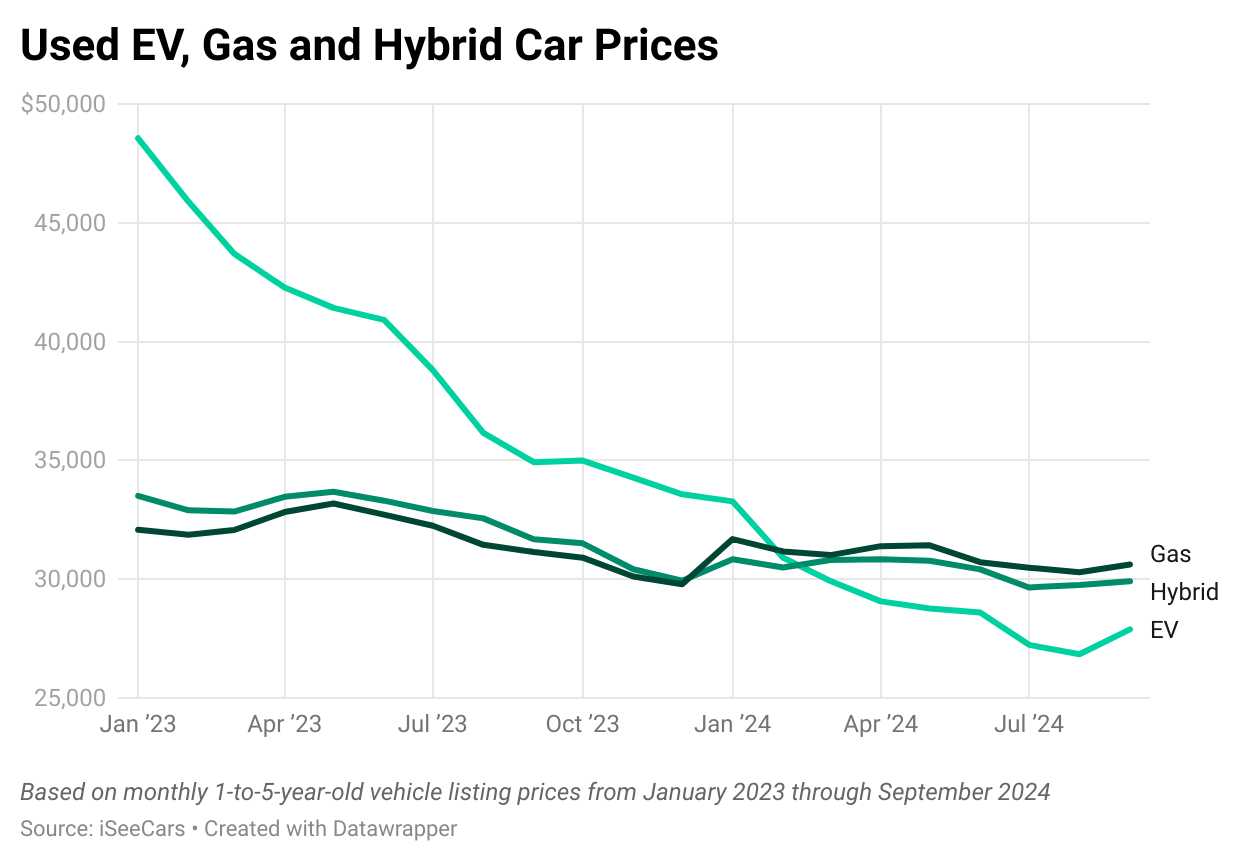
Photo by: Tim Levin/InsideEVs
In September, the average 1-to-5-year-old EV was listed for $27,886, roughly $3,000 less than a gas counterpart. Tesla's Model 3 sedan has been one of the worst performers. A September iSeeCars study found that prices had dropped by 25% year-over-year, the most of any model.
Black Book, which helps dealers value inventory, projects that three-year depreciation for new EVs will average around 60% by November. That’s significantly higher than the industry average of 42%. However, some in-demand EV models hold value better than others.
The Tesla Factor
Experts say Tesla is largely responsible for the sinking values.
“The biggest single factor can be summed up in two words, and that’s Elon Musk,” Brauer said.
After charging more and more during the high-demand pandemic years, Tesla slashed its vehicle prices throughout 2023. As the early-adopter appetite for EVs faded, competitors closed in and interest rates rose, Tesla had to act to keep inventory from piling up. And act it did. In 2023, Musk cut prices by around 25% across the board—ranging from 17% for the entry-level Model 3 to 35% for the high-performance Model X Plaid, according to Recurrent, a research firm that tracks the used EV market.

Tesla slashed prices for the Model S, Model X, Model Y and Model 3 throughout 2023.
Tesla
At its peak in 2022, Tesla’s popular Model Y cost around $67,000 for the Long Range AWD variant. Today, that exact crossover costs $48,000.
Virtually overnight, all Teslas were worth less. That not only left customers royally pissed off, but it also had profound ripple effects across the entire EV market. Since Teslas account for about half of America’s EV sales, the price cuts also depressed what dealers could charge for battery-powered Fords, Kias and Toyotas.
In part, the demand crisis was Tesla’s own fault. It failed to revamp its lineup at the same rhythm that competitors do, which forced it to stoke sales with price cuts, said John Helveston, a professor at George Washington University who studies the EV market.
“This is pretty common knowledge in automotive,” Helveston said. “You have to constantly release new models. If you don’t, your biggest competitor becomes the used version of your own car.”
It's Not Just Tesla
Tesla isn’t the only culprit. EV growth has slowed amid economic uncertainty and high borrowing rates. In other words, people are still buying them, but just not at the accelerated rates the industry once projected. Now, however, used EVs are selling faster than used gas vehicles, which suggests to Brauer that the lower prices have brought demand more in line with supply.
The $7,500 federal EV tax credit and generous manufacturer incentives also play a role, experts said. EV depreciation doesn’t look so ugly when you remember that many buyers wind up paying far below sticker price.
“The subsidy effect here is very real,” Helveston said. “There’s still a gap, but it’s not as extreme as it looks on paper.”

Get InsideEVs' must-read coverage in your inbox daily.
back
Subscribe For more info, read our Privacy Policy & Terms of Use.
Moreover, the introduction of a used EV tax credit in 2023 accelerated the drop in values toward that program's price cap of $25,000, Recurrent says.
Finally, used EVs straddle two vastly different car-buying groups, Brauer said. Wealthier EV enthusiasts would rather buy new or lease to access the latest technology in a fast-moving market. Used car buyers, meanwhile, focus on price and practicality. They’re less likely to have home charging or the same eagerness to take a chance on a new technology. “Philosophically, they’re more no-B.S.,” Brauer said.
Where’s The Bottom?
It’s the best time ever to snag a deal on a lightly used, long-range EV. For anybody who’s been banished to the sidelines of the EV transition by a lack of affordable options, that’s great news. But how low will prices go?
Liz Najman, director of market insights at Recurrent, says the pace of used-EV depreciation is beginning to slow. That tracks with iSeeCars’ observations too. Black Book projects that new EV depreciation will trend toward the industry average.
The Chevy Bolt EV.
“If you've been holding off on buying an EV because you're worried about price fluctuations, we feel like this is a great time to buy,” Najman said. She expects used EV prices to remain stable through 2026 or 2027.
The $25,000 price cap for the used-EV tax credit creates a natural floor for prices, she said. Plus, there aren’t many new electric models hitting the scene in the next few years. So the rapid pace of innovation, another contributor to bad resale value, is subsiding.
Around 2026, though, a flood of off-lease EVs will start hitting the used market. That could change everything. EVs are leased at a much higher rate than gas vehicles because any leased model qualifies for a $7,500 federal incentive, whereas only some buyers and models are eligible when a car is bought.
The deluge could depress prices further, Brauer said. But low prices may not be such a bad thing if the ultimate goal is to seed EV adoption.
What do you think?
View
Comments
“An EV is something that’s still pretty new for most Americans,” Helveston said. “If they see a used one and it’s pretty darn cheap, that might start changing some minds.”
Contact the author: tim.levin@insideevs.com
More EV Buying Advice
How Do You Find An Electric Car Charging Station?
Costco, Known For Gas Discounts, Cautiously Goes Into EV Fast Charging
Used Electric Car Buying Guide: Tips For Trouble-Free Ownership
Women Are Lagging Behind In EV Adoption: Study
This Test Proves That The Porsche Taycan Is The Best Road-Trip EV
BMW iX xDrive50 Long-Term Review: Hauling Cargo
We want your opinion!
What would you like to see on Insideevs.com?
Take our 3 minute survey.
- The InsideEVs team
Share this Story
- (https://twitter.com/intent/tweet?url=https%3A%2F%2Finsideevs.com%2Ffeatures%2F738897%2Fused-ev-tesla-prices-falling%2F&text=Why%20Used%20Tesla%20Prices%20Are%20Tanking&via=InsideEVs)
- copy
GO TO COMMENTS
(
)
Got a tip for us? Email: tips@insideevs.com
View all comments ( )
Trending
GM's Next-Generation EV Platform Has 30% Less Wiring And 20% Less Battery
Can The BMW iX3 Take Down The Tesla Model Y L And Rivian R2?
GM's OnStar AI Assistant Debuts In The Cadillac Lyriq
Electrify America’s Largest EV Charging Station Is Missing One Big Thing
latest articles
- The Ferrari Luce Officially Starts At $560,800 Oct 22 - News -
- The 2027 Ford Mustang Mach-E Has More Range As Standard Oct 22 - Official -
- BMW’s Electric M3 Had To First Win Over One Of Its Own Oct 22 - News -
- Seattle Is Installing Hundreds Of Curbside EV Chargers Oct 22 - Charging -
- Spotify’s First Native In-Car App Is Hitting Audi EVs First Oct 22 - Software -
- Tesla Says 75% Of New Car Buyers Subscribe To FSD In North America Oct 21 - News -
- 'End Of The Year': Tesla Says Cybercab Customer Deliveries Will Begin Soon Oct 21 - News -
RECOMMENDED FOR YOU
Tesla Says 75% Of New Car Buyers Subscribe To FSD In North America
The 2027 Ford Mustang Mach-E Has More Range As Standard
'End Of The Year': Tesla Says Cybercab Customer Deliveries Will Begin Soon
BMW’s Electric M3 Had To First Win Over One Of Its Own
The Best Affordable Electric Cars In 2026: Cheap, Reliable Options For Everyone
Seattle Is Installing Hundreds Of Curbside EV Chargers
The Boring Company Uses Tesla Model 3 Sleds To Shuttle Shipping Containers Through Its Tunnels