
The Gyesera Is Karma’s First New Model In A Decade. But It Doesn’t Feel New
The Gyesera Is Karma’s First New Model In A Decade. But It Doesn’t Feel New
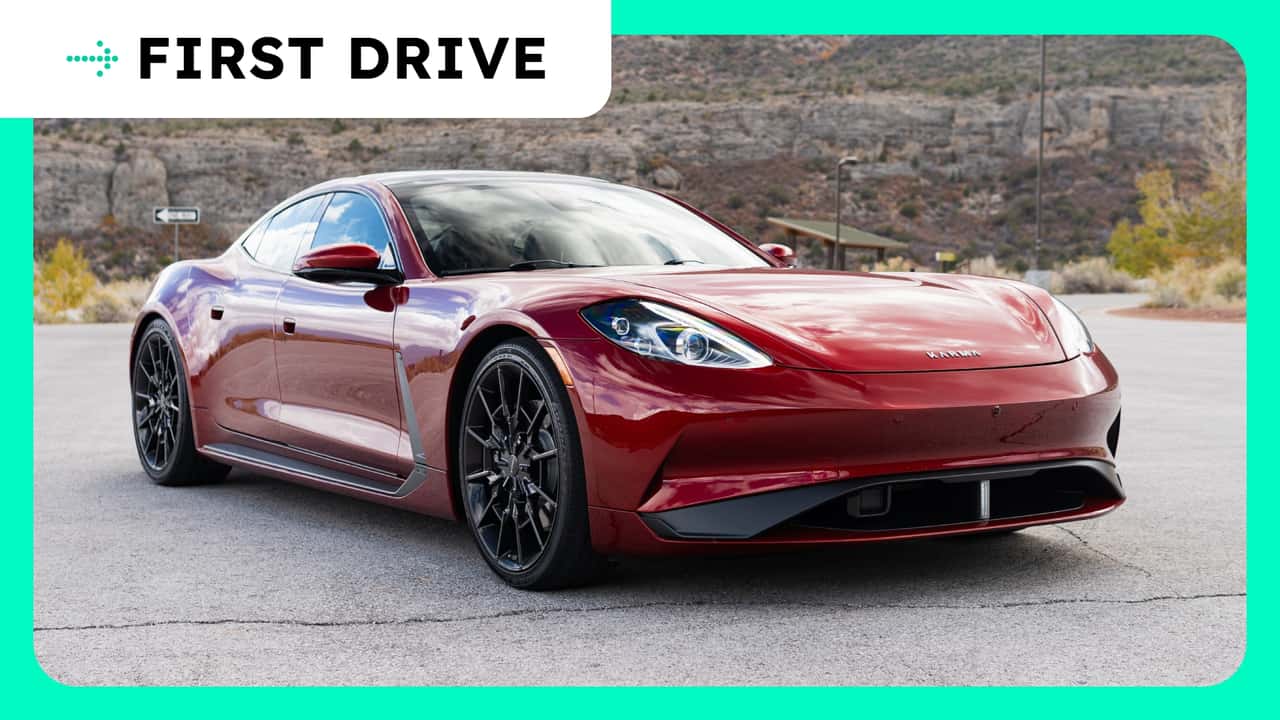

Let’s get one thing straight off the rip: This is not a Fisker.
Karma bought the assets of the original Fisker Automotive, which built the series-hybrid Fisker Karma and went bust back in 2014. The brand bears no relation to the recently deceased Fisker Inc., builders of the Ocean. Instead, it’s been carrying on the hybrid’s legacy, with an updated version of called the Karma Revero. And now, 12 years into its life, it has a new product: The Gyesera.
But “new” is perhaps an ambitious term. Mask off the front and rear fascias and the gorgeous silhouette of the original Fisker Karma shines through. Climb aboard and you notice the same terrible packaging constraints, with its tunnel-mounted battery and low roof squeezing rear passengers into awkward shapes. Take a look around the interior and you’ll see the bubbly steering wheel, which looks like something out of 2010, because it is.
(Full Disclosure: Karma flew me to Vegas and put me up in the Wynn for the first drive event. The company provided meals and test cars.)
These choices are the natural results of Karma’s position. Cash-light and still attempting to break into mainstream consciousness, the brand couldn’t afford to wholly rework the crash structure of the vehicle, or alter safety-critical parts like the airbag in the steering wheel. Given the resources available to the company, it’s made remarkable strides in making the Gysera even prettier than its predecessors, a better hybrid, and a more luxurious car.
But does that mean I’d recommend forking over $139,995 for one? No. If Karma wants to win a seat at the table, it’s going to need something new. Executives at the company seem to know this, and are quick to point to the upcoming Amaris and (long-delayed) Keveya EV as lynchpins of their new era. Twelve years into its history, though, the company is running out of time to prove it can do more than just tweak a platform developed by someone else.
Gallery: 2027 Karma Gyesera: First Drive




What Is It?
The Gyesera is the descendant of the second plug-in hybrid (PHEV) ever sold in America, or arguably the first extended-range electric vehicle (EREV) offered here, depending on how you look at it. Unlike the first PHEV, the Volt, the Fisker Karma had no ability to connect its engine to the wheels, with it functioning solely as a generator.
Fifteen years later, the Gyesera uses the same formula. But almost every input into that equation is different. While the Fisker used a General Motors-sourced 2.0 liter four-cylinder, the Revero and now Gyesera use a BMW-sourced 1.5-liter three-cylinder. The Fisker took over 6 seconds to hit 60 and went only 32 miles on electricity alone. The Gyesera hits 60 in 3.7 seconds and can travel 80 miles before the engine kicks on.
That’s thanks to a 28 kWh nickel-manganese-cobalt (NMC) battery pack squeezed into that tunnel that cuts through the car. The pack now supports fast charging at 50 kW, too, so you can top it off in 30 minutes.
Like the original Karma, the Gyesera squeezes its battery into a tunnel that runs through the spine of the car. That makes the rear seat comfort—which already suffers from the low roof and lack of legroom—even less practical.
To manage the car’s powertrain, drivers can toggle between three modes using the paddles behind the wheel. In Stealth mode, it’s a pure EV. In Sustain, it runs the engine to keep the battery topped off. In Sport, it uses both for a maximum attack mode, unleashing 566 hp and making quite a racket doing so.
That’s representative of Karma’s new approach, which seems to emphasize the engagement of the internal combustion engine. While the Fisker Karma arrived to a world in which electric power was the novel and exciting thing, the Gyesera is trying to make space in a high-end market that seems skeptical of pure EVs. So that three-banger dumps its exhaust right next to the driver, making it sound extra rowdy.
How Is It To Drive?
To test out the Gyesera, Karma led us on a 200-mile tour of the areas outside of Las Vegas. We stormed through Red Rock Canyon and climbed deep into the mountains, focusing much more on high-speed gas-burning shenanigans than on silent electric motoring.
There was really nothing silent about the day. My most prominent memory is of the raspy three-cylinder singing away, always a beat or two behind what was actually happening on the road. Stomp the accelerator and the Gyesera surges forward at idle, only for the revs to quickly climb a half-second later. Let off and the engine keeps singing for another measure or two.
I’m not sure if it’s because I find three-cylinder engine-notes to be the worst of any engine configuration, or because it exits the car so close to the driver’s eardrum, but it was a deeply irritating racket by the end of the day. I’m no hater of exhaust notes, either: I love the sound of a straight-six, a V-8, or any naturally aspirated sports car. But this has a charmless sound and, because it isn’t actually operating in time with your acceleration, doesn’t really add to the engagement.
It was even irritating standing still. When I left the car running in Sport mode, it desperately tried to recoup the energy it had lost on our high-altitude climb, buzzing away. This is a purportedly electric car that idles louder than my 20-year-old V-8 Chevy Tahoe did.
I can’t say its performance won me over in the corners, either, with twitchy manners that made it hard to trust. The car was often unsettled under braking, shimmying left and right as I slowed. Get on the power and you notice the unique two-motor setup. Both motors are on the rear axle, designed to enable quicker corner exits thanks to torque-vectoring software. But in the real world it often felt as if the wheels weren’t working in perfect harmony.
So as a sports car, it’s hard to argue in the Gyesera’s favor. It’s slower than just about any gas or electric competitor, less charming than any gas or hybrid option with a proper engine that drives its wheels, and far too unrefined for any EV fan. The fact that it costs more than cars like the BMW M5, Porsche Taycan, Lucid Air, or forthcoming Jaguar Type 01 dooms the case.
If you want to drop $140,000 on an electrified sedan, there are a lot of options. The Gyesera may look great, but it doesn't really beat any of its competitors in other metrics.
But there’s another benefit to a four-door EREV: Grand touring. Here the Gyesera performs better, but not exactly well. The suspension tuning finds a good balance between athleticism and comfort, especially given that it’s a fixed spring setup with no adjustability. (Manually adjustable Öhlins dampers are available, but stiffer and not available for testing.) But an ok ride is negated by the seats, which are not nearly as supportive or nice as any competitor. My butt was sore after only an hour.
Still, at cruising speeds the Gyesera is nice enough to not be frustrating. It settles down nicely at freeway speeds, although poor sealing on the driver’s door—potentially a prototype issue, as these were pre-production cars—made it noisier than I would like.
I found the interior much less luxurious than it appears in these polished press photos.
How Is It To Live With?
The longer highway stretches gave me time to take in the trimmings and tech. Here, once again, the ancient roots shine through. Despite Karma proudly boasting of using top-dollar materials—great leather, real metal, carbon fiber, and more—they live inside a cabin that’s clearly two generations behind par. Nice leather covers uncomfortable seats. Metal accents adorn panels that look cheap and rudimentary.
And most of what you touch—the gear selector, the entire center stack, the steering wheel controls—it’s all black plastic. Dive deeper and you find that, despite Karma’s insistence that this is a software-defined vehicle, the screen isn’t very quick to respond, the software feature set is barren, and everything is too dark and monochrome to be easily digestible. Karma representatives had us all lean on CarPlay for mapping and music, which is what I imagine most owners will do.
Finally, I must note that the rear seat is more coupe than sedan. I’m only 5’ 6”, and still there wasn’t enough room behind my seating position for my 5’ 11” drive partner to feel comfortable. Headroom is also an issue. Cargo space, too, is tiny, though Karma doesn’t share an exact figure. Either way, the opening itself is tiny, and often looks open even when shut, thanks to massive panel gaps.
Conclusion
Designing a competitive car is extremely challenging and even more expensive. Armed with a limited amount of time and cash, I understand why Karma is leaning on the only platform it has.
But the result is too rough to recommend. The Gyesera looks fantastic and has plenty of EV range. In almost every other metric, subjective or objective, it’s a clear laggard in its class. The company is attempting to market it as an ultra-luxury product, yet it feels cheaper inside than a mid-spec BMW 5 Series. It is supposed be a performance car, too, but is slower, less refined to drive, and less charming than any of its conventional competitors.
Karma President Marques McCammon with the Amaris prototype. The two-door coupe is still essentially a Gyesera/Revero/Karma underneath, but it's at least a new take on it.
So why buy one? The only argument Karma executives made that really holds water is its exclusivity. It’s no accident that the first drive event was linked the Concours at Wynn Las Vegas, which was stuffed to the brim with Bugattis, Paganis, and McLaren F1s. The audience for a car like this isn’t supposed to be cross-shopping it with Porsches; they already have Porsches, and Rolls-Royces, and everything else. Why not add another to the pile?
Among that audience, a hand-built car with a great design may be enough on its own. Those people aren’t likely to read many reviews before pulling the trigger. If you’re here, you’re likely wondering if Karma is truly entering a new era, and moving beyond re-hashes of the same old tune.
It may be. Once the Amaris coupe and all-electric Kaveya launch, they could herald the dawn of something new. The Gysera, though, does not. It’s just as compromised as the original Karma of 15 years ago, now competing in a market that has moved on.
Related Stories
RECOMMENDED FOR YOU
Want The Best Range Rover? Get The Electric One: First Drive
Tesla's Kickflipping Roadster Looks Like A Great Way To Lose Your Lunch
I Drove The Electric BMW X5. It Makes The Gas Version A Tough Sell.
This Chinese EV Maker Wants To Put A Foot Bath In The Back Seat Of Your Car. Really
I Drove the $30,000 Kia EV3—And It Might Be the Best Value EV Yet
The Lincoln Aviator PHEV May Have Died In America, But It’s Coming Back In China
The 2027 Karma Gyesera Is $35,000 Cheaper Than The Revero It Replaces