
This New EV Motor Spins To 30,000 RPM. It’s Designed For Normal Cars
ZF's new drive uses half the magnet material of a comparable system, with nearly 25% less weight and bulk.
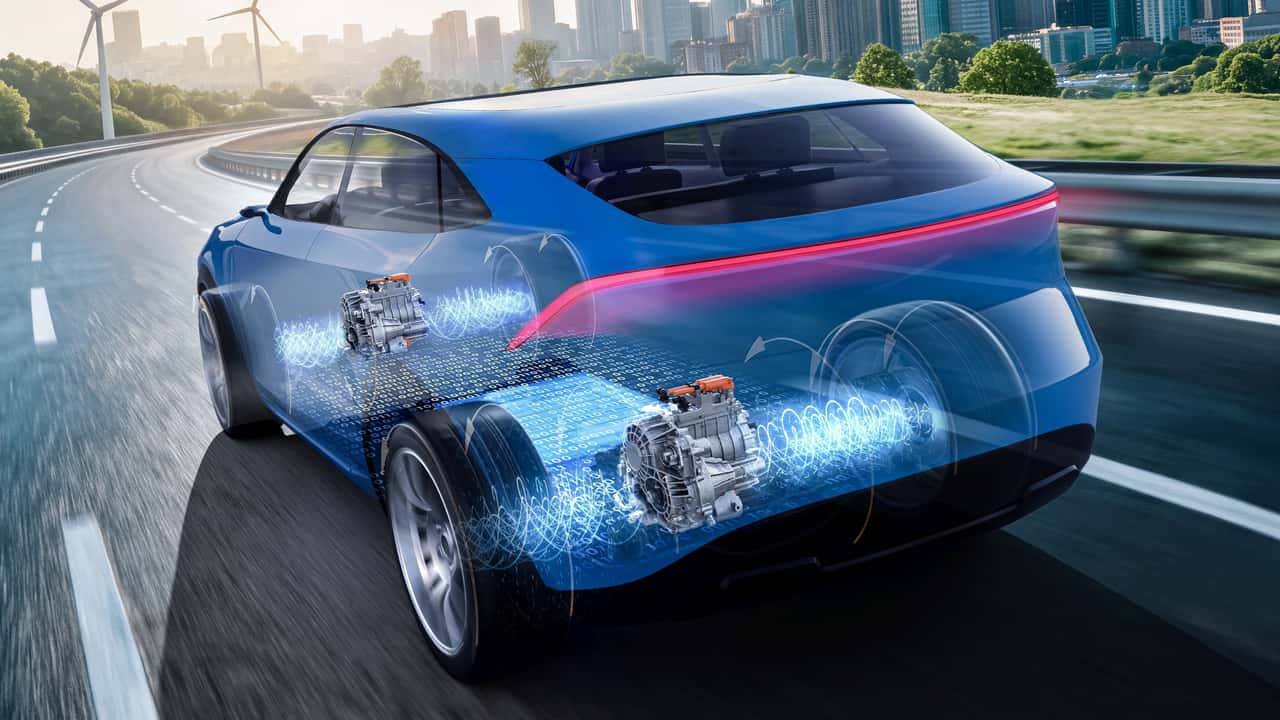

- ZF’s new motor spins at 30,000 rpm to deliver the same power in a smaller package.
- The company claims nearly 25% less drive-unit weight and bulk, with half the magnet material.
- Production is targeted for 2030, but ZF hasn’t named any cars that will use it.
An electric motor spinning at 30,000 rpm sounds like something you might find in a high-power EV supercar. ZF has something less extravagant in mind: making the hardware that powers everyday EVs smaller, lighter, and less hungry for expensive materials.
ZF’s new High Revolution Drive combines the motor, power electronics, and transmission all in the same housing. Unlike Mercedes-Benz, though, it doesn't also put the brakes inside the same housing.
Compared with one of ZF’s comparable Select drive units, which spins up to 18,000 rpm, the company claims nearly 25% less weight and volume, half the magnet mass, and a similar efficiency of almost 93%.

ZF High Revolution Drive
This helps because less mass improves EV range, and fewer magnets reduce costs and supply-chain dependence.
According to ZF, spinning the motor faster lets it deliver the same power from a smaller, lighter package. Gears then reduce that speed and increase the turning force sent to the wheels, using a reduction ratio of about 18:1. The version ZF showed produces up to 268 horsepower, with the gearing delivering peak torque of 2,581 pound-feet (3,500 Nm) to the wheels.
The torque measurement comes after the gearing has multiplied the motor’s output. The “two-stage transmission” doesn’t actually mean a two-speed gearbox. It describes successive gear reductions, not two separate driving ratios.

The company says the production High Revolution Drive should deliver 200 to 268 hp and work with both 400- and 800-volt platforms. Reusing its modular Select architecture should simplify installation, shorten development and control costs, and retain manufacturing flexibility. Talks with automakers are underway, with production targeted by 2030.
ZF isn’t alone in trying to squeeze more useful output from a smaller package. One prototype of Yasa’s ultra-compact axial-flux motor produced over 1,000 hp and weighed just 28 pounds. That’s its short-term peak figure, with continuous output estimated at 469–536 bhp.
Yasa’s figure describes only the motor, while ZF’s weight reduction refers to the whole integrated drive unit. Gearing and power electronics still need somewhere to live, and they also add weight.
ZF has also introduced repair kits intended to let workshops fix individual drive unit components, such as gearbox bearings, instead of replacing entire assemblies. That addresses a different problem from shrinking and making hardware lighter, but one buyers may care about considerably more once the warranty expires.
However, ZF hasn’t said whether these two developments are connected, or whether the kits it revealed should be taken as a repairability promise for this new drive. There’s also no mention of which production EV would get this new drive unit. We also don’t know whether those engineering gains will remain unchanged from today’s announcement to something you can actually buy.
Still, this kind of EV development deserves attention even without a four-figure horsepower claim. A family car doesn’t need to break acceleration records, but making its drive unit lighter and less expensive (and possibly easier to repair, too) is exactly what it needs. Whether any savings reach buyers is another question, but giving cars the same power with smaller and less hardware is a good place to start.
RECOMMENDED FOR YOU
BYD's Ultra-Luxury Electric Sedan Can Do Tank Turns And Go Over 600 Miles
Ford Tested 36,000 Mustang Mach-E Batteries. Here’s How They Held Up After 100,000 Miles
EV Buyers Could Foot The Bill For Saving Europe’s Carmakers
Hyundai Is Recalling Nearly 30,000 Kona EVs Because Their Airbags May Not Deploy
Toyota Quietly Gave The 2027 Toyota RAV4 PHEV A Big Upgrade
Cadillac Is Bringing GM’s Super Cruise Hands-Free Driving System To Europe
China's World-Beating Supercar Just Hit 312 MPH