Home
Ford
News
Unpacking Ford's Spat With The Trump Administration Over China
Washington wants to push back against China's car industry. But what exactly does that mean?
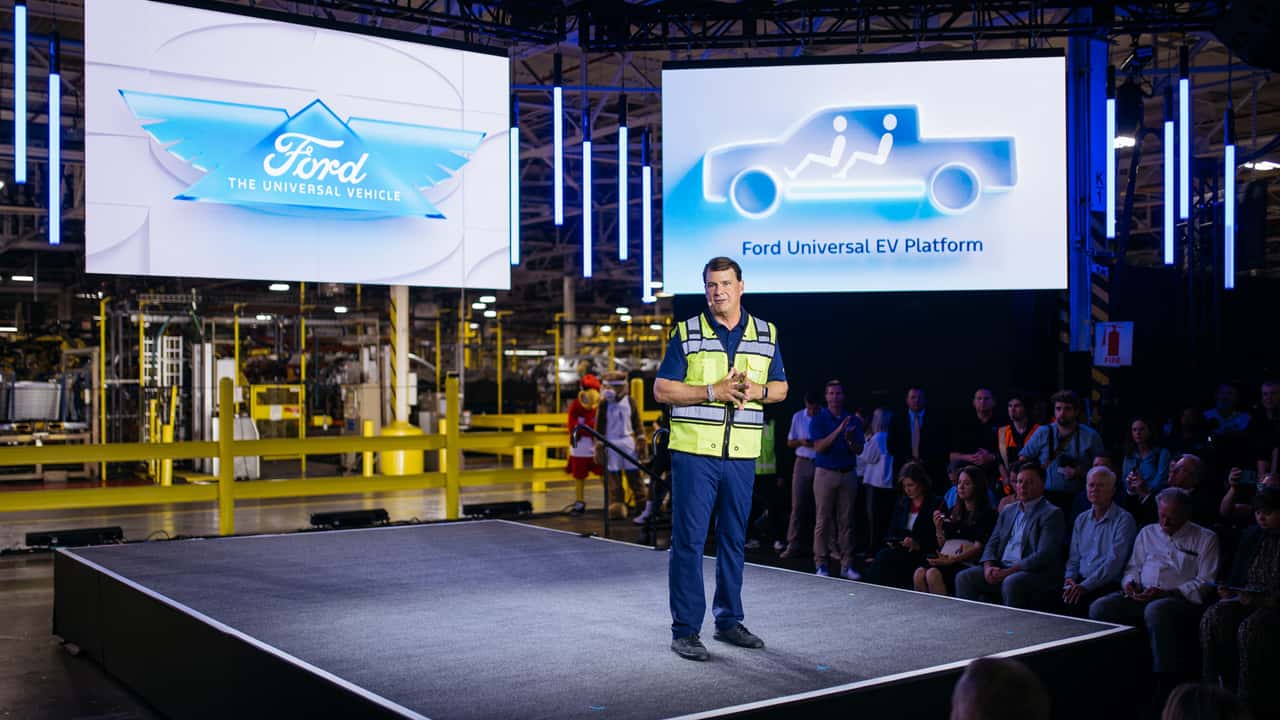
Photo by: Ford
Tim Levin 
By: Tim Levin
Sep 12, at 7:00am ET
Add InsideEVs as a preferred source in Google
- (https://twitter.com/intent/tweet?url=https%3A%2F%2Finsideevs.com%2Fnews%2F808027%2Fford-duffy-china-letter-podcast%2F&text=Unpacking%20Ford%27s%20Spat%20With%20The%20Trump%20Administration%20Over%20China&via=InsideEVs)
- copy
Share
Comment
The political battle over China’s car industry is heating up, and Ford just got caught in the crossfire.
Transportation Secretary Sean Duffy sent a scathing letter to Ford CEO Jim Farley this Tuesday, urging him to cut ties with Chinese companies. Duffy expressed “profound concern” at Ford’s strategic direction, and said he was “deeply alarmed” by the automaker’s licensing deal with CATL to make lithium iron phosphate batteries in Michigan.
“When a company intentionally chooses to deepen operational dependencies on strategic competitors, it fails to act as the reliable partner the American public and this DOT require,” the letter reads. Brutal stuff.
Clearly, even American companies aren’t safe from the growing backlash to China’s auto industry. But the Ford spat also exposes just how scattered America’s China-car policy is becoming. Washington seems certain that it wants to disentangle the U.S. auto industry from China—and less sure what that actually means.
[We discuss the Ford situation, Mack's first drive in the Jeep Recon, the Tesla Cybercab hitting streets, and more on this week's Plugged-In Podcast. Check it out!]
It’s not obvious why Ford, of all the Detroit automakers, got singled out. General Motors uses Chinese batteries in the Chevy Bolt. Stellantis (which is only part American, but still) owns part of Leapmotor and distributes that company’s cars abroad. Slate (small potatoes, to be sure) is using LFP batteries produced in the U.S. by China’s Gotion.
Notably, Duffy doesn’t accuse Ford of breaking any laws, so it’s even less clear why the administration is lashing out at it specifically.
Ford seemed completely blindsided by this, and it clapped back hard. The company slammed Duffy’s letter as a “wrongheaded attempt to capture headlines” and posted a lengthy response on its website. Farley gave an interview to The Wall Street Journal to correct the record.
On the one hand, it has seemed like “we don’t want Chinese cars” is a rallying cry both sides of the aisle can get behind—a rarity these days. The U.S. already has 100% tariffs on Chinese vehicles and a ban on certain Chinese tech. Both were established in the Biden years. A Senate committee recently advanced an even stricter bill that would bar auto companies that have more than 15% Chinese ownership from selling in America. Another proposal would keep Chinese cars from crossing the Mexican or Canadian borders into America, even if they were sold legally in those countries.
Critical Materials subscribers got this early.
Our newsletter breaks down the biggest mobility news every Friday.
Sign up today!
At the same time, the anti-China effort at the federal level comes off as increasingly unpredictable. Just days ago, the White House praised the very same battery plant in Michigan that Duffy’s letter blasted. After this controversy blew up this week, the White House’s rapid response X account posted that Ford “is a GREAT American company and has done a tremendous job on increasing investments domestically and shoring production back to the U.S.” So which is it?
Likewise, Geely-controlled Polestar was kicked out of the U.S. market this year due to its Chinese tech, while Geely-controlled Volvo managed to stick around. (The Volvo EX90 and Polestar 3 even share a platform and are built at the same facility in South Carolina.) Polestar still has no idea what happened. On top of it all, Senator Elissa Slotkin posted on X this week that she heard a rumor that President Trump plans to open the U.S. to Chinese cars within weeks.
It’s not even clear that prohibiting U.S. automakers from dealing with China is the right move. There’s a solid argument that it isn’t. After all, China’s auto companies learned from American and European ones through joint ventures, then leapfrogged the world. Now Chinese manufacturers set the bar in terms of development speed, in-vehicle technology, and battery production.
What do you think?
View
Comments
Duffy says the goal is to “out-innovate competitors.” But based on how far ahead China is right now, that may not be possible on American gumption alone.
Contact the author: Tim.Levin@InsideEVs.com
Catch Up On This Week's EV News
 This Chinese Luxury Brand Wants To Take Europe By The End Of The Year
Europe's First Truly Driverless Robotaxi Just Started Rides In Croatia
The Tesla Cybertruck Finally Gets A Feature That Was Promised Three Years Ago
This 80 MPH Chevy Bolt Range Test Shows The Value Of Not Speeding
We want your opinion!
What would you like to see on Insideevs.com?
Take our 3 minute survey.
- The InsideEVs team
Share this Story
- (https://twitter.com/intent/tweet?url=https%3A%2F%2Finsideevs.com%2Fnews%2F808027%2Fford-duffy-china-letter-podcast%2F&text=Unpacking%20Ford%27s%20Spat%20With%20The%20Trump%20Administration%20Over%20China&via=InsideEVs)
- copy
GO TO COMMENTS
(
)
Got a tip for us? Email: tips@insideevs.com
View all comments ( )
Trending
Tesla Opens Self-Driving Cybercab Orders To 'Select Customers' At $29,990
Solid-State Cells Can Make The U.S. Competitive In Batteries Again: CEO
I Took A Rivian R2 On A Camping Trip To The Middle Of The Desert
Google’s Gemini AI Assistant Now Works On Apple CarPlay
Latest Stories
- Tesla Opens Self-Driving Cybercab Orders To 'Select Customers' At $29,990 Nov 13 - News -
- Do EVs Wear Tires Faster? Here's What The Studies Show Nov 13 - Features -
- The VW ID. Buzz Is Getting A New Job As A Robotaxi Nov 13 - News -
- Audi A4 EV Delayed Amid VW Group Financial Troubles: Report Nov 13 - News -
- Tesla Just Killed Its Cheapest All-Wheel-Drive Model Y Nov 13 - News -
- A Record Number Of Uber Miles Are Happening In EVs Nov 13 - News -
- Slate Is Selling A $30 'Screenless GPS' For Its Low-Tech Truck Nov 12 - News -
RECOMMENDED FOR YOU
The Best EV Lease And Finance Deals In November 2026
Tesla Opens Self-Driving Cybercab Orders To 'Select Customers' At $29,990
Ford's Radical New EV Manufacturing Process Is Already Building Trucks
Do EVs Wear Tires Faster? Here's What The Studies Show
Ford Tested 36,000 Mustang Mach-E Batteries. Here’s How They Held Up After 100,000 Miles
The VW ID. Buzz Is Getting A New Job As A Robotaxi
They Wanted The Fiesta ST To Beat These EV Hot Hatches. It Came Last