
Slate's Cheap EV Pickup Is Surprisingly Easy To Make Expensive
Slate's $25,000 electric pickup is refreshingly simple, but its endless menu of accessories can quickly add up to something else.
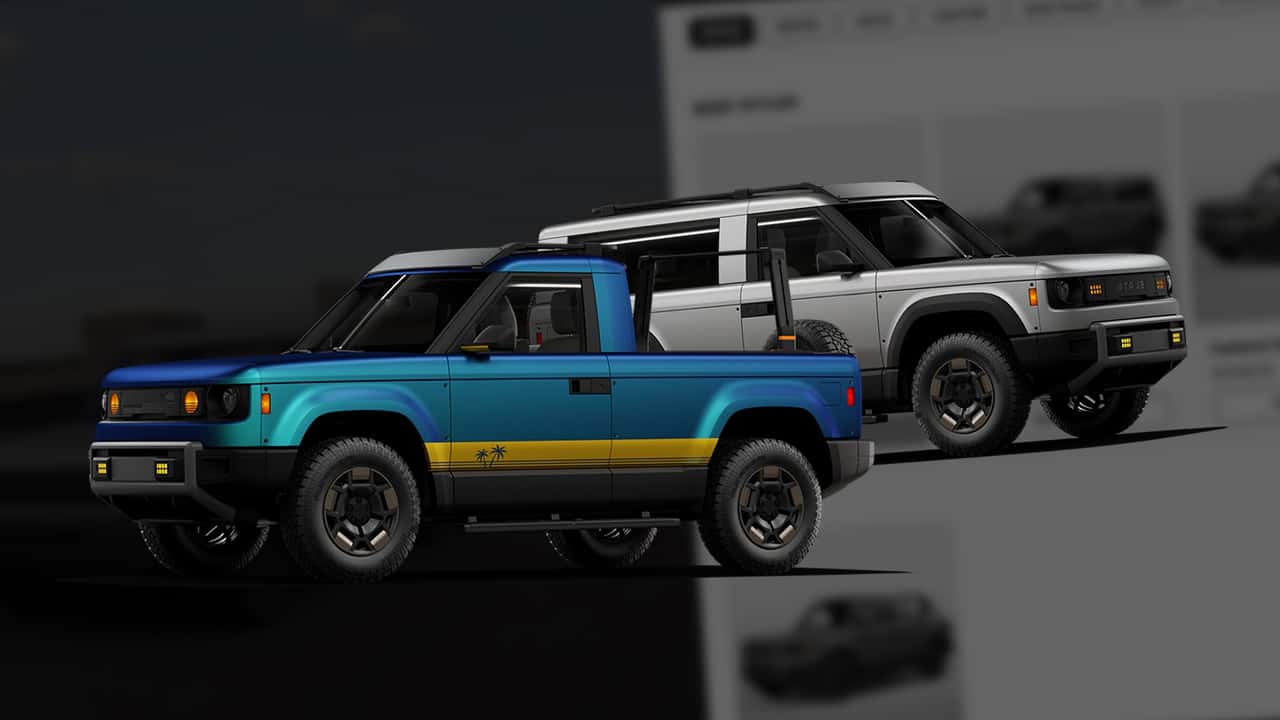

- Slate's EV is extremely customizable.
- The problem is, all of those options quickly add-up.
- Can you build the truck you actually want to buy without driving the truck out of affordable territory?
One of the biggest selling points of Slate's tiny electric pickup is that it doesn't try to be everything. It's small. It's simple. It has crank windows, steel wheels, and enough bare plastic to outshine a 1997 Nissan Hardbody.
And at around $25,000, it's probably the most refreshingly priced new car we've seen since the Ford Maverick debuted—and it has a plug. Plus, and here's the other big Slate selling point, it offers a laundry list of one-off accessories you won't find anywhere else. Just beware: That also makes it incredibly easy to spend your way out of a bargain.

Now that Slate has released its treasure trove of accessories and starter packs for its new EV (as well as their prices), we're getting a much clearer picture of how the company expects customers to buy these trucks. The base model really is cheap. But cheap like a plain hamburger where the bun, cheese, and every pickle are all optional extras.
That isn't necessarily a criticism. In fact, some might argue that it's a genius business model to let people pay for exactly what they want to add on to the base package.
See, Slate's entire philosophy is almost the polar opposite compared to every other brand that's out there today. No need to spend $70,000 on a top-tier trim just because that's the one with heated seats and a 360-degree camera. If you want to add something on, just buy it and install it. Whether that's when you buy the actual truck or later on.
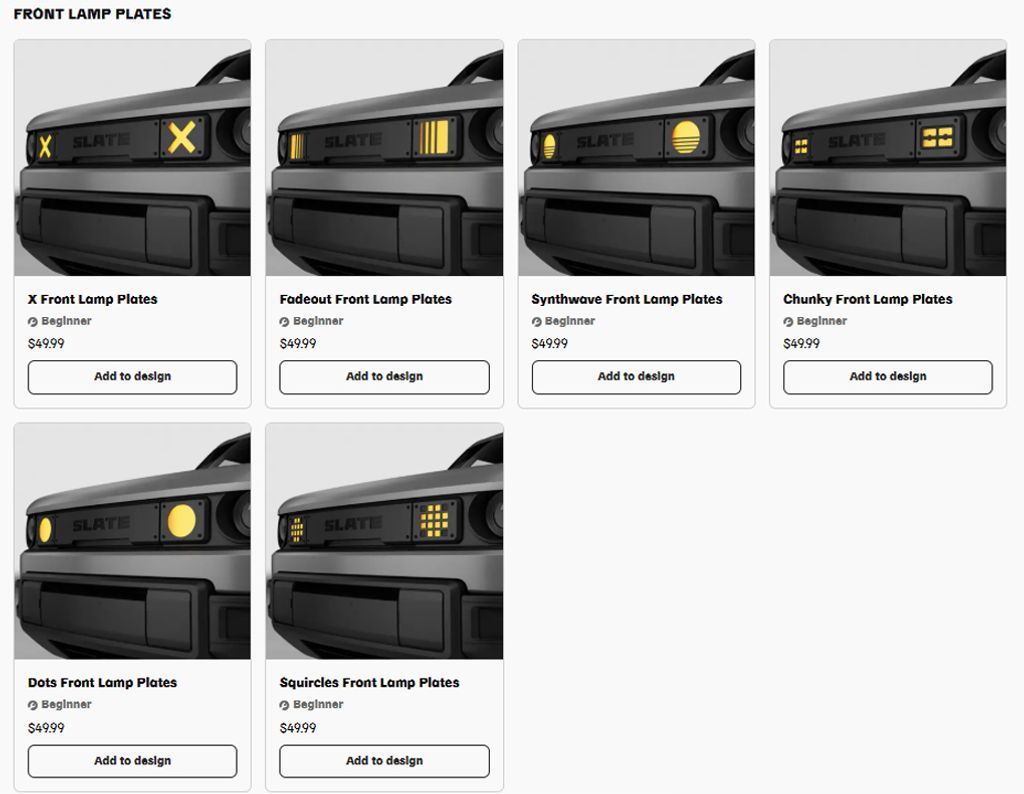
Some of the accessories feel like an absolute steal. Under $60 to personalize the look of your truck with front lamp plates, tail light plates, or a new grille? In the world of car parts, that's cheap no matter how you look at it. $150 for fender flares feels decently priced, and at a combined $1,100, chunky, upgraded front and rear bumpers also doesn't break the bank.
There are some really cool ideas, too. If you do want vehicle telematics (this is probably mostly aimed at fleets) Slate will sell you a cellular bridge for $275. Likewise, Slate offers a Bluetooth module to control your phone's audio from your steering wheel. And if you decide you want a big ol' tablet on your dash, you can install one with a factory Slate-branded mount. Animated taillights are also possible, for $500.
A ton of interior panels and surfaces are available in different colors (ranging from $50 to $105, depending on the part). The dash art—which Slate calls a "Slatelet"—isn't yet priced, but I'd be lying if I said I didn't want a pink donut starting at me while I drive.
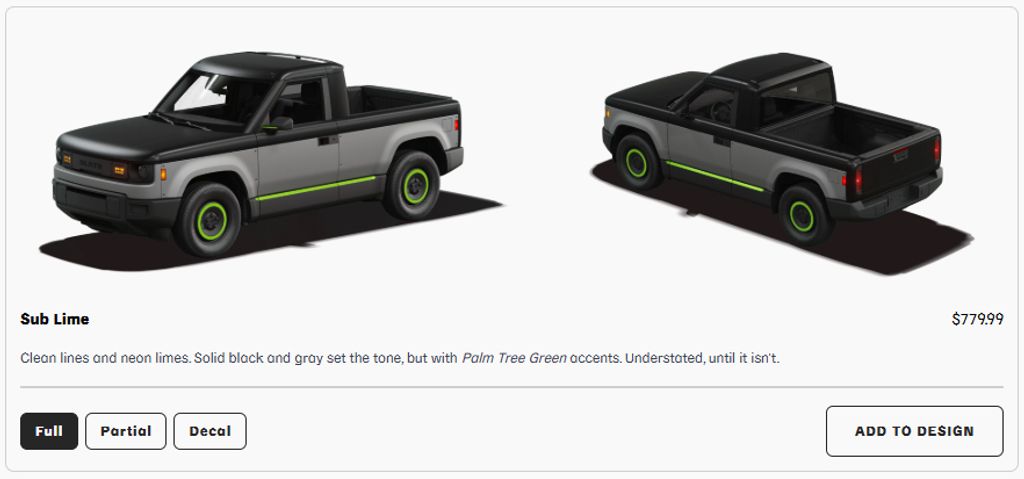
And let's not forget that you can order a ton of different wrap or decal sets. Accents for the side mirrors or rocker panels will cost you $60 and $80, respectively. A sweet throwback decal for the truck's side—à la a vintage Toyota Land Cruiser—is a little over $300. Full wraps start at $500 and are available in a huge variety of colors and finishes.
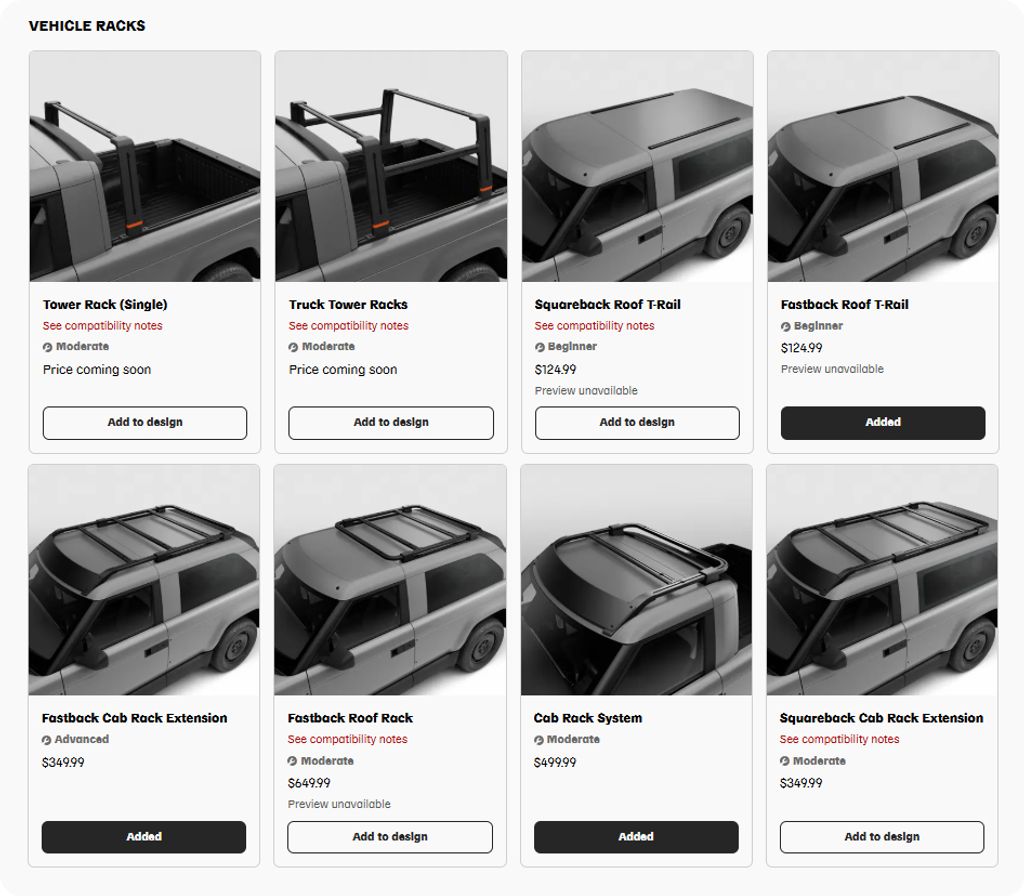
Things can also get a bit more expensive. Adding on an SUV kit—probably the Slate's standout feature—costs $5,000 for a boxy one and $7,000 for a sleeker fastback. That alone runs up the Slate's price into the $30,000s. It costs $1,200 for a roof platform, $1,400 for 17" wheels, or $2,300 for a folding solar tonneau cover. Then again, those are genuine extras you'd have to add on to any truck.
There might also be some basic creature comforts that you'd never have thought would be optional. A center console is $250. If you want a lock for your glovebox, that'll cost you too. A sound system starts at $250 for a central bluetooth unit that slots into the dash, and $150 buys you a pair of additional speakers. That's not too bad, but it's also something I'd imagine most people will want.
By the time I was done with my Fastback SUV build, I managed to hit a whopping $41,283.66. Admittedly, I did go a bit nuts with accessories. I upgraded pretty much any exterior light I could find (including animated headlights and tail lights, roof bar, fogs, and light pods), upgraded front and rear bumpers, spare tire carrier, full roof carrier, running boards, fender flare, and 17" wheels and tires. I also added on the lift kit to fit the larger tires, but Slate doesn't have a price announced on what that will cost just yet. Surely, there are far more modest builds that will make people happy.

None of this is deceptive. In fact, Slate is incredibly transparent on its pricing. It's just revealing something that other automakers either don't offer or bake into the final price. Customization costs money.
The question is whether buyers will still see value once those accessories start piling up, especially since the cheap EV landscape isn't standing still. Do you buy the delightfully weird and minimalist truck, DIY-ing it into your dream EV? Or do you buy the one that already comes that way from a more established company?
Slate deserves enormous credit for trying something genuinely different. The modular approach is clever, and the level of customization offered is something that many have wished for. But there's a fine line between paying for only what you need and everything you need costing extra. Soon we'll see where people stand.
More Slate EV News
RECOMMENDED FOR YOU
I Drove Slate’s $25,000 Electric Truck. It Could Be A Real Game-Changer
What To Know About California's $3,500 EV Rebate—And Which Teslas Qualify
Exclusive: We Finally Know The Slate Truck's Destination Fee. Here's The Final Price
BMW's Oldest Plant Has Always Made Gas Cars. Starting Next Year, It'll Only Make EVs
Clemson's Solar-Powered EV Project Looks Like A Cardboard Shoe. But It's A Lot More Clever Than It Looks
This EV Never Hit Peak Power. But It Still Beat Its Charging Claim
Toyota Will Modernize Your Aging Plug-In With Its Factory Upgrade Program