Home
News
Sales
This Is What Happened To EV Prices When The Tax Credit Went Away
Put simply: What did you expect? But there are reasons to be optimistic, too.

Photo by: Kevin Williams/InsideEVs
Patrick George 
By: Patrick George
Nov 3, 2025 at 5:53pm ET
Add InsideEVs as a preferred source in Google
- (https://twitter.com/intent/tweet?url=https%3A%2F%2Finsideevs.com%2Fnews%2F777827%2Fev-tax-credit-new-car-price-change%2F&text=This%20Is%20What%20Happened%20To%20EV%20Prices%20When%20The%20Tax%20Credit%20Went%20Away&via=InsideEVs)
- copy
Share
Comment
- Edmunds reports that EV average transaction prices shot up $5,000 in October, a month after the tax credit came to an end.
- Leasing rates slowed down as the deals cooled off—further proof that the new EV market was overly reliant on leasing.
- But there are reasons for optimism, including people's growing enthusiasm for electrification.
By most accounts, this year was a big party for any carmaker selling electric vehicles in America. But all good parties have to come to an end, and if it was a truly good party, there's also a hangover to deal with.
And yet, news coverage about the decline of new EV sales in the U.S. is often lacking in nuance. Yes, EV sales were down in October, the first month without the modern EV tax credit. Yes, they may stay down for a while. But is that the end of the EV in America? That's not even a possibility, and the latest data from Edmunds may help you understand why.
The car-buying website reports that in October, EV transaction prices went up without the tax credit, because of course they did. And EV leases, which drove the vast majority of new EV acquisitions, since leasing allowed all of them to qualify for the now-dead $7,500 credit, also decreased. (And that may also not be a bad thing.) However, Edmunds also found reasons to be optimistic, too.

Stay informed with our newsletter every weekday
back
Subscribe For more info, read our Privacy Policy & Terms of Use.
"October’s EV buyers were less deal-driven and more committed to embracing electrification," the website said in its latest report. "EV consideration on Edmunds dipped modestly in October but remains steady, showing that consumer interest in EVs hasn’t disappeared despite affordability challenges."
The average transaction prices for new EVs in the U.S. rose to $65,021, up from $60,167 in September, the website reported. The average EV's MSRP—its price without incentives and such—rose to $67,835, which is the highest it's been in a while. And leasing dropped to about 60% of all EV purchases, down from their September and January highs of 74%.
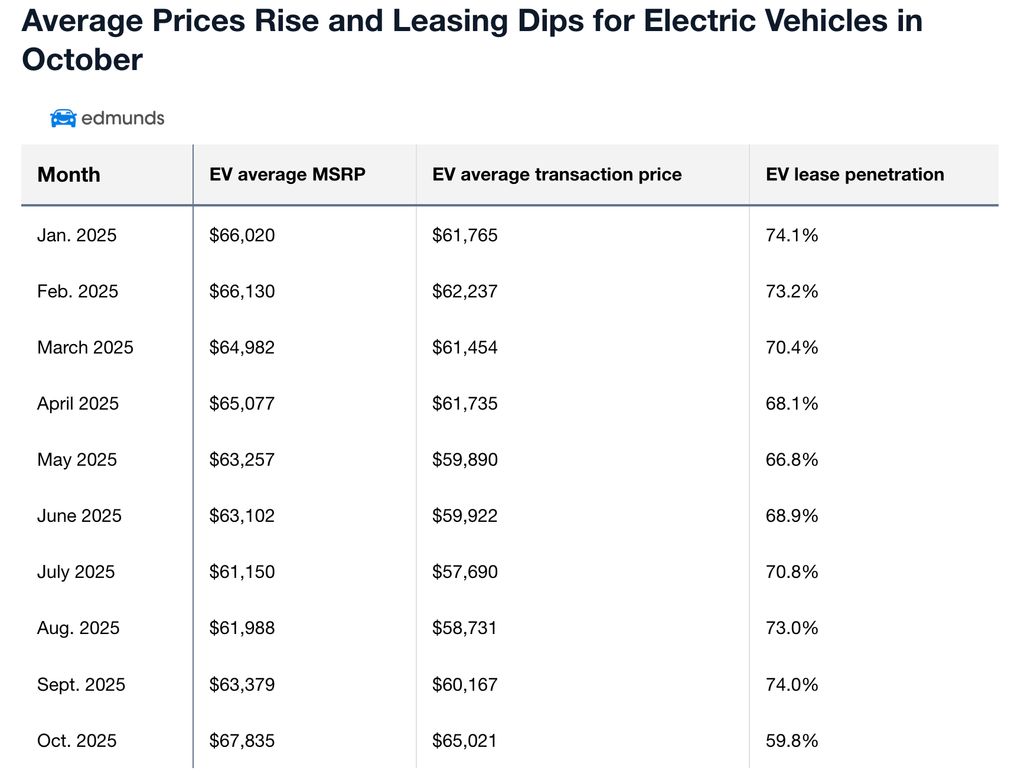
Source: Edmunds
Photo by: Edmunds
That data also excludes sales from the direct-to-consumer brands, like Tesla, Rivian and Lucid. Given the former's penchant for price cuts and new, cheaper Standard models, the actual price data may even be lower if they're accounted for.
In fact, Edmunds' numbers are higher than we've seen from other data sources. In September, J.D. Power estimated that the average transaction price for an EV dipped below that of the average combustion-powered vehicle, at $44,908. (I'd be willing to bet Tesla helped get that figure down more.) But the point is that without the tax credits, EV prices will unfortunately climb.
That's a tough proposition for consumers as well as automakers. Due to battery costs remaining high, many EVs sold in America are either not profitable or less profitable than their gas-powered counterparts—hence the lack of many truly affordable options and really only one under $30,000 at the moment. The tax credit helped to ease that burden while getting people interested in going electric, which they're likely to stay with long-term. Without the credit, and since they're all being hammered by tariffs, automakers are inclined to push consumers toward their gas- and hybrid-powered options instead, and even cancel previously announced models that may not be as viable now.
But there is hope, including the fact that over 1 million EVs were sold in the U.S. through September—a new record, and a lot of people who need charging infrastructure to grow and who likely aren't going back to gas. And Edmunds' data indicates plenty of people remain interested in electric powertrains.
Gallery: 2025 Hyundai Ioniq 5 XRT

111






Source: Patrick George
"Edmunds site data shows EV consideration dipped from 12.7% in early September to 9.0% in mid-October, a modest decline that reflects normalization more than a total collapse," the site reported. "Many buyers are likely taking a more deliberate approach—weighing ownership costs, charging availability, and model variety now that the price advantage created by leasing incentives has faded."
I'd add that the new-car market is facing an affordability crisis in general. When the average new car price is around $50,000 in America, agnostic of what powers it, a $259-per-month lease deal on a Honda Prologue is pretty enticing. We'll see how car sales in America in general look without those super-cheap deals to boost numbers, but nobody thought they'd last forever, anyway. And what's more, many automakers are responding by adjusting their prices already. Take the 2026 Hyundai Ioniq 5. It was already a top recommendation, and now it starts around $35,000.
The EV market always needed to mature and stand on its own merits, and automakers need to find ways to make them profitably or get left behind. I'd call it a growing-pains moment rather than a sales apocalypse, and Edmunds seems to agree.
"For now, this moment doesn't signal the end of EV enthusiasm—it marks the beginning of a more grounded, sustainable market that has a greater emphasis on product virtues over low monthly payments," Edmunds said.
What do you think?
View
Comments
In other words: no more participation trophies.
Contact the author: patrick.george@insideevs.com
More EV Buying Trends
Turo's Solution To Ultra-High Car Prices: Rent One For A Year
The 2026 Hyundai Ioniq 5 May Be America's Best EV Deal After A Huge Price Cut
Experts Predicted An EV Sales Collapse. It's Already Started
These Are America's 10 Best-Selling EVs Of 2025 (So Far)
We want your opinion!
What would you like to see on Insideevs.com?
Take our 3 minute survey.
- The InsideEVs team
Share this Story
- (https://twitter.com/intent/tweet?url=https%3A%2F%2Finsideevs.com%2Fnews%2F777827%2Fev-tax-credit-new-car-price-change%2F&text=This%20Is%20What%20Happened%20To%20EV%20Prices%20When%20The%20Tax%20Credit%20Went%20Away&via=InsideEVs)
- copy
GO TO COMMENTS
(
)
Got a tip for us? Email: tips@insideevs.com
View all comments ( )
Trending
Diesel Prices Are Surging. This Electric Trucking Company Is Seeing More Interest
Tesla Opens Self-Driving Cybercab Orders To 'Select Customers' At $29,990
Solid-State Cells Can Make The U.S. Competitive In Batteries Again: CEO
I Took A Rivian R2 On A Camping Trip To The Middle Of The Desert
Latest Stories
- Diesel Prices Are Surging. This Electric Trucking Company Is Seeing More Interest Nov 14 - News -
- Tesla Opens Self-Driving Cybercab Orders To 'Select Customers' At $29,990 Nov 13 - News -
- Do EVs Wear Tires Faster? Here's What The Studies Show Nov 13 - Features -
- The VW ID. Buzz Is Getting A New Job As A Robotaxi Nov 13 - News -
- Audi A4 EV Delayed Amid VW Group Financial Troubles: Report Nov 13 - News -
- Tesla Just Killed Its Cheapest All-Wheel-Drive Model Y Nov 13 - News -
- A Record Number Of Uber Miles Are Happening In EVs Nov 13 - News -
RECOMMENDED FOR YOU
Over A Quarter Of BMW, Mini, And Rolls-Royce Models Sold In Q3 Had A Plug
Diesel Prices Are Surging. This Electric Trucking Company Is Seeing More Interest
Defying Online Backlash, The Ferrari Luce EV Is Already Sold Out Through 2027
Tesla Opens Self-Driving Cybercab Orders To 'Select Customers' At $29,990
Nearly 1 In 3 Hyundais Sold In October Was A Hybrid As High Gas Prices Push Buyers To Pivot
Do EVs Wear Tires Faster? Here's What The Studies Show
Smart’s New City EV Is Already Off To A Great Start