Home
News
Industry Outlook
EVs Are Now Cheaper Than Gas Cars in America—But Not for Long
Historically expensive electric cars are now a bargain, thanks to the expiring EV tax credit and hefty manufacturer incentives.
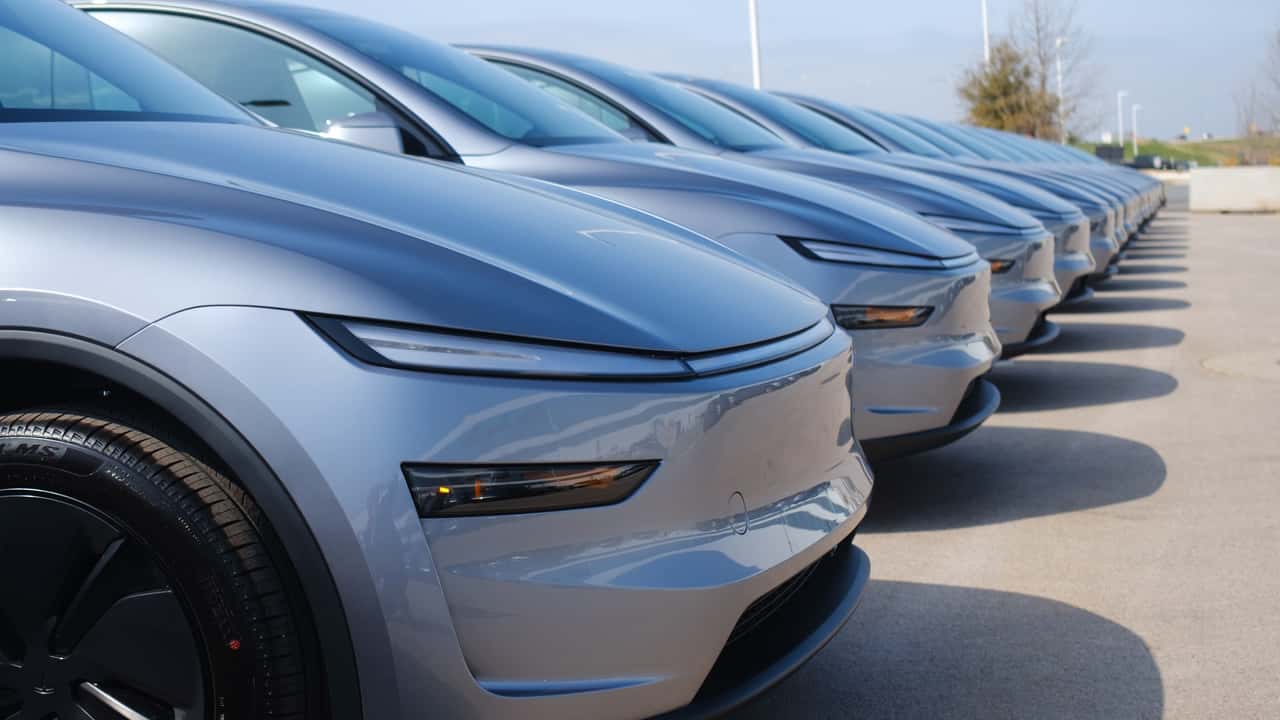
Photo by: Tesla
Tim Levin 
By: Tim Levin
Sep 23, 2025 at 5:04pm ET
Add InsideEVs as a preferred source in Google
- (https://twitter.com/intent/tweet?url=https%3A%2F%2Finsideevs.com%2Fnews%2F772938%2Fev-cheaper-than-gas-tax-credit%2F&text=EVs%20Are%20Now%20Cheaper%20Than%20Gas%20Cars%20in%20America%E2%80%94But%20Not%20for%20Long&via=InsideEVs)
- copy
Share
Comment
Price parity between electric and combustion vehicles has launched electric-vehicle sales into the stratosphere in the few markets that have reached that elusive milestone. The logic is simple: Electric cars may be cleaner, cheaper to refuel and punchier from a stop than gas vehicles, but none of that carries much weight for a buyer who can't afford one in the first place.
Show consumers that EVs cost the same or less up front, though, and mass adoption can really take off.
Oddly enough, that critical turning point happened this summer in the U.S. during a time of massive uncertainty for the country’s clean-car industry. But don’t expect the trend to last.
In both July and August, the average transaction price for an EV dipped below that of a combustion-powered vehicle, according to data from J.D. Power shared with InsideEVs.
Last month, the average new EV cost an estimated $44,908, about $600 less than the $45,521 going rate for gas vehicles. In January 2023, before Tesla went on a price-cutting spree, the average EV cost roughly $62,500, some $16,000 more than a gas vehicle, according to J.D. Power's data
Today's $600 gap may be small, but it's an enormous shift when you consider the huge premium EVs have historically demanded. High battery costs, limited economies of scale for manufacturers and a focus on luxury models have kept EV prices stubbornly high in the U.S., limiting their appeal among mainstream buyers.
“It is fairly recent and rare that we're actually seeing EV transaction prices fall below ICE,” Tyson Jominy, the firm’s senior vice president of data and analytics, told InsideEVs, using the industry lingo for vehicles with internal combustion engines.
The Clock Starts Ticking
It’s no coincidence that July and August were the two months immediately following the passage of the Republicans’ sweeping policy agenda, which started running the clock on great EV deals.
The One Big Beautiful Bill Act set a Sept. 30 expiration date for the EV tax credits that have been supporting sales of cleaner cars for years. Now, amid a mad scramble to sell down EV inventory before the rug gets yanked out, manufacturers have been lathering on incentives to help move cars off of dealer lots, Jominy said.

2025 Hyundai Ioniq 5
Photo by: Hyundai
“Once we hit October, the clock strikes midnight on Oct. 1, a lot of these EVs turn into pumpkins, and they become a lot more difficult to sell,” he said.
Combine that pile of cash on the hood with an EV tax credit worth up to $7,500 and you’re left with EVs that—for a short window, at least—are cheaper to buy than conventional cars.
“You put those two together, and the deals that can be found on EVs are pretty tremendous,” Jominy said.
In August, the average manufacturer incentive spend per EV hit nearly $7,500 (compared to around $2,500 for combustion cars), J.D. Power said. The firm put the average discount from the EV tax credit at around $5,000, a figure that has also grown lately.
Through something of a loophole, all EV leases can benefit from the entire $7,500 credit. For EVs purchased outright, however, rules surrounding assembly location, battery sourcing and personal income mean that only a fraction of models qualify. As a result, since the latest tax credit policy took effect in 2022, EV leasing has exploded, hitting 70% of EV transactions in July.
More EV Market Analysis
Closing This Tax Credit 'Loophole' Could Break The EV Market
The EV Winners And Losers In 2025's Rollercoaster First Half
Federally funded discounts have risen in parallel. J.D. Power estimates that consumers buying or leasing a new EV saved $5,124 thanks to the federal tax credit in 2024, up from $4,302 in 2023 and $1,629 in 2022.
'Back To Gas'? Not So Fast
Why not just cut EV production and supply, rather than flooding the market with cars and dumping on incentives? That will happen down the line—we’ve already seen numerous companies cut back production plans or new models due to slowing demand growth—but it’s not that simple. Automakers have long-term commitments with suppliers, and they can’t just change production on a dime, Jominy explained.
“It's more like trying to pull a U-turn in an aircraft carrier,” he said. “A lot of these EV plans were set in stone before the legislation changed.”
The hefty discounts—plus a tax credit-fueled buying frenzy—have created a booming EV market. In August, the electric share of U.S. vehicle sales hit a record high of 9.9%, according to Cox Automotive.
This mirrors what’s happened in other markets when EVs have gotten cheaper than gas vehicles. Generous government programs in Norway made electric cars too good to resist, propelling the country’s EV sales share to nearly 90% in 2024. China, by far the global leader in both EV sales and production, is another prime example.
In 2018, just 10% of electric cars sold in the country were cheaper than their ICE equivalents, according to the International Energy Agency. By 2024, that proportion rose to two-thirds. As costs plummeted, annual EV sales in China grew eightfold during that six year period, from 800,000 units to 6.4 million.

Keep up with the fast-moving future of transportation straight from your inbox.
back
Subscribe For more info, read our Privacy Policy & Terms of Use.
Compare that to what’s happening in the U.S. In 2024, just one in five electric SUVs and pickup trucks was sold at a lower price than the average gas-powered equivalent, the IEA says. And just two electric models were priced below $30,000, compared with 50 options in the combustion segment. One culprit, according to the research firm BloombergNEF, is America's obsession with large trucks and lots of driving range. Both require big battery packs that drive up costs.
Battery-powered vehicle sales have skyrocketed over the last several years in the U.S., but the pace of growth has slowed notably. In large part, surveys show, this is because Americans simply can’t afford electric cars.
Between steadily falling battery costs and the gradual introduction of lower-cost options like the new Nissan Leaf and upcoming Slate truck, the U.S. EV market is bound to hit price parity with gas vehicles someday. But this summer’s pricing was likely more of a blip than a milestone.
With various tailpipe emissions regulations weakened or eliminated by the new Republican administration, automakers are already under far less pressure to sell cleaner cars. Soon, the EV tax credits will stop being a factor too. Over time, automakers will dial back supply, likely leading to lower incentives. Without the carrots and sticks prodding car buyers and sellers to move in a zero-emission direction, it will take longer for car companies to build the scale they need to sell electric models profitably.
J.D. Power expects that EV prices will rise above ICE prices again next year, and that electric sales won’t go anywhere fast in the near term.
What do you think?
View
Comments
“In the short term, EVs will probably, at best, go sideways,” Jominy said. “But over the long term, we are still optimistic about EVs. We do not believe that this is the end.”
Contact the author: Tim.Levin@InsideEVs.com
We want your opinion!
What would you like to see on Insideevs.com?
Take our 3 minute survey.
- The InsideEVs team
Share this Story
- (https://twitter.com/intent/tweet?url=https%3A%2F%2Finsideevs.com%2Fnews%2F772938%2Fev-cheaper-than-gas-tax-credit%2F&text=EVs%20Are%20Now%20Cheaper%20Than%20Gas%20Cars%20in%20America%E2%80%94But%20Not%20for%20Long&via=InsideEVs)
- copy
GO TO COMMENTS
(
)
Got a tip for us? Email: tips@insideevs.com
View all comments ( )
Trending
Diesel Prices Are Surging. This Electric Trucking Company Is Seeing More Interest
Tesla Opens Self-Driving Cybercab Orders To 'Select Customers' At $29,990
Solid-State Cells Can Make The U.S. Competitive In Batteries Again: CEO
I Took A Rivian R2 On A Camping Trip To The Middle Of The Desert
Latest Stories
- Diesel Prices Are Surging. This Electric Trucking Company Is Seeing More Interest Nov 14 - News -
- Tesla Opens Self-Driving Cybercab Orders To 'Select Customers' At $29,990 Nov 13 - News -
- Do EVs Wear Tires Faster? Here's What The Studies Show Nov 13 - Features -
- The VW ID. Buzz Is Getting A New Job As A Robotaxi Nov 13 - News -
- Audi A4 EV Delayed Amid VW Group Financial Troubles: Report Nov 13 - News -
- Tesla Just Killed Its Cheapest All-Wheel-Drive Model Y Nov 13 - News -
- A Record Number Of Uber Miles Are Happening In EVs Nov 13 - News -
RECOMMENDED FOR YOU
China Has An Iron Grip On EV Batteries. Here's America’s Plan To Break It
Diesel Prices Are Surging. This Electric Trucking Company Is Seeing More Interest
‘We Are Long-Term Committed In Europe’: Why Tariffs Won’t Scare Zeekr Off
Tesla Opens Self-Driving Cybercab Orders To 'Select Customers' At $29,990
The EV Tax Credit Could Come Back. Here's What Stands In The Way
Do EVs Wear Tires Faster? Here's What The Studies Show
Fuel Economy Rollback Will Burn Billions More Gallons Of Gas, Trump Administration Says