Home
Zeekr
News
Watch A Chinese EV Charge From 4% To 80% In Less Than 7 Minutes
The upgraded Zeekr 001 is capable of charging at over 1.3 MW. That’s nearly four times faster than the fastest-charging American EV.
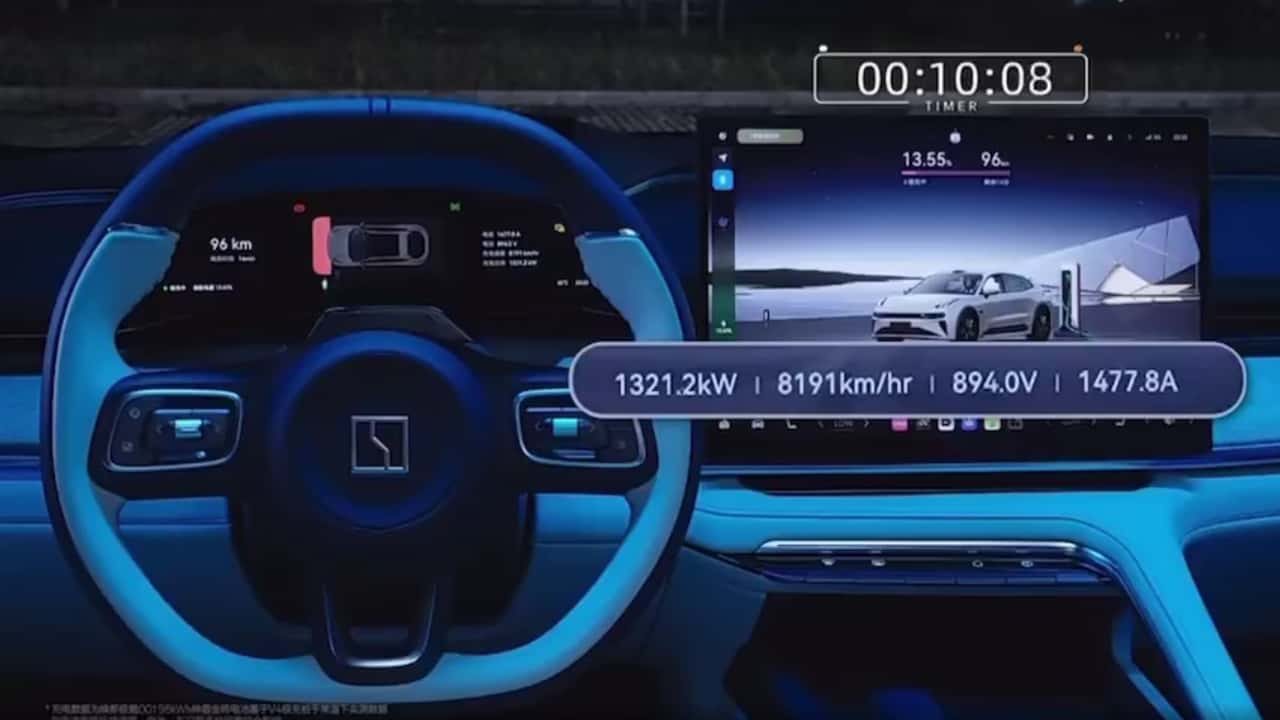
Photo by: Zeekr
Iulian Dnistran 
By: Iulian Dnistran
Oct 13, 2025 at 6:55am ET
Add InsideEVs as a preferred source in Google
- (https://twitter.com/intent/tweet?url=https%3A%2F%2Finsideevs.com%2Fnews%2F775571%2Fzeekr-001-ultra-fast-charging-7-minutes%2F&text=Watch%20A%20Chinese%20EV%20Charge%20From%204%25%20To%2080%25%20In%20Less%20Than%207%20Minutes&via=InsideEVs)
- copy
Share
Comment
- The refreshed Zeekr 001 electric car is a fast-charging monster.
- Thanks to several technical improvements, the upmarket fastback will charge faster than it takes to get a coffee.
- With a 12C charging rate that allows over 1.3 megawatts of power, the Zeekr 001 needs less than seven minutes to go from 10% to 80%.
The Zeekr 001 is a little-known electric car from China. It’s made by the Geely Group, the same company that owns Polestar, Lotus and Volvo. Despite a strong backing and decent popularity at home, it never made it to the United States, and only a handful were sold in Europe.
The 001 debuted back in 2021, and after its second technical update in 2024, its 800-volt battery could charge at over 500 kilowatts, leading to a 10-to-80% top-up in just 12 minutes. That surpasses all the EVs sold today in the United States, where the Lucid Gravity currently holds the title for the fastest-charging EV, with a maximum input of 400 kW and a 0-to-80% time of 27 minutes.

2026 Zeekr 001
Photo by: Zeekr
Now, though, Zeekr has given the 001 a third refresh in a timespan of just four years, and the sleek fastback is once again upping the ante in the charging department. We already wrote about all the improvements made to the refreshed model, but a new video surfaced on the web yesterday, emphasizing just how quickly the Chinese-made EV can get back on the road after running the battery down to just 4%.
The roughly one-minute video comes from Zeekr via Felix Hamer. It shows a new 001 fitted with a 95-kilowatt-hour lithium iron phosphate (LFP) battery hooking up to one of the automaker’s new megawatt charging stalls. The power input immediately goes over 500 kW and peaks at a whopping 1,321 kW. Going from 4% to 10% takes roughly one second.
Just ten seconds after plugging in, peak power is achieved, with a maximum voltage of 894V and a current of 1,488A. After that, it’s smooth sailing–it takes roughly three minutes to hit 50% state of charge, and just six and a half minutes to get to 80%. With a nearly full battery, the car reported an estimated range of 353 miles (568 kilometers) on the rather lenient CLTC testing procedure. On the EPA test, it would likely be around 250 miles, but that’s still mighty impressive for less than seven minutes of charging.
But the charging session doesn’t end there–it keeps going until the battery is fully charged. A full charge, starting from 4%, took 13 minutes and 23 seconds, enabling the car to drive an advertised 441 miles (710 km) on the CLTC cycle. It goes without saying that this thing is blisteringly fast, but it also goes to show that it just doesn’t make much sense to fully charge an EV when you’re on a long road trip.
The refreshed Zeekr 001 needed less than seven minutes to reach 80%, but that time nearly doubled to get to 100%.

Stay informed with our newsletter every weekday
back
Subscribe For more info, read our Privacy Policy & Terms of Use.
What do you think?
View
Comments
Having such a fast-charging EV puts an end to the gas station fill-up comparison, but it’s also worth mentioning that you have to have a powerful enough DC fast charger to enjoy the benefits of seven-minute charging stops.
While the United States and Europe have a steady supply of 350 kW stalls, China has charged ahead with megawatt-capable stations that can get you back on the road in no time, as we learned during our time there. The U.S. and Europe are behind, but they’re trying to catch up, with several operators testing ultra-fast chargers.
More Stuff Like This
'This Is Game-Changing': BYD Brings EV Production, Megawatt Charging To Europe
Mercedes Aims At BYD With Megawatt-Capable Ultra-Fast EV Chargers
Eight-Minute EV Fast-Charging Comes To Europe This Year
BYD's 5-Minute EV Fast Charging: We Tried It. It's A Game-Changer
We want your opinion!
What would you like to see on Insideevs.com?
Take our 3 minute survey.
- The InsideEVs team
Share this Story
- (https://twitter.com/intent/tweet?url=https%3A%2F%2Finsideevs.com%2Fnews%2F775571%2Fzeekr-001-ultra-fast-charging-7-minutes%2F&text=Watch%20A%20Chinese%20EV%20Charge%20From%204%25%20To%2080%25%20In%20Less%20Than%207%20Minutes&via=InsideEVs)
- copy
GO TO COMMENTS
(
)
Got a tip for us? Email: tips@insideevs.com
View all comments ( )
Trending
I Drove The Electric And Gas-Powered BMW X5. I Know Which One I'd Pick.
The 2027 Ford Mustang Mach-E Has More Range As Standard
GM's Next-Generation EV Platform Has 30% Less Wiring And 20% Less Battery
Can The BMW iX3 Take Down The Tesla Model Y L And Rivian R2?
latest articles
- Want The Best Range Rover? Get The Electric One: First Drive Oct 22 - First Drives -
- I Drove The Electric And Gas-Powered BMW X5. I Know Which One I'd Pick. Oct 22 - First Drives -
- The Ferrari Luce Officially Starts At $560,800 Oct 22 - News -
- The 2027 Ford Mustang Mach-E Has More Range As Standard Oct 22 - Official -
- BMW’s Electric M3 Had To First Win Over One Of Its Own Oct 22 - News -
- Seattle Is Installing Hundreds Of Curbside EV Chargers Oct 22 - Charging -
- Spotify’s First Native In-Car App Is Hitting Audi EVs First Oct 22 - Software -
RECOMMENDED FOR YOU
Waymo Plans To Have 20,000 Cars By The End Of 2027
The 2027 Ford Mustang Mach-E Has More Range As Standard
Seattle Is Installing Hundreds Of Curbside EV Chargers
BMW’s Electric M3 Had To First Win Over One Of Its Own
Electrify America’s Largest EV Charging Station Is Missing One Big Thing
Spotify’s First Native In-Car App Is Hitting Audi EVs First
I Let Android Auto Plan My EV Roadtrip. Here’s How It Worked