Home
Rivian
News
Rivian Says Not To Rule Out Lidar In Future Models
With lidar costs falling and camera sensors hitting their limits, Rivian isn't ruling out the technology just yet.
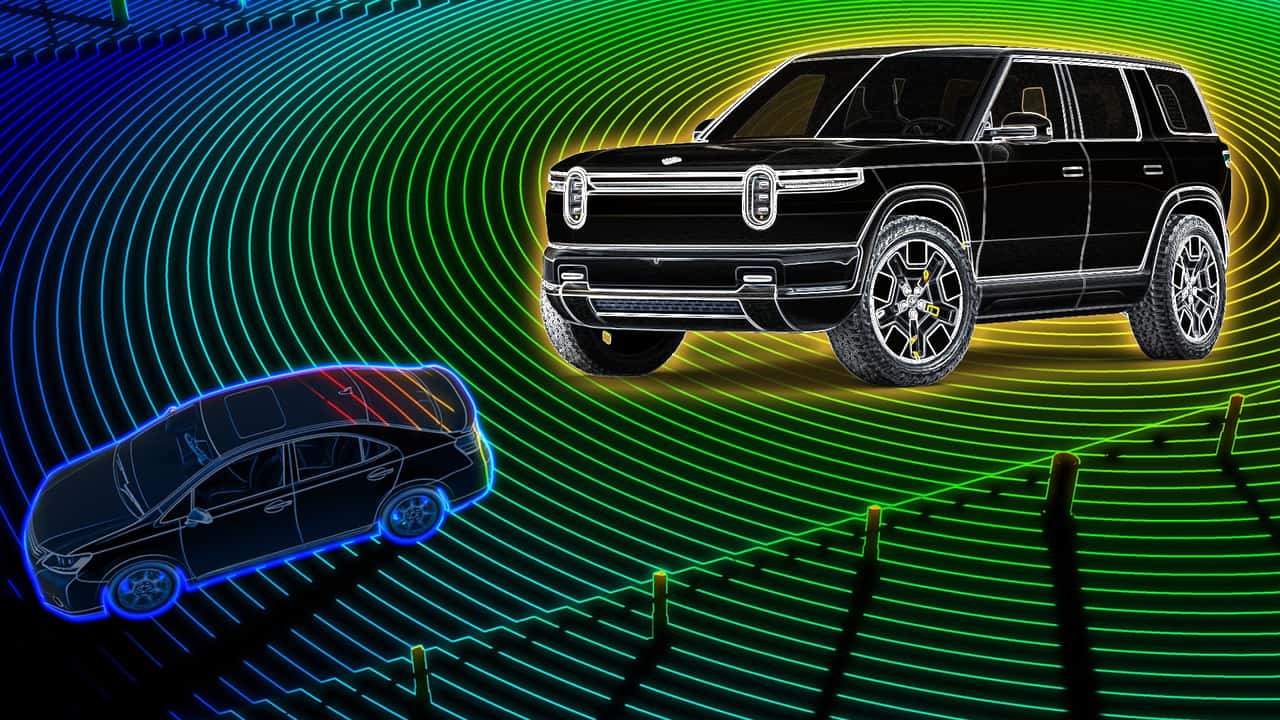
Photo by: InsideEVs
Rob Stumpf 
By: Rob Stumpf
Oct 8, 2025 at 4:03pm ET
Add InsideEVs as a preferred source in Google
- (https://twitter.com/intent/tweet?url=https%3A%2F%2Finsideevs.com%2Fnews%2F774968%2Frivian-lidar-future-models-possible%2F&text=Rivian%20Says%20Not%20To%20Rule%20Out%20Lidar%20In%20Future%20Models&via=InsideEVs)
- copy
Share
Comment
- Rivian says that it's not ruling out lidar in future models.
- CEO RJ Scaringe recently explained how multiple sensors is a beneficial way to approaching autonomy.
- He also noted how the old guard's argument against lidar is no longer an excuse.
Rivian made a name for itself by building electric trucks for folks who wanted capability without compromise. It quickly became the Patagonia of the EV world, pumping out adventure-focused trucks while moonlighting as the company that makes all of those happy-looking Amazon delivery vans.
Somewhere between the introduction of the R1 and the start of 2025's Great EV Market Correction, Rivian started to evolve. And as the company grew, so did its ambitions. Now Rivian is preparing to dip its toes further into the river of autonomy—and it's game plan could include using lidar to get there.

Photo by: Marques Brownlee/YouTube
Self-driving technology is a hot topic right now. Automakers across the globe are figuring out ways to bring it to consumers especially as hands-free driving becomes the most in-demand feature of new car buyers.
In an interview on The Verge's "Decoder" podcast, Rivian CEO RJ Scaringe took a few minutes to address what the automaker's future autonomy hardware stack could look like. Host Joanna Stern asked Scaringe what he thinks of lidar—a laser-based system that creates a 3D impression of the surrounding world—and whether Rivian is considering adding it to its vehicles.
"Our view is that there is a real benefit [to lidar]," Scaringe said, also noting that he "wouldn't rule out lidar." The implication is that Rivian could include lidar sensors in its future cars.
Scaringe's view of lidar varies vastly from other automakers that are taking a vision-first approach to autonomy like Tesla. CEO Elon Musk once called the tech a "crutch" and doubled-down by removing radar and ultrasonic sensors from the car. Then Xpeng followed, claiming that lidar sensor data "can't contribute to the AI system" used to train its self-driving model.
Meanwhile, Rivian says that multiple sensor modalities is the natural way to build a better automated driving system. Other companies, like autonomous-car leader Waymo, agree. Those spinning gizmos you see all over Waymo's cars? Those are lidars.
Here's a snippet from Scaringe on "Decoder" explaining why sensors apart from cameras are important.
The view of the entirety of the science community is that having multiple sensors is helpful because you build a more accurate view of the world. The way that we build these neural nets is that you want a broad understanding of the world, and you want the highest accuracy.
And if you have more than one camera, you’re going to have multiple cameras that have different signals, which have different signal-to-noise ratios that need to be managed. But ultimately, the way that that information is fused very early, if you have multiple cameras coupled with radar, coupled with potentially lidar, as you said, it gives you a more fulsome and accurate picture. It also allows you to train your model better.
Scaringe also mentioned that be believes a lot of companies are stuck in the early days of lidar when sensors cost tens of thousands of dollars instead of hundreds.
It used to be common-place to build a "rules-based environment," which is a fancy way of saying that the car responded directly to the environment based on a set of predefined "if this happens, do that" statements with strict guardrails in place. Today, the landscape has shifted to using a neural net to train models, and a fusion of sensors to build a more complete picture of the world around the car to better utilize in-car inference of that model.
He explains further:
And there’s another thing I’d just say, which is important to note. I think a lot of the debate around lidar was born out of [autonomous vehicles] 1.0, where you actually had a rules-based environment, where this idea of an early fusion or building of a neural net that wasn’t there. In a rules-based environment, it was more complex to do some of these fusion activities because the fusion typically happened a little later.
Now, what’s happened is that we no longer run the models like that. So the models benefit from the maximum amount of information on the front of the model. The cost of lidar used to be tens of thousands of dollars. It’s now low, a couple of hundred bucks. So it’s a really great sensor that can do things that cameras can’t.
In early videos of the Rivian R2 being assembled, a lidar-shaped pocket can be seen in the roof of the vehicle. We asked Rivian about this at the time and didn't receive confirmation, however, based on Scaringe's comments and a recent job posting, Rivian may be looking to integrate lidar into its sensor stack in later models.
In August, Rivian posted a Software Engineer position for its Pose team—the group responsible for developing the complex algorithms and programming that goes into its autonomy platform. One of the listed job responsibilities is developing and writing "custom calibration algorithms for calibration of Rivian’s Autonomy sensor suite which includes cameras, IMU, lidar, and radar."

Stay informed with our newsletter every weekday
back
Subscribe For more info, read our Privacy Policy & Terms of Use.
What do you think?
View
Comments
None of this is confirmation that Rivian will definitely dabble into the business of putting lidar in its vehicles. However, with the brand shooting to include certain eyes-off autonomy features in its cars next year, lidar could make it easier (or as Scaringe hopes for, quicker) to accomplish.
Could it accomplish the same with vision? Maybe, but Rivian is aiming for both speed and safety when it comes to autonomy. Its clear that the brand's CEO is championing for lidar's usefulness, and with sensor prices hitting a fraction of what they once were a decade ago, it could be a move that pays off in the end.
More Rivian News
Rivian R2 Is Up Next As Auto Industry Rethinks Door Handles
Rivian Offers $6,500 Off Of R1T And R1S Leases As Tax Credits End
Rivian Needs The R2 Now More Than Ever
Rivian Owners Now Get More Hands-Free Driving, Cheaper Charging
We want your opinion!
What would you like to see on Insideevs.com?
Take our 3 minute survey.
- The InsideEVs team
Share this Story
- (https://twitter.com/intent/tweet?url=https%3A%2F%2Finsideevs.com%2Fnews%2F774968%2Frivian-lidar-future-models-possible%2F&text=Rivian%20Says%20Not%20To%20Rule%20Out%20Lidar%20In%20Future%20Models&via=InsideEVs)
- copy
GO TO COMMENTS
(
)
Got a tip for us? Email: tips@insideevs.com
View all comments ( )
Trending
Every Kind Of Hybrid Explained: Parallel, Series, EREV, PHEV, MHEV
DJI Made A Commuter E-Bike. I Tested It, And It's Really, Really Good
I Tried Mercedes' Answer To Tesla FSD. Here's How It Went
Tesla Model 3 Maintenance Guide: What Needs Servicing And What Doesn't
Latest Stories
- How Does The REO Runabout Stack Up Against Slate? Nov 17 - News -
- Chevy, GMC, and Cadillac EV Owners Can Now Plug And Charge At Electrify America Nov 17 - Charging -
- Every EV Motor Type Explained: They Aren't All The Same Nov 17 - EV 101 -
- DJI Made A Commuter E-Bike. I Tested It, And It's Really, Really Good Nov 17 - E-Bike Reviews -
- Every Kind Of Hybrid Explained: Parallel, Series, EREV, PHEV, MHEV Nov 17 - EV 101 -
- BYD Is Winning Over Japan With A Very Japanese Kind Of EV Nov 17 - News -
- Bentley’s First EV Is Already Sold Out, And Production Hasn’t Even Started Nov 17 - Sales -
RECOMMENDED FOR YOU
BMW’s iX5 Beat The Lucid Gravity On Highway Range. Not On Efficiency
Every Kind Of Hybrid Explained: Parallel, Series, EREV, PHEV, MHEV
I Took A Rivian R2 On A Camping Trip To The Middle Of The Desert
BYD Is Winning Over Japan With A Very Japanese Kind Of EV
The AI Boom Is Making Ordinary Car Parts Harder To Get, Rivian Says
Bentley’s First EV Is Already Sold Out, And Production Hasn’t Even Started
Rivian's New Robots Will Initially Handle 20% Of Factory Tasks. The Goal Is 80%, CEO Says